
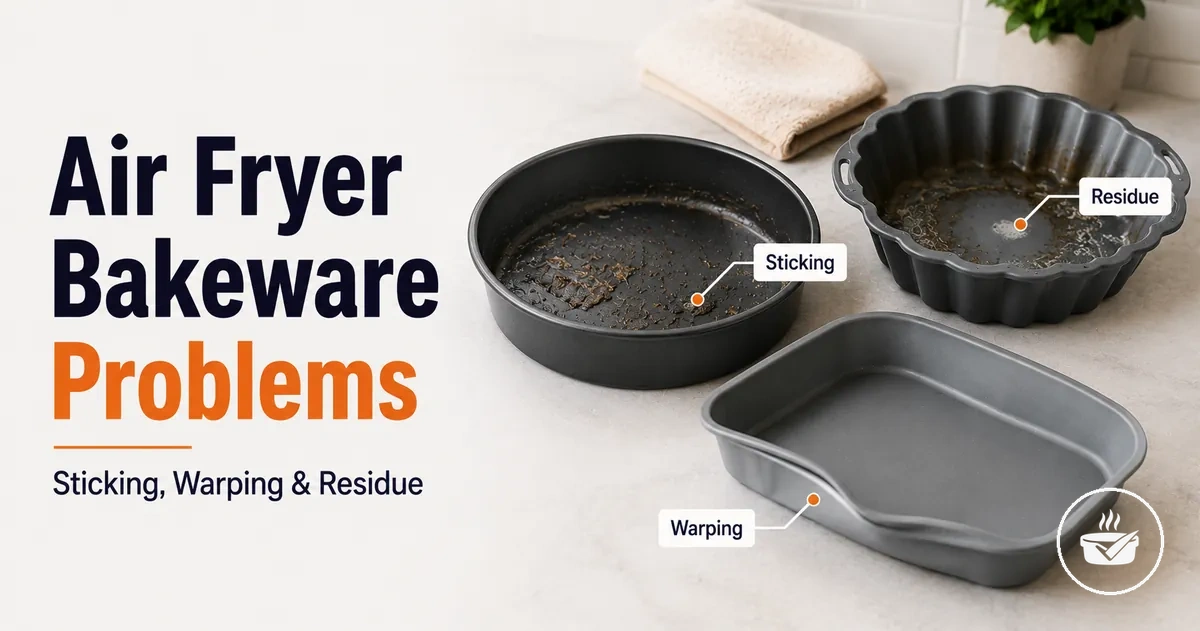
Air Fryer Bakeware Problems: Diagnosis and Safe Fixes
Air fryer bakeware problems are usually condition, fit, cleaning, coating, or airflow problems, not one universal failure. Sticking, warping, rust, peeling, and poor browning each point to a different cause group. The tray, pan, rack, surface, or coating should be checked by symptom first. Cause-first diagnosis helps separate a cleaning issue from a fit issue, material issue, airflow issue, or replacement concern.
Sticking can come from residue, scratches, moisture, or a worn nonstick surface that changes release. Warping may relate to metal heating and cooling, tray thickness, rim structure, or tight fit pressure. Rust, corrosion, and peeling need more caution because safe reuse can depend on spread, food-contact location, cleaning response, and coating condition. Poor browning usually points to blocked airflow, pan depth, food load, or limited surface contact rather than one certain bakeware fault.
If food sticks, a pan rocks, a coating lifts, or baked food stays pale, treat the visible sign as the first diagnostic clue. The next step is to sort the symptom by surface, shape, airflow, or replacement boundary before choosing a cleaning, adjustment, or safer reuse decision.
How Air Fryer Bakeware Problems Show Up
Symptoms are visible clues that help sort air fryer bakeware problems before deciding on a likely cause. They are best grouped by surface, shape, and airflow so similar signs are easier to distinguish without assuming a single cause.
How Air Fryer Bakeware Problems Show Up is easier to understand when visible cues are organised before troubleshooting begins. The image below groups surface, shape, and airflow signs so they can be recognised before moving into detailed diagnosis.
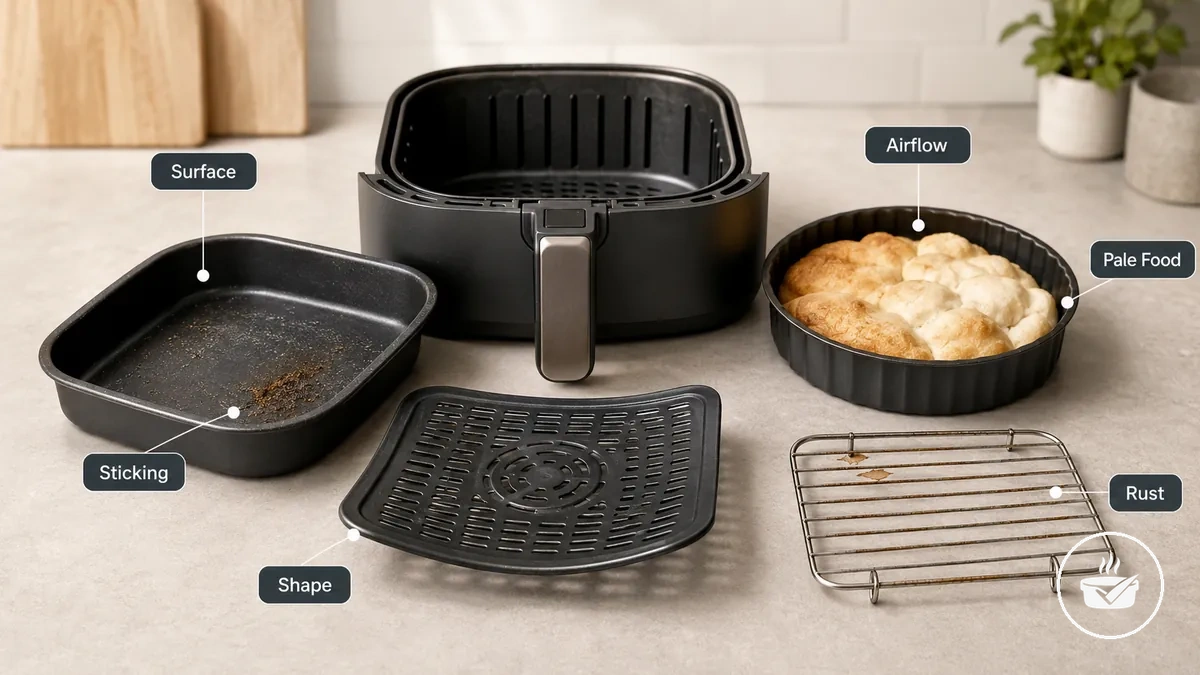
| Symptom | Likely cause group | First check |
|---|---|---|
| Sticking or residue | Surface condition or cleaning | Look for residue, scratches, or changes to food release. |
| Warping or rocking tray | Shape, fit, or material behaviour | Check whether the tray shape sits evenly inside the basket. |
| Rust or peeling | Surface wear or exposed metal | Inspect for corrosion, flaking, or coating wear. |
| Pale food or uneven browning | Airflow or circulation | Check airflow space, pan depth, and food placement. |
These symptoms identify observable signs rather than confirm a final diagnosis because the same result may come from cleaning, fit, material, or normal use. Pale food or uneven browning can also reflect normal air fryer cooking variation when no matching surface, shape, or airflow cue is present. For broader context, see the air fryer bakeware guide.
Symptoms That Point to Surface, Shape, or Airflow Issues
When a symptom first appears, sorting it into the correct group can help avoid the wrong diagnosis. The first visible clue usually points toward a surface issue, shape change, or airflow restriction rather than a single confirmed cause.
Symptoms That Point to Surface, Shape, or Airflow Issues are easier to interpret when visible signs are organised before troubleshooting. The image below highlights common visual cues that support early symptom sorting.
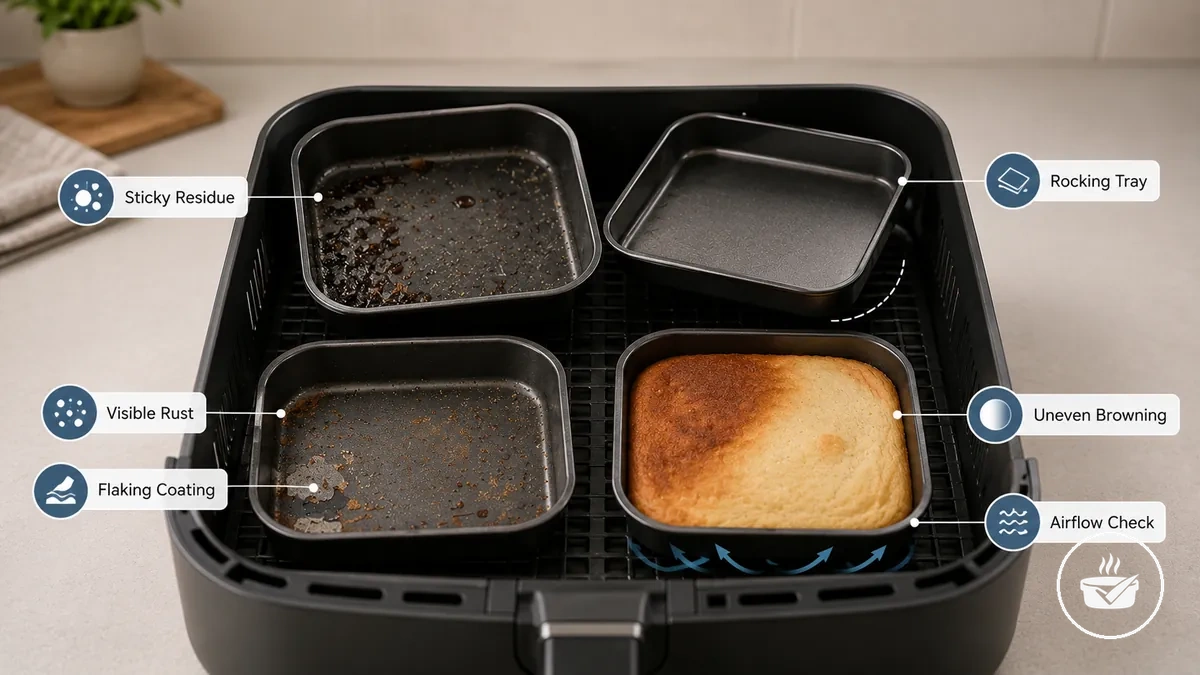
A sticky residue may result from remaining food deposits, while a similar appearance could also indicate flaking coating, so the next clue helps separate the two. A rocking tray may suggest a shape change, but checking whether the bent tray sits unevenly can help distinguish a fit issue from heat-related warping. Use the checklist below to guide the next observation instead of assuming a certain cause.
- Sticky residue → likely surface issue → check whether the residue changes after cleaning.
- Rocking tray → likely shape change → check whether the tray sits flat and remains stable.
- Visible rust → likely surface issue → inspect whether corrosion is localised or spreading.
- Flaking coating → likely surface issue → look for exposed areas beneath the coating.
- Uneven browning → likely airflow restriction → check airflow space, food depth, or blocked circulation.
Food Sticking and Nonstick Surface Failure
When food sticking becomes frequent, the cause is often either temporary cooking conditions or changes to the nonstick surface. Separating use-related sticking from coating wear helps identify whether the release problem may improve with normal cleaning and cooking adjustments or whether replacement risk should be considered.
Food Sticking and Nonstick Surface Failure is easier to understand when removable residue is distinguished from lasting surface damage. The image below highlights the difference between stuck food, residue, scratches, and visible coating wear before moving into diagnosis.
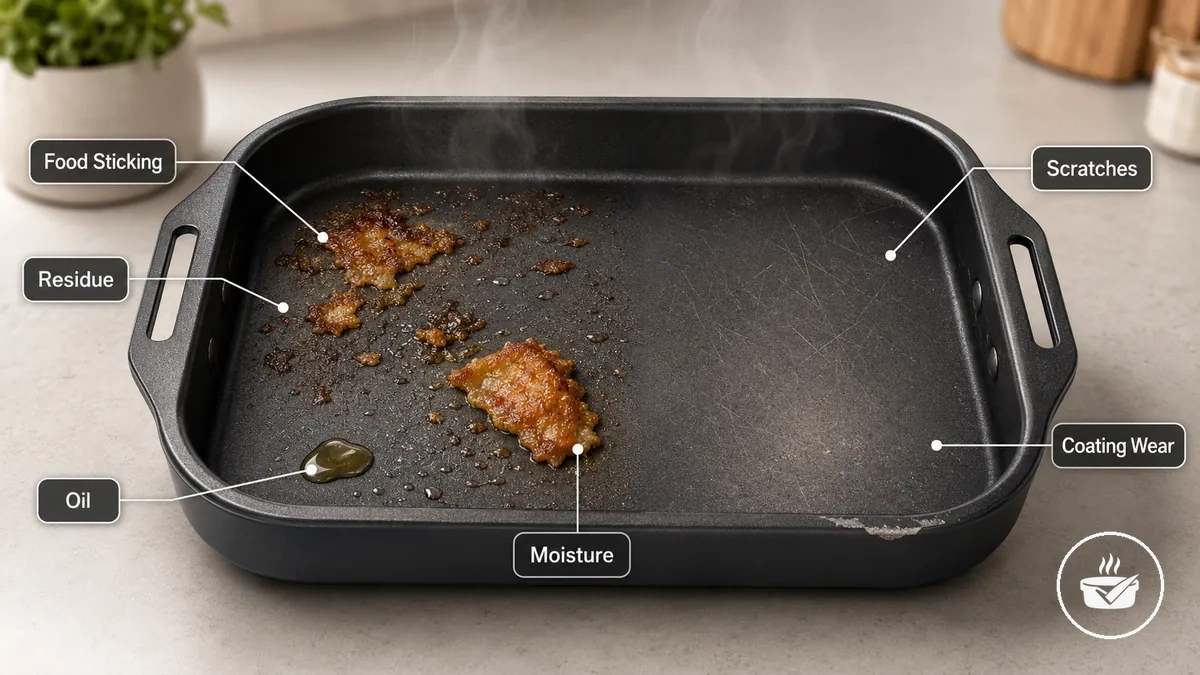
Food sticking can occur on an intact nonstick surface when oil is limited, moisture remains on the food, preheating is insufficient, or foods containing batter or sugar are more likely to adhere. These situations affect food release but do not necessarily indicate coating failure.
- Food sticking with little residue → check oil level, moisture, and preheating condition.
- Stuck food after repeated use → inspect for baked-on grease that may reduce release.
- Scratches or dull areas → check whether coating wear is increasing sticking.
- Flaking or exposed surface → consider replacement risk instead of assuming normal wear.
- Residue after cleaning → inspect the release surface for texture changes or coating wear.
Residue, scratches, and coating wear affect the release surface differently. Residue buildup may reduce food release without indicating permanent damage, while scratches and worn coating can increase sticking over time. If flaking exposes the underlying surface, replacement may be appropriate depending on the extent of the damage.
If sticking continues after cooking conditions and residue have been checked, inspect the bakeware for visible surface changes before deciding on the next step. For broader selection criteria, see material and coating issues.
Oil, Preheating, and Food Moisture Conditions
Oil, preheating, and food moisture can cause food sticking even when the bakeware has an intact surface. Before assuming nonstick surface failure, check whether cooking conditions are affecting release behaviour.
Oil, Preheating, and Food Moisture Conditions are easier to assess when use variables are separated from surface damage. The image below shows how oil, surface heat, and food moisture can influence release behaviour while the bakeware surface remains functional.
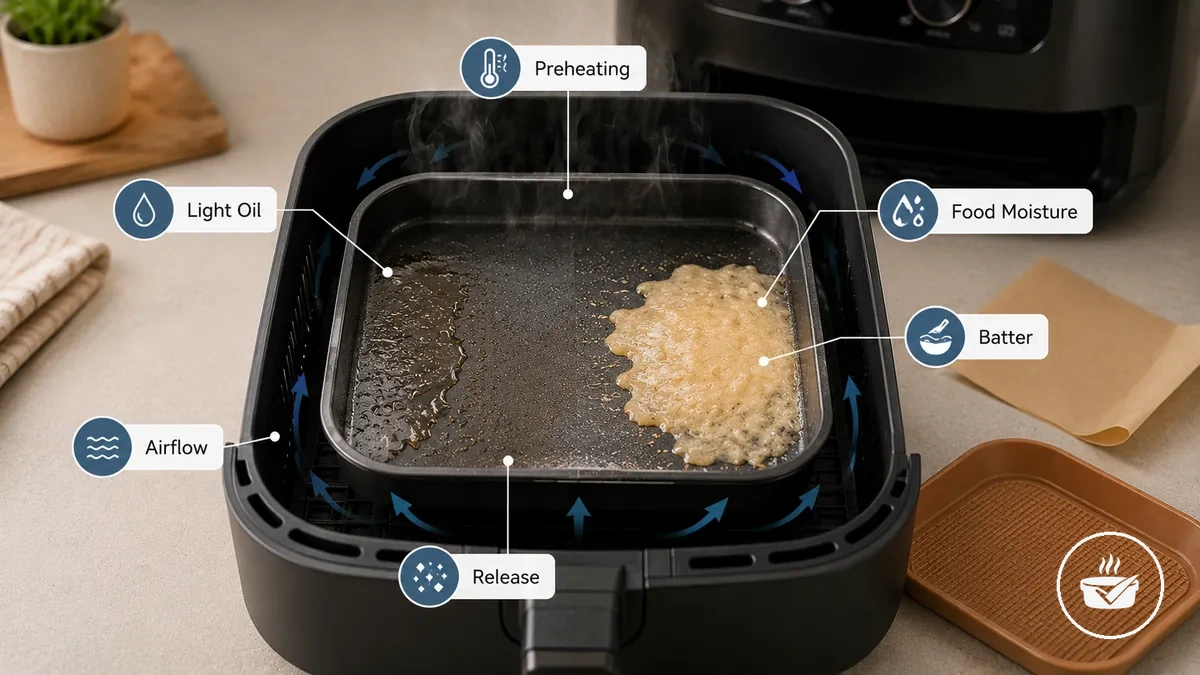
Food type, food moisture, and preheating state can all affect how easily food releases. Batter, sugar, and protein may adhere more readily, while a light coating of oil may improve release in some situations. The effect of a spray, parchment, or silicone liner depends on the food, bakeware fit, and airflow rather than acting as a universal solution. If sticking continues under suitable cooking conditions, inspect the bakeware surface for residue or coating wear before attributing the problem to use conditions alone.
- Light oil coating → may improve release behaviour → the amount depends on the food and surface.
- Preheating → can improve surface heat → the benefit varies with the recipe and bakeware.
- High food moisture → increases sticking risk → wet food may release less easily.
- Batter, sugar, or protein → can increase sticking → sticky foods may need different release conditions.
- Spray, parchment, or silicone liner → may help in some cases → airflow and fit should still be considered.
Residue, Scratches, and Worn Release Surfaces
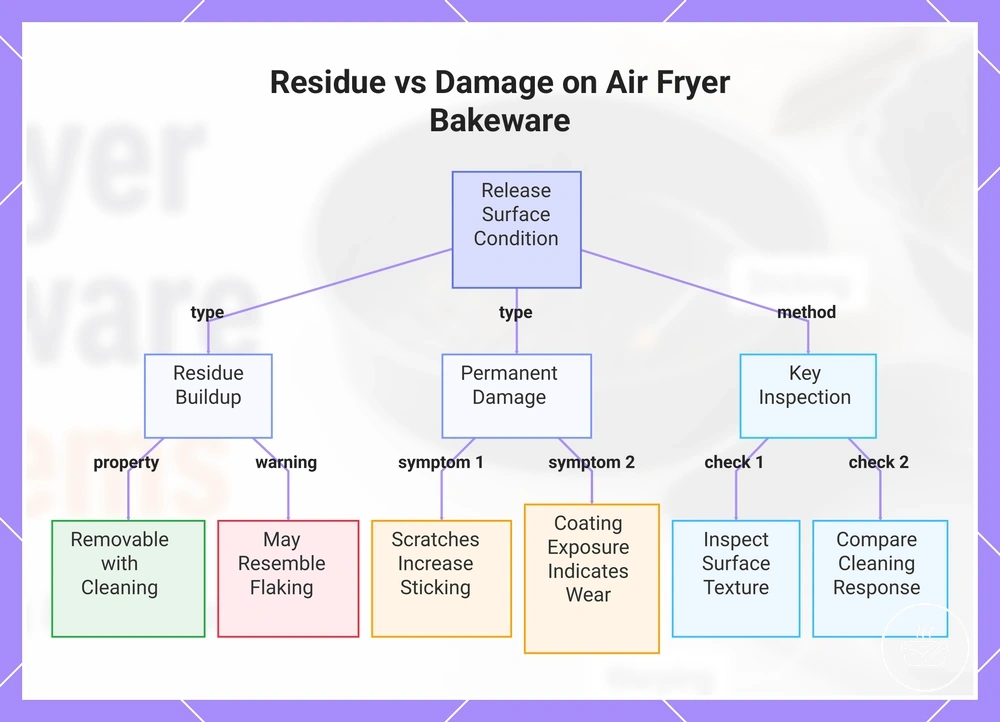
Residue buildup changes the release surface differently from scratches or a worn coating. Baked-on grease can alter surface texture and increase sticking while remaining removable, whereas scratches or coating exposure may indicate surface wear rather than residue alone.
Inspect the texture and cleaning response before deciding whether the surface is simply dirty or showing lasting damage. A dull surface that improves after residue removal may still have a functional release surface, but scratches, flaking, or coating exposure can continue to increase sticking after baked-on grease has been removed.
- Residue buildup → changes surface texture → inspect whether cleaning changes the release surface.
- Baked-on grease → may resemble surface wear → compare texture after cleaning.
- Scratches → may increase sticking → inspect whether the release surface is exposed.
- Worn coating → may indicate coating exposure → check for flaking or visible surface wear.
Baked-on grease can sometimes look similar to flaking nonstick layers, so distinguishing cleaning response from permanent surface change is the key inspection step. For the next stage after this assessment, see cleaning air fryer bakeware.
This chart shows how to distinguish between temporary residue buildup and permanent surface damage on air fryer bakeware by inspecting texture and cleaning response.
Warped, Bent, or Unstable Air Fryer Bakeware
Warped bakeware is often linked to heat stress, metal expansion, construction, or fit pressure rather than one confirmed defect. A bent tray or unstable pan may rock in the basket when rapid heating, cooling shock, thickness, or rim structure changes the shape of the bakeware.
| Cause condition | Visible sign | Reuse concern | Next check |
|---|---|---|---|
| Rapid heating or cooling shock | Warping, bowing, or buckling | May affect stability | Check whether the tray still sits flat. |
| Thin tray or light construction | Bent tray or flexing | May reduce stability during use | Inspect tray thickness and rim structure. |
| Metal expansion | Rocking or uneven contact | Reuse depends on fit and condition | Check whether the shape returns after cooling. |
| Tight fit pressure | Deformation around edges | May affect basket or rack fit | Inspect contact points and overall stability. |
Metal expansion during rapid heating and cooling can change the shape of a tray, especially when thickness or rim structure gives less resistance to deformation. Fit pressure inside the basket or on an oven rack may also contribute to a warped or unstable shape. Whether the bakeware returns to its original form or remains bent depends on the material and the extent of the deformation.
If a tray only shows slight bowing but still sits flat without rocking, the change may be largely cosmetic. If warped bakeware becomes unstable, develops sharp edges, or no longer fits securely, reuse should be judged cautiously rather than assuming the shape can be restored or safely used in every case.
Rapid Heating, Cooling, and Uneven Metal Expansion
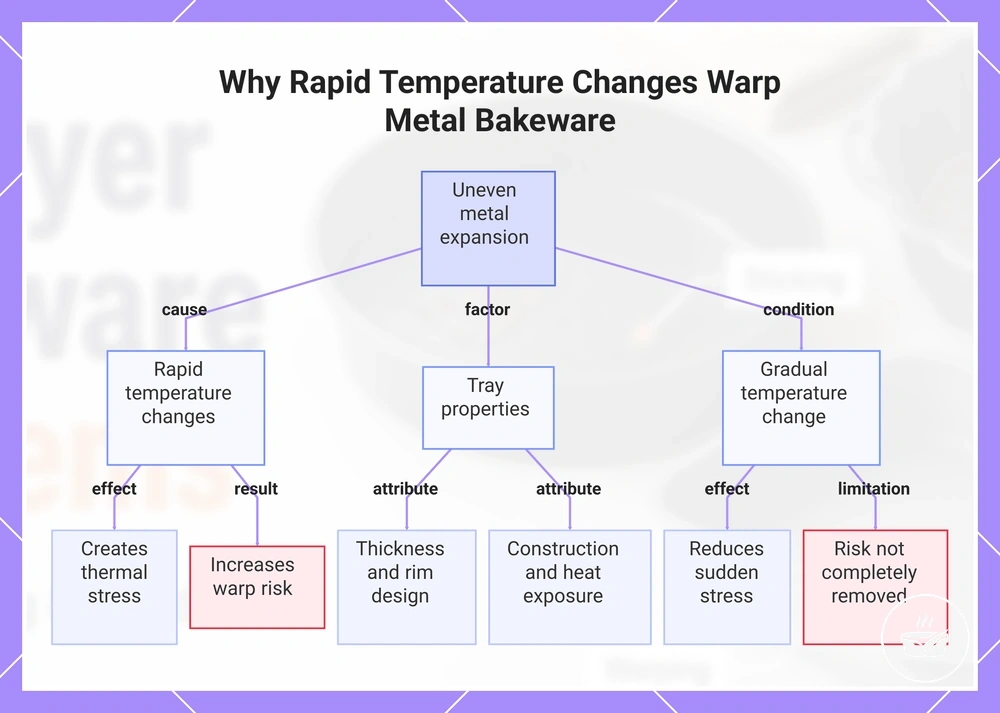
Metal expansion is the way a metal tray expands and contracts as temperature changes. Uneven metal expansion can create thermal stress when one part of the tray changes shape faster than another part, which may increase warp risk.
Rapid heating and rapid cooling can make that expansion difference more noticeable, especially when tray thickness or rim structure gives the bakeware less resistance to buckling. Gradual temperature change may reduce sudden stress, but it does not remove warp risk for every tray. The amount of change depends on construction, thickness, rim design, and heat exposure rather than one exact threshold.
This chart explains how uneven metal expansion from rapid temperature changes creates warp risk, the factors that influence it, and the effect of gradual temperature change.
Thin Trays, Tight Fit, and Basket Pressure
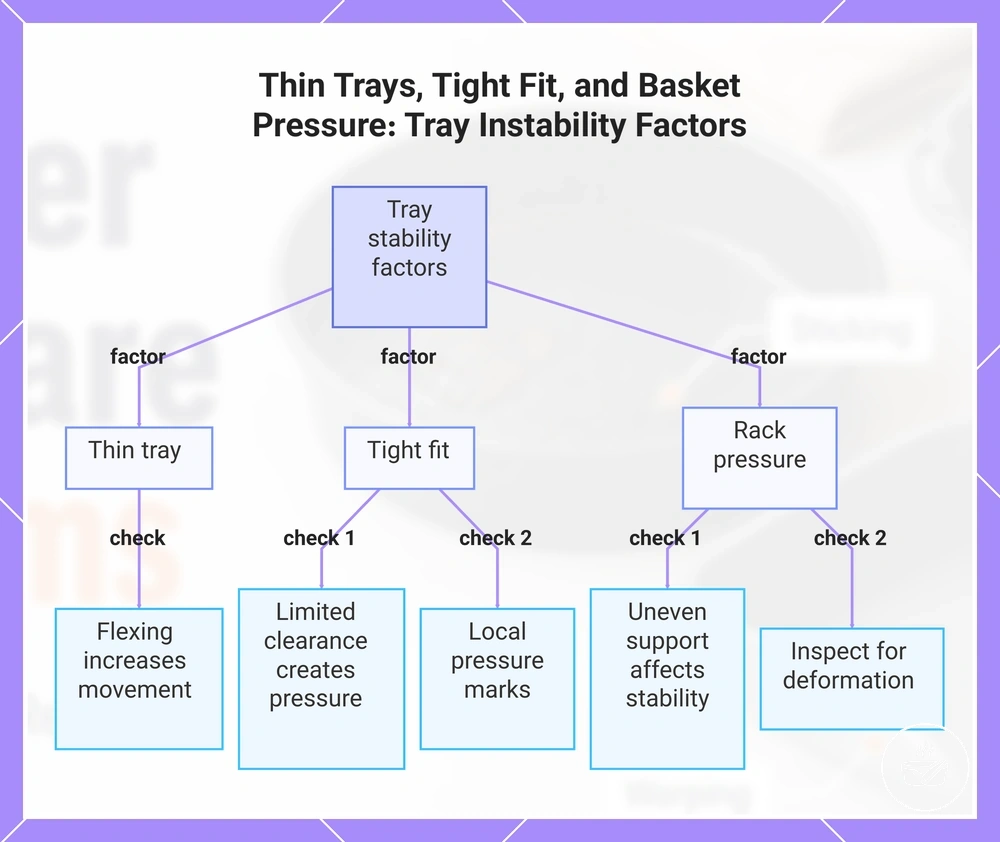
Thin trays and a tight fit can create bending, rocking, or pressure marks that resemble heat-only warping. Stability depends on tray thickness, clearance, basket pressure, and contact points rather than heat exposure alone.
A tray made from suitable material can still become unstable when a snug fit creates pressure at one contact point or when rack pressure limits normal movement. Before assuming permanent deformation, check whether restricted clearance or uneven support is causing the tray to rock instead of sitting flat.
- Thin tray → check whether flexing increases movement during use.
- Tight fit → inspect whether limited clearance creates pressure against the basket wall.
- Contact point → look for local pressure marks where the tray touches the basket or rack.
- Rack pressure → check whether uneven support affects stability or causes rocking.
- Movement → if the tray shifts or rocks, inspect for deformation before attributing the issue to heat alone.
This chart identifies the key factors causing tray instability that can be mistaken for heat warping, and the specific checks to perform for each factor.
Rust, Corrosion, and Peeling Coatings
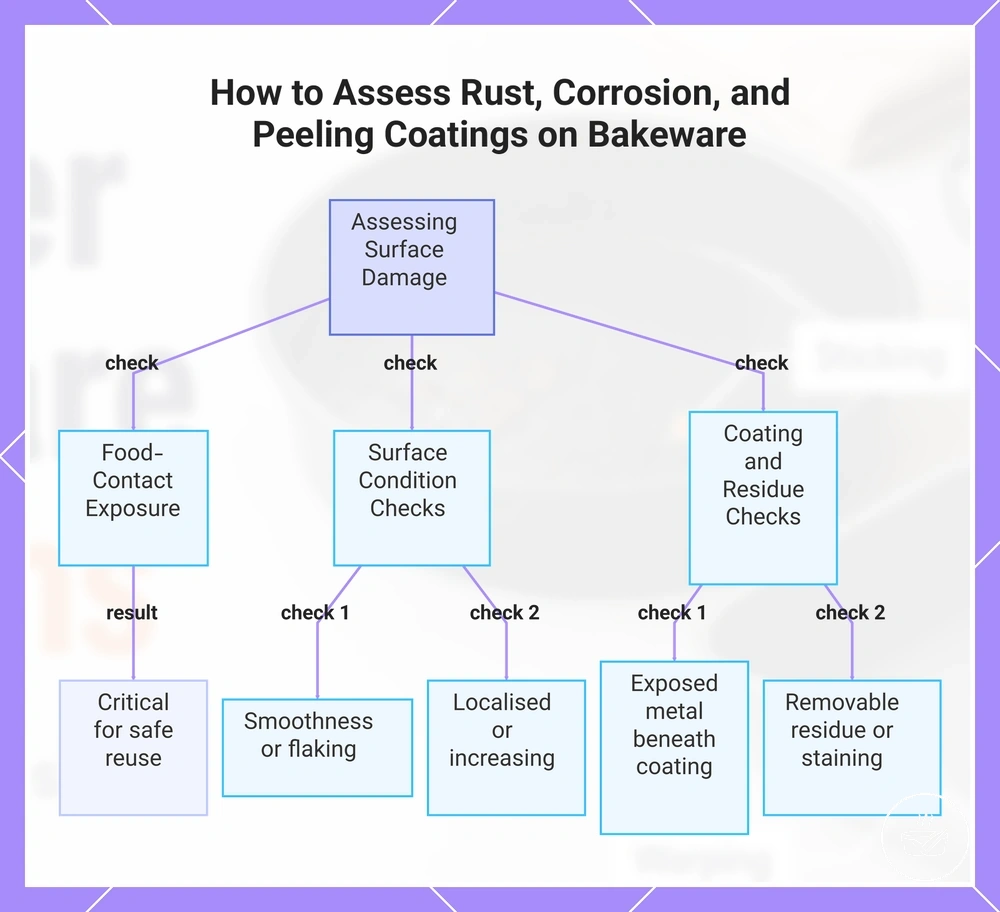
Rust, corrosion, and peeling coatings should be assessed by their location, spread, texture, and food-contact exposure rather than treated as equally serious. A rust spot, corrosion, or peeling coating may require different decisions depending on whether the affected area is localised, expanding, or directly contacts food.
Moisture exposure, abrasive cleaning, and dishwasher use can contribute to changes in the surface layer over time. Use the checklist below to distinguish removable residue from coating damage or exposed metal before deciding whether safe reuse may still be appropriate.
- Location → check whether the affected area is on a food-contact surface or a non-contact area.
- Texture → inspect whether the surface is smooth, rough, or actively flaking.
- Spread → check whether rust or corrosion remains localised or appears to be increasing.
- Peeling coating → look for exposed metal beneath the nonstick layer.
- Cleaning response → determine whether the mark is removable residue, staining, or remains after normal cleaning.
Exposed metal and flaking coating can reduce confidence in the food-contact surface because the protective layer has changed. Whether safe reuse is appropriate depends on the extent of the damage, its location, and whether flaking or corrosion affects the food-contact area rather than on one visible mark alone.
Staining, removable residue, active rust, and flaking coating are different surface conditions and should not be treated as the same problem. For broader air fryer bakeware safety guidance, judge surface condition by food contact, texture, and visible change instead of assuming every discoloured area presents the same level of concern.
Use these criteria to evaluate surface damage and decide whether bakeware can be safely reused.
Moisture, Dishwashing, and Improper Drying
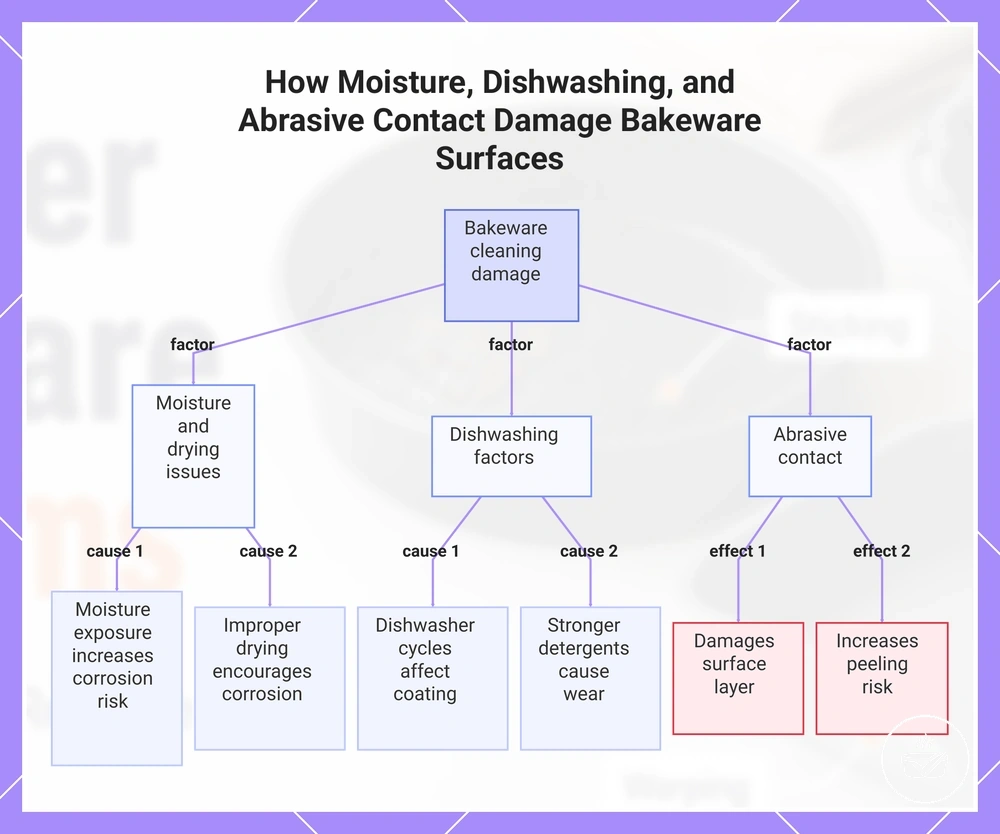
Moisture exposure, dishwashing, and improper drying can contribute to rust, corrosion, or coating deterioration over time. Water retention after cleaning and abrasive contact are maintenance-related conditions that may affect the surface even when the bakeware initially appears undamaged.
Each cleaning condition influences the surface differently, so the visible change should be matched to the likely cause rather than assumed. Detergent strength, drying completeness, and abrasive contact can weaken coating condition, while dishwasher-safe claims should still be treated cautiously because the effect of a dishwasher cycle may depend on the material, coating condition, and how thoroughly the bakeware dries afterward.
- Moisture exposure → retained water can increase corrosion risk when the surface remains damp.
- Dishwashing → dishwasher cycles may affect coating condition depending on the material and drying quality.
- Detergent → stronger detergents can contribute to gradual surface wear.
- Abrasive contact → rough cleaning tools can damage the surface layer and increase peeling risk.
- Improper drying → water retention after cleaning can encourage corrosion when moisture remains on the surface.
This chart shows the main cleaning-related causes of rust, corrosion, and coating deterioration on bakeware, with each category broken into specific factors and effects.
Rust Stains, Exposed Metal, and Flaking Nonstick Layers
Rust stains, exposed metal, and flaking nonstick layers should be assessed by more than colour alone. Colour is only an initial clue, while texture, spread, lift, and substrate exposure provide stronger criteria for deciding whether a visible mark may affect the food-contact surface.
Compare how the mark looks and feels before reaching a conclusion. Brown residue may sit on top of the surface and respond to cleaning, whereas an orange rust mark may indicate corrosion. Flaking nonstick that lifts from the substrate or reveals exposed metal deserves closer inspection because the food-contact risk may change when the protective surface is no longer intact.
| Visible mark | Texture clue | What it may mean | Action boundary |
|---|---|---|---|
| Brown residue | Sits on the surface and may wipe away | May be surface residue rather than rust stains | Inspect again after normal cleaning. |
| Orange rust | Rough texture that may spread | May indicate corrosion affecting the surface | Check the spread and whether the food-contact surface is affected. |
| Coating flakes | Lifted flaking nonstick with exposed substrate or exposed metal | May indicate coating deterioration | Judge continued use cautiously when flaking or exposed metal affects the food-contact surface. |
Poor Browning, Uneven Cooking, and Airflow Restrictions
Poor browning and uneven cooking are often linked to airflow, pan geometry, food load, material response, or surface contact rather than the appliance alone. When bakeware restricts airflow or changes how heat reaches the food, result patterns such as pale tops, soggy bottoms, or uneven edges can help identify the likely cause.
The troubleshooting table below connects common browning results to bakeware-related factors. Match the visible cooking pattern with the likely cause before adjusting broader cooking variables such as recipe timing.
| Result problem | Likely bakeware factor | Check | Adjustment direction |
|---|---|---|---|
| Pale tops | Restricted airflow or tall pan geometry | Check whether pan walls or food height block airflow. | Improve airflow or use a shallower tray when appropriate. |
| Soggy bottoms | Deep pan depth or limited surface contact | Check for trapped moisture beneath the food. | Increase exposed surface area and reduce moisture pooling. |
| Uneven edges | Material response or uneven pan geometry | Check whether the bakeware heats or supports food unevenly. | Improve food placement or use bakeware with more even surface contact. |
| Soft texture | Heavy food load or blocked circulation | Check whether crowding restricts airflow around the food. | Reduce the food load to improve air movement. |
Airflow and pan geometry influence how heat reaches the food. Deep pans, solid sides, or crowded food loads can reduce browning potential by limiting airflow and exposed surface contact. Material response may also affect texture because different bakeware can transfer heat differently depending on its construction.
Pale tops often point to restricted top airflow, while soggy bottoms may indicate excess moisture, pan depth, or limited surface contact. Uneven edges can suggest uneven heat transfer, pan geometry, or crowding rather than a single fault. For broader usage guidance after this diagnosis, see airflow problems when using bakeware.
Solid Pans, Deep Moulds, and Blocked Circulation
Solid pans and deep moulds can reduce hot-air movement around food by creating blocked circulation around the sides, base, or top surface. When wall height, food coverage, or limited clearance restricts airflow, browning may decrease and undercooking can become more likely in thicker or less exposed areas.
Use the checklist below to verify whether pan shape is limiting circulation before changing other cooking variables. Solid pans can contain loose foods effectively, but deeper walls and fewer openings may reduce browning potential when airflow cannot reach the food surface as freely.
- Wall height → check whether tall sides restrict airflow around the food.
- Clearance → verify that space remains around the bakeware for circulating hot air.
- Perforation → check whether the pan design allows air to move beneath or around the food.
- Food coverage → inspect whether a deep or full layer limits exposed surface area and increases undercooking risk.
- Pan shape → compare whether a deep pan provides better containment but may reduce browning compared with a more open design.
Material, Pan Depth, and Food Load Effects
Material, pan depth, and food load directly influence heat transfer, moisture retention, and surface exposure during air frying. The same recipe can produce a different browning outcome because bakeware material and pan geometry change how heat reaches the food and how moisture escapes.
The table below compares common bakeware attributes rather than ranking materials. Metal, silicone, glass, ceramic, shallow trays, and deep moulds can behave differently depending on recipe, fit, preheating, and air circulation.
| Factor | What changes | Likely result | Qualification |
|---|---|---|---|
| Metal | Heat transfer and surface exposure | May encourage faster browning | Results vary with recipe, airflow, and pan design. |
| Silicone | Moisture retention and heat response | May produce a softer texture and slower browning outcome | Depends on food type and air circulation. |
| Glass or ceramic | Heat transfer and pan depth | May change browning and texture | Performance depends on recipe, preheating, and bakeware shape. |
| Food load | Surface exposure and airflow | Heavier loads can reduce even browning | Crowding and pan depth influence the outcome. |
Heat transfer, moisture retention, and surface exposure should be considered together when evaluating bakeware performance. A shallow tray may expose more food to circulating air, while a deep mould or heavier food load can retain more moisture and reduce browning. For example, metal may brown food more quickly than silicone under similar conditions, but the final result still depends on recipe, fit, preheating, and air circulation.
When Air Fryer Bakeware Should Be Repaired, Cleaned, or Replaced
Air fryer bakeware should be repaired, cleaned, adjusted, or replaced based on severity, food-contact surface exposure, fit stability, coating condition, and cleaning response. Use the decision checklist below to separate cleanable residue, minor correction, safer use adjustment, and stronger replacement signals.
| Problem condition | Try cleaning or adjustment? | Replacement signal | Qualification |
|---|---|---|---|
| Residue or baked-on grease | Yes, if the cleaning response improves the surface. | No improvement after normal cleaning | Removable residue differs from coating damage. |
| Minor warping with stable fit | Check fit stability and result quality. | Tray becomes unstable or no longer fits securely | Small cosmetic changes may not prevent continued use. |
| Rust or corrosion | Inspect location and rust spread. | Active rust on the food-contact surface or spreading corrosion | Severity depends on exposure and condition. |
| Flaking coating or exposed metal | Minor correction is generally not appropriate. | Visible flaking or exposed food-contact surface | Coating condition becomes the replacement signal. |
Cleanable residue should be evaluated through its cleaning response before it is treated as permanent damage. If normal cleaning restores the surface and cooking results remain acceptable, continued use may still be reasonable depending on the remaining condition.
Fit stability should be checked whenever bakeware has warped or bent. A tray that rocks, shifts, or no longer fits securely may need to be replaced because stable positioning is part of the reuse decision.
Rust spread, peeling, and exposed metal deserve closer attention than cosmetic marks because they affect the food-contact surface. When coating condition continues to deteriorate or corrosion spreads, replacement is usually a safer decision than further repair.
If uncertainty remains after checking condition, severity, and fit, review the air fryer bakeware FAQ for common decision scenarios. Small cosmetic marks may allow continued use in many cases, while unstable fit, active rust, or flaking coating are stronger replacement signals.
Safe Reuse Checks for Warping, Rust, and Coating Damage
Safe reuse depends on visible condition, food-contact exposure, stability, and airflow risk rather than a universal guarantee. Warping, rust, and coating damage should be checked by where the damage sits, whether it touches food, and whether it affects fit during use.
Non-contact cosmetic wear may allow cautious use when the bakeware remains stable and the food-contact surface is intact. Damage that creates sharp edges, active rust, flaking, unstable fit, or blocked airflow needs closer scrutiny because the problem can affect contact, movement, or cooking performance.
- Food-contact exposure → check whether rust, flaking, or coating damage touches the food-contact surface.
- Stability → if warping makes the tray rock or shift, cautious use may no longer be appropriate.
- Sharp edges → inspect bent or damaged areas that could affect handling or fit.
- Flaking → check whether the coating lifts from the surface or exposes material beneath.
- Rust activity → inspect whether rust appears localised, spreading, or returning after cleaning.
- Airflow risk → check whether deformation blocks circulation or changes how the bakeware sits in the basket.
Replacement Cues That Affect Fit, Release, and Cooking Results
Replacement cues appear when fit, release, corrosion, or cooking results no longer respond to reasonable cleaning or adjustment. The decision depends on performance loss rather than appearance alone, with attention to reliable food release, stable fit, and predictable cooking results.
Recurring functional problems are stronger replacement signals than isolated cooking results because they indicate an ongoing issue rather than a one-off condition. Persistent corrosion, recurring warping, and blocked airflow should be assessed alongside food-contact exposure and stability before deciding whether replacement is appropriate.
- Release failure → sticking continues after normal cleaning and appropriate use, reducing reliable food release.
- Persistent corrosion → rust continues to return or spread, especially where it affects the food-contact surface.
- Recurring warping → repeated deformation interferes with fit or cooking performance.
- Unstable fit → movement or rocking prevents the bakeware from sitting securely during use.
- Blocked airflow → deformation continues to restrict air circulation and contributes to inconsistent cooking.
- Poor browning → uneven cooking results continue despite reasonable cleaning, adjustment, and suitable operating conditions.
- Predictable cooking results → when ongoing performance loss prevents reliable food release or consistent cooking, replacement may be the more appropriate option.