
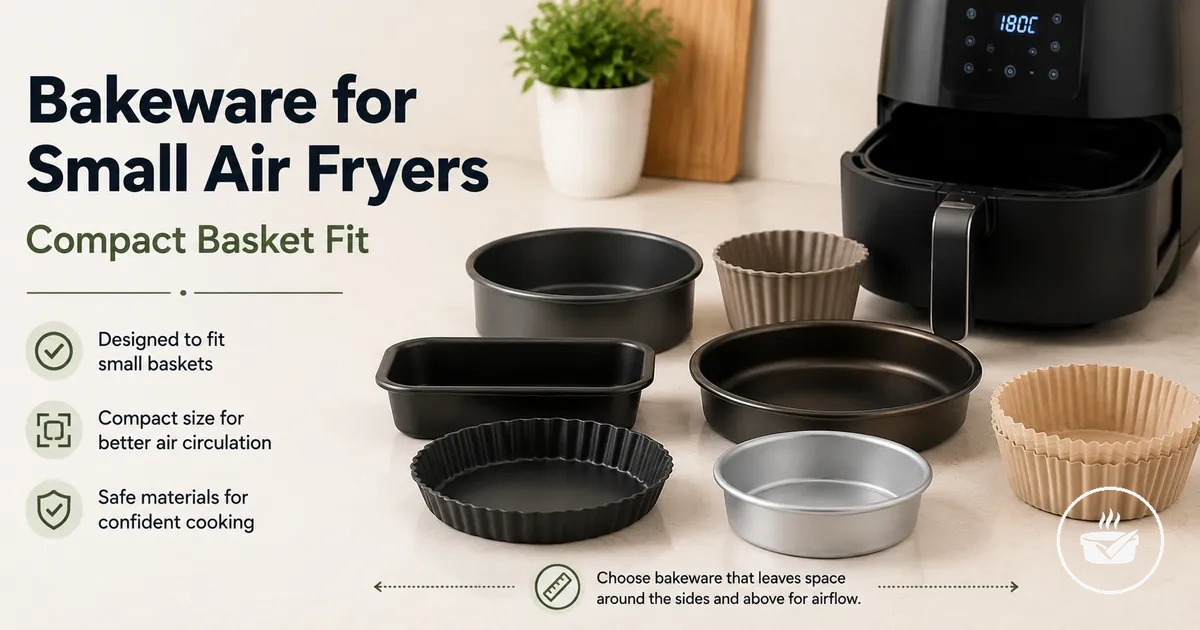
Air fryer bakeware sets: useful pieces, fit, and value
An air fryer bakeware set is worth considering only when several included pieces fit your air fryer and support real baking uses. A cake pan, muffin cups, rack, or tray can add value when the set pieces match your basket size, clearance, material needs, and cooking habits.
A baking kit and an accessory set can look similar, but not every bundle is focused on baking. A baking-focused set usually needs useful pieces such as silicone cups, a nonstick pan, or a tray, while broader baking accessories may include items that do not improve everyday baking use.
The main decision is not the number of pieces in the box. Fit, material, airflow, and value decide whether an air fryer bakeware set is practical, so the next step is to separate bakeware sets, accessory sets, and baking kits before judging the included pieces.
Bakeware sets, accessory sets, and baking kits
Bakeware sets, accessory sets, and baking kits are labels that often overlap in market usage, so they are best judged by baking relevance rather than by the bundle label alone. Comparing the included pieces helps separate baking purpose, expected use, and selection risk before you decide whether a bundle offers good value.
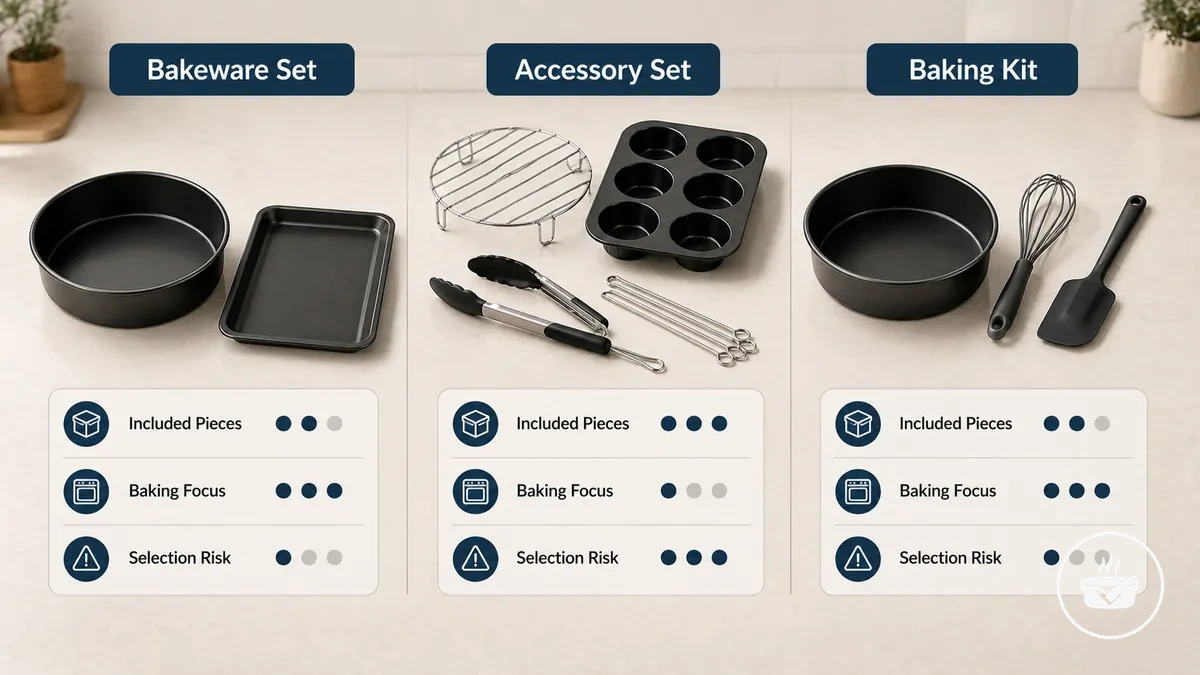
| Bundle label | Typical included pieces | Selection caution |
|---|---|---|
| Bakeware set | May include a baking pan, tray, or other air fryer bakeware intended for baking-focused cooking. | Check fit, material, and value instead of assuming every piece suits your air fryer. |
| Accessory set | May combine baking pieces with racks or other accessories, including non-baking items. | Broader bundles can contain items outside the baking-focused purpose of this page. |
| Baking kit | May include pans, a tray, and related pieces commonly used for baking recipes. | Compare the included pieces rather than relying on the bundle label. |
A bakeware set usually emphasizes baking-focused pieces, while an accessory set may cover a wider range of air fryer tools. A baking kit often groups items for common baking tasks, but the contents can vary between bundles. Checking the included pieces helps reduce selection risk, especially when non-baking accessories are included.
It is a common misconception that bundle labels follow fixed definitions. In practice, the label is less important than the baking use, fit, material, and included pieces. For broader bakeware guidance beyond these bundle meanings, visit the air fryer bakeware hub.
Included pieces that usually matter
Useful included pieces are the ones that fit your air fryer and support repeated baking tasks instead of simply increasing the piece count. A cake pan, muffin cups, silicone molds, rack, tray, or crisper piece can each provide value when the size, material, and recipe role match how you plan to bake. Evaluate each piece by its baking purpose before judging the bundle by quantity.
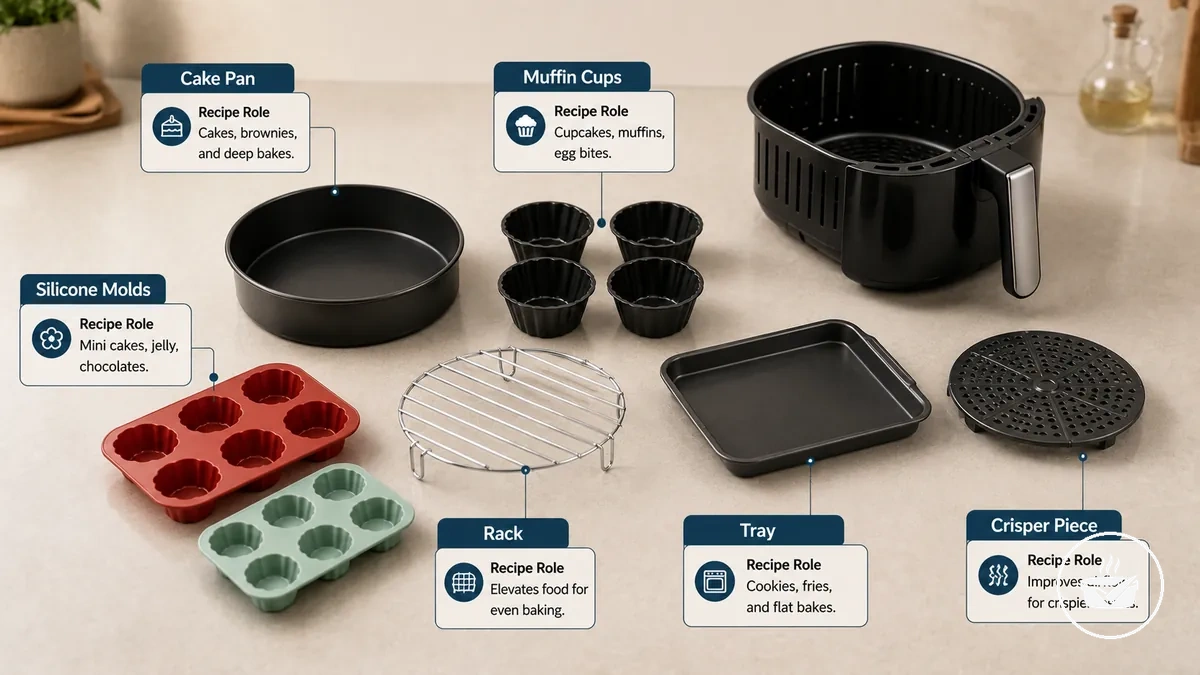
Included pieces that usually matter are easier to compare when grouped by baking role rather than treated as a long list of accessories. Core pieces are intended for frequent baking tasks, while other additions may suit only occasional recipes. The table below organizes each piece group by its main attribute, likely baking use, and practical value or limitation.
| Piece | Main attribute | Likely baking use | Value or limitation |
|---|---|---|---|
| Cake pan | Size and material | Cakes, loaves, and baked desserts | Useful when the fit matches the basket and recipe role |
| Muffin cups and silicone molds | Flexible material and portion size | Individual bakes and small desserts | Value depends on recipe type and available space |
| Rack and tray | Raised support or flat baking surface | Layered baking and general baking tasks | May add flexibility when compatible with the air fryer |
| Crisper piece | Perforated design | Recipes that benefit from airflow | Often suits specific recipes rather than everyday baking |
If two sets contain a similar number of pieces, the one with more useful core baking items may offer greater long-term value than one filled with low-use add-ons. Focus on repeated baking needs first, then treat extra accessories as optional. For broader coverage of accessory types beyond these core set pieces, see air fryer bakeware accessories.
Cake pans, loaf tins, pizza pans, and baking sheets
Cake pans, loaf tins, pizza pans, and baking sheets support different baked foods because their shape and depth influence how batter or dough cooks inside an air fryer. A cake pan may suit cakes and brownies, a loaf tin can hold taller mixtures, while a pizza pan or baking sheet provides a shallower surface that may encourage browning for flatter recipes. The right choice depends on diameter, depth, and fit within the basket.
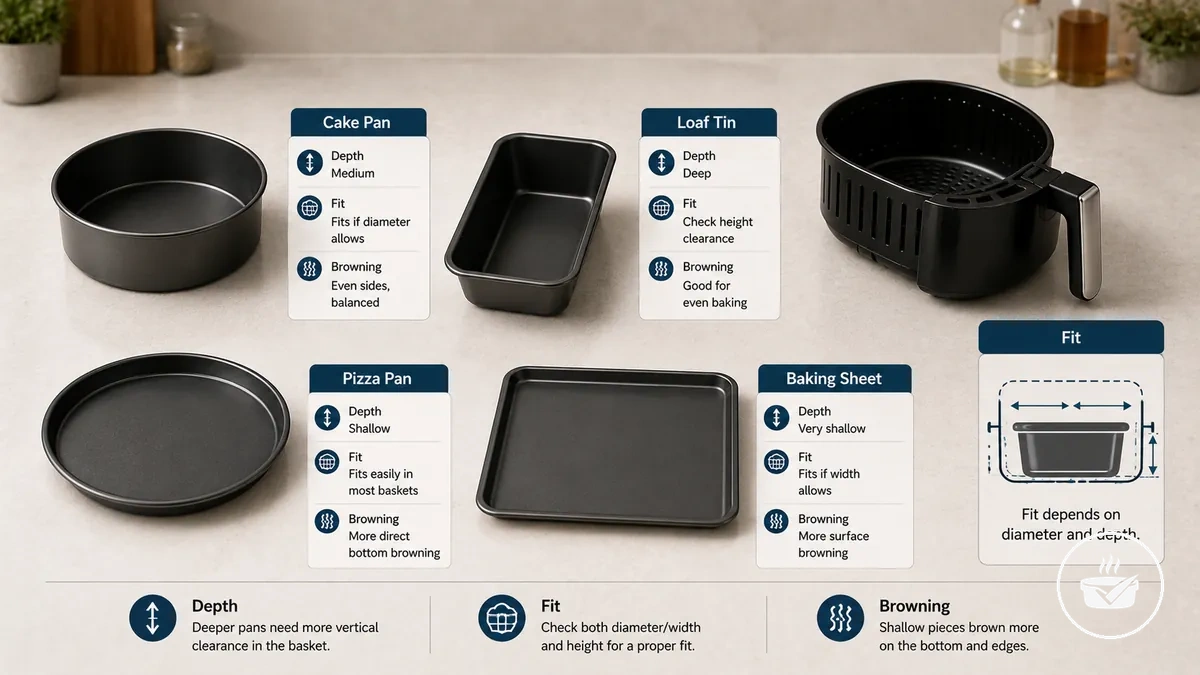
- Cake pan: Moderate depth for cakes and similar batters; fit and clearance affect baking space.
- Loaf tin: Greater depth for taller bakes; height and volume may reduce available clearance.
- Pizza pan: Shallow profile for pizza-style foods and other flat recipes that may benefit from browning.
- Baking sheet: Flat surface with a rim that can help handling and may simplify cleaning after baking.
Deeper pans can hold more batter but may leave less room for airflow, while shallower pieces expose more surface area for flatter baked items. A raised rim may help contain spills and make handling easier, although cleaning can vary with the recipe and pan design. Choose the pan shape that matches the intended baked item, then confirm that its depth and diameter suit your air fryer.
Muffin cups, silicone molds, and small-batch cups
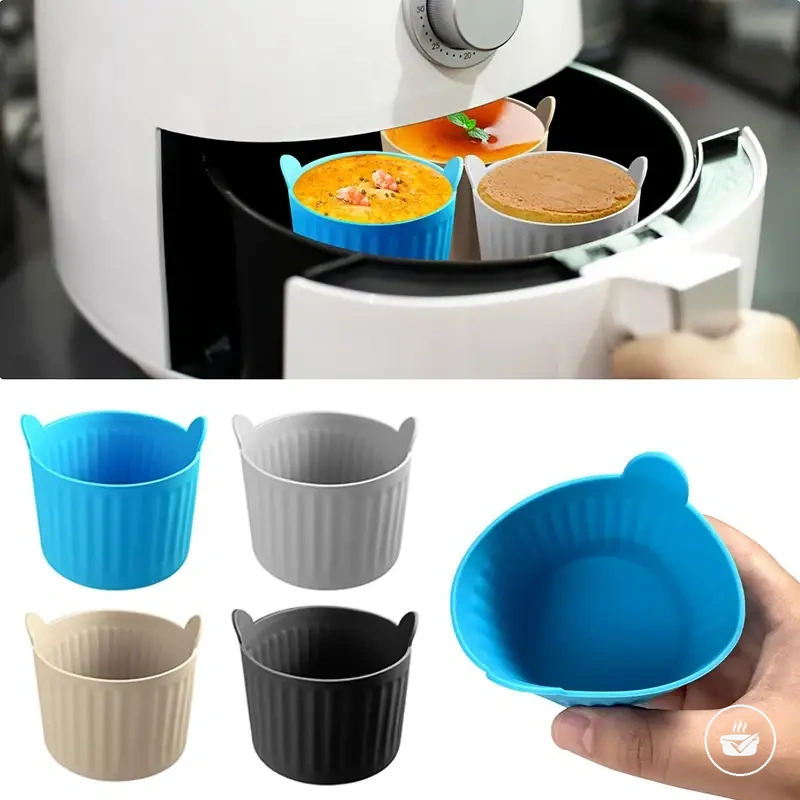
Muffin cups, silicone molds, and small-batch cups are useful for portioned baking when they are stable and made from food-grade silicone with an appropriate heat rating for the intended use. They can help separate individual portions and may make release easier, while browning can vary with silicone thickness, mold shape, and fill level. Stable placement inside the basket helps reduce the chance of shifting during baking.
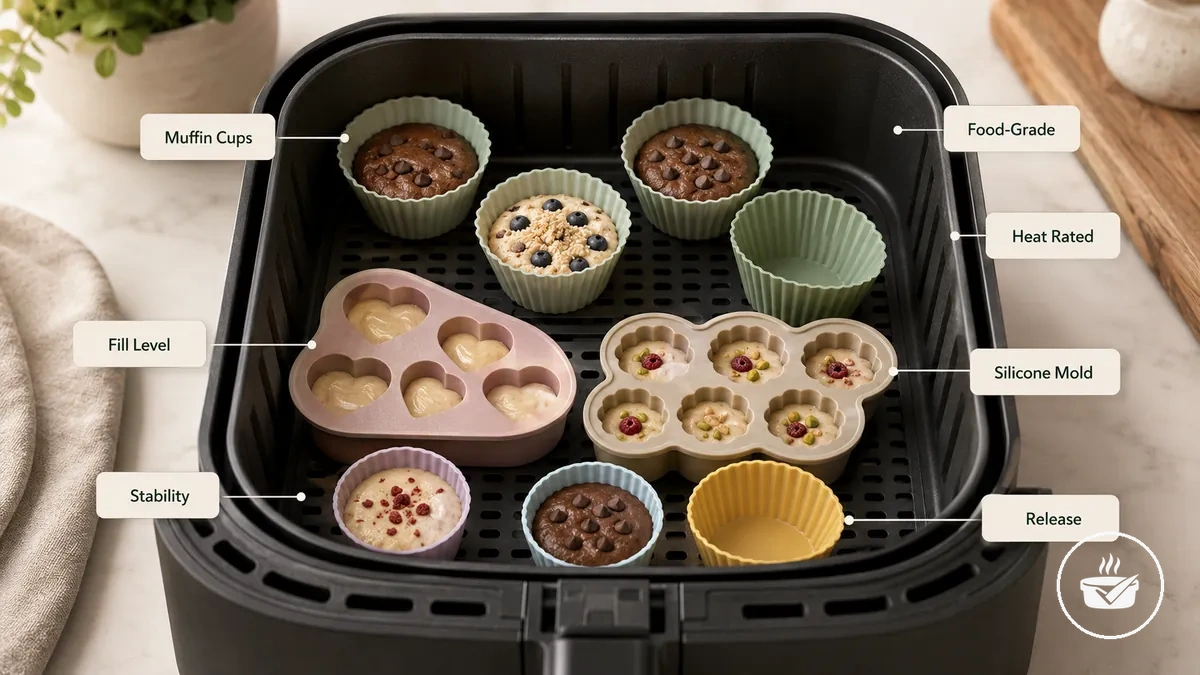
Use this checklist to verify stability, fill level, and heat rating before baking:
- Check that the food-grade silicone product has an appropriate heat rating for the intended use.
- Fill each muffin cup or silicone mold to a suitable level to help maintain stability.
- Leave enough basket space between small-batch cups for airflow and handling.
- Confirm the cups fit securely without overcrowding the basket.
- Clean and inspect the cups after use before storing them.
Flexible silicone molds can make release easier, but overfilling or using very soft cups without support may increase the chance of shifting. Browning may differ from metal bakeware depending on silicone thickness, mold shape, and the recipe, so move filled cups carefully when placing them into or removing them from the air fryer.
Racks, trays, baskets, and crisper pieces
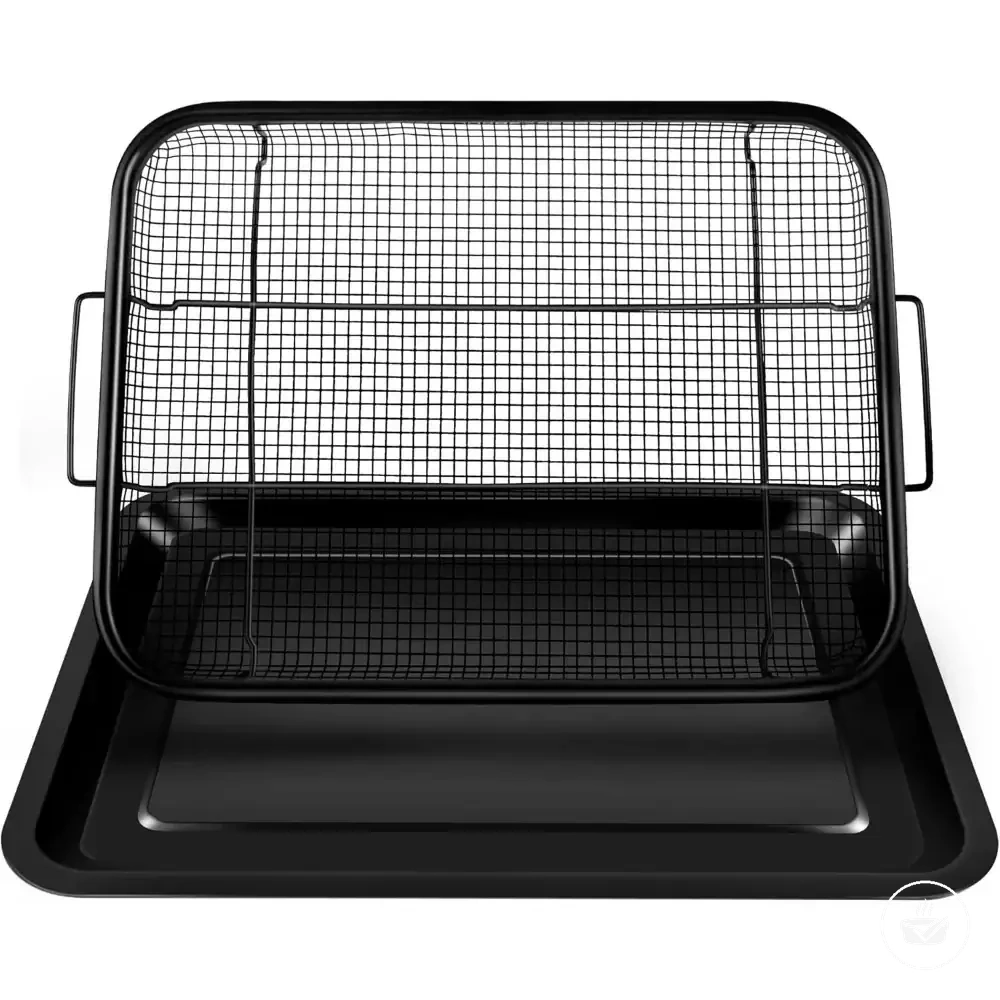
Racks, trays, baskets, and crisper pieces can expand usable cooking layers or improve airflow only when they preserve enough space inside the air fryer. Unlike solid baking pans, these pieces often use perforation, raised height, or an open design to support airflow around food. Their usefulness depends on proper fit, clearance, and stable handling.
| Airflow-support piece | Solid or bulky piece |
|---|---|
| Perforation may help airflow around food when the piece fits correctly. | Solid surfaces can reduce airflow beneath food. |
| A rack can add another cooking layer when height and clearance allow. | A bulky insert may reduce usable cooking space. |
| A basket, tray, or crisper piece with a practical handle can make removal easier when it fits securely. | A poorly fitting insert may make handling more difficult and limit airflow. |
A rack can create an additional layer, while a tray, basket, or crisper piece may improve airflow through perforation when space allows. Greater height can reduce clearance, and handle design affects how easily an insert can be removed. Choose each piece only if its fit, height, and shape leave enough room for airflow and reduce the risk of awkward handling.
Fit and compatibility before buying a set
Fit and compatibility depend on comparing each piece with the usable air fryer cavity before buying a set. Measure the internal width, depth, height, and available clearance, then compare those dimensions with the pan diameter or tray footprint instead of relying on quart size, bundle titles, or brand names alone. A model-specific measurement is the most reliable fit check.
Advertised dimensions do not always represent the usable size inside an air fryer, so compare the actual cooking space with each piece before making a decision. Use this checklist to organize advertised size, usable size, and clearance conditions:
- Measure the internal width of the air fryer cavity.
- Measure the internal depth and available height.
- Check pan diameter or tray footprint, including handles or rims.
- Leave enough clearance for airflow around the basket, drawer, or tray.
- Confirm the piece fits the usable space rather than relying on the stated appliance size.
A round basket may limit larger square trays, while a square drawer can leave corner space that affects fit differently. An oven-style air fryer usually requires checking shelf position, tray footprint, and airflow clearance before choosing a set. For a more detailed measurement process, see set size and fit.
This chart shows the key checks to ensure an air fryer accessory set fits your appliance before purchase, based on actual measurements and clearance conditions.
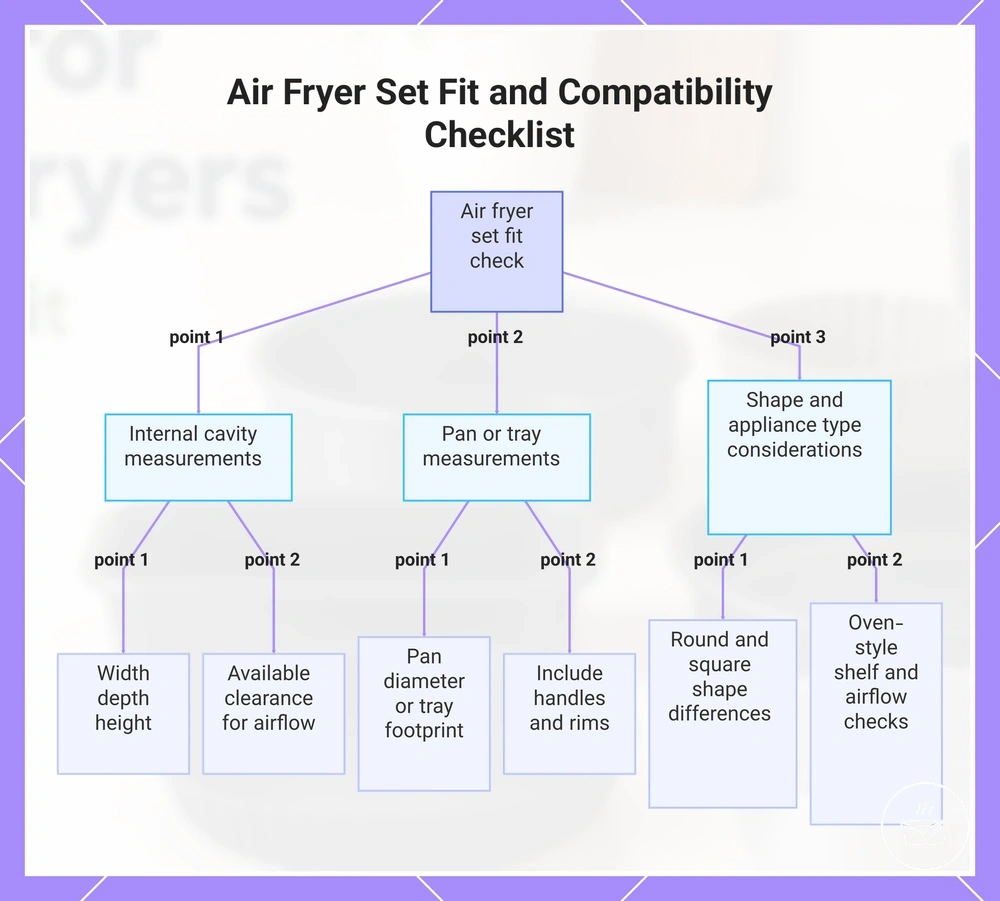
Basket clearance and usable pan diameter
Basket clearance and usable pan diameter determine whether a set piece can be inserted, removed, and used without crowding. The usable pan diameter is often smaller than an advertised or outer measurement because the internal diameter, rim, handles, corner shape, and height can reduce the available space. Measure the inner space before deciding whether a pan will fit.
Use this mini-checklist to organize internal diameter, corner shape, handle clearance, and height:
- Measure the internal diameter or usable width of the basket or drawer.
- Include any added handle width when comparing the usable pan diameter.
- Check the rim and overall height against the available basket clearance.
- Allow a small clearance gap for airflow and easier handling.
- Consider how the corner shape affects insertion and removal.
A pan may match the usable width but still become difficult to insert or remove if the rim, handles, or height reduce the available space. Basket clearance, corner shape, and handle clearance all influence the final fit outcome, so confirm these measurements before choosing a set piece.
This chart shows the key measurements and clearance factors to check when determining whether a pan will fit in a basket or drawer.
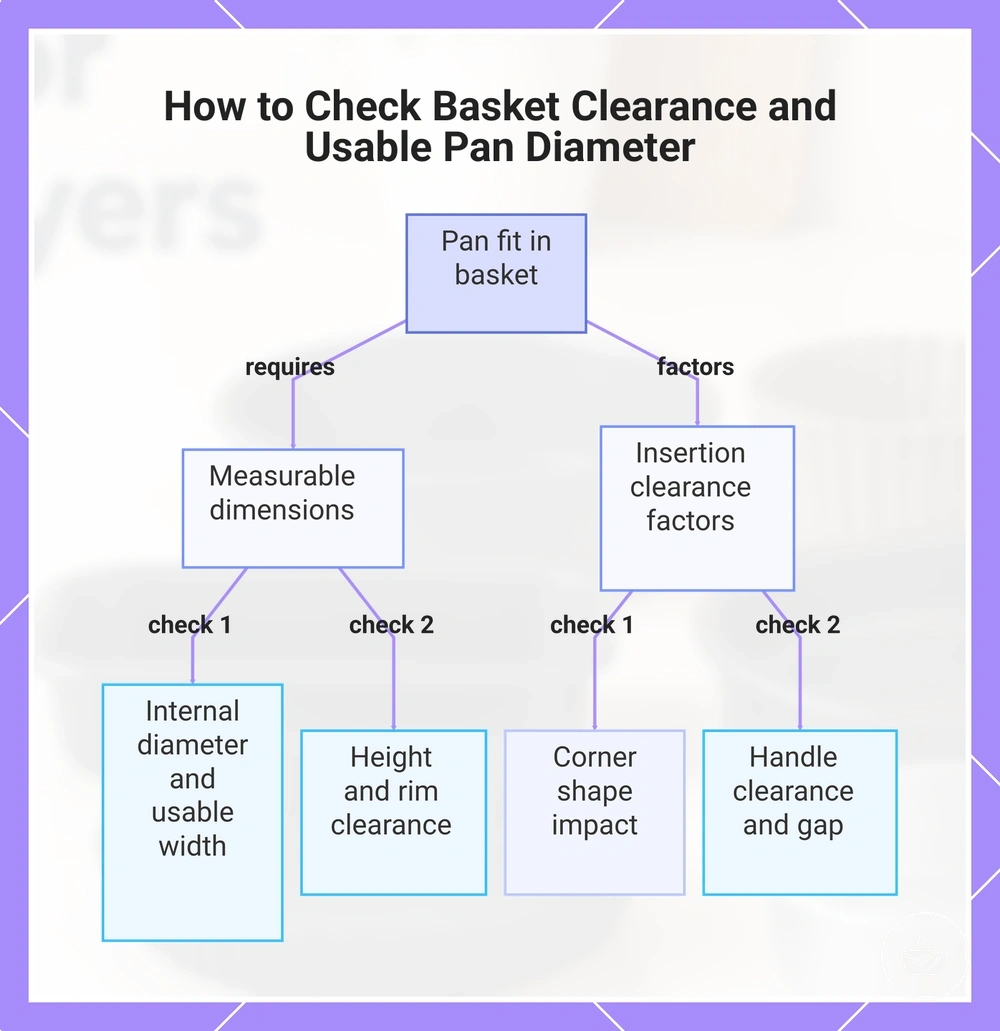
Drawer, basket, and oven-style set differences
A drawer air fryer, basket air fryer, and oven-style air fryer change which bakeware set pieces are practical because each format uses a different cavity shape, shelf position, and airflow path. The same set can suit one appliance format but become less convenient in another when usable space or layout changes. Compare the set with your appliance format before deciding which pieces are likely to be useful.
| Air fryer format | Pieces that tend to work | Compatibility caution |
|---|---|---|
| Drawer air fryer | Pieces with a pan footprint that suits the square cavity and available clearance. | Cavity shape, corners, and handles may reduce usable space. |
| Basket air fryer | Round pans and accessories sized for a compact basket. | Handles and the airflow path can affect fit in limited space. |
| Oven-style air fryer | Rack-and-tray set pieces that suit the shelf position and cooking layout. | Height, tray position, and airflow path may change usable space. |
Drawer air fryers usually suit pieces that match the cavity shape, while a basket air fryer often works better with compact basket accessories that leave room around the airflow path. An oven-style air fryer may accommodate a rack-and-tray set more easily when the shelf position and available height are suitable. The final fit still depends on the dimensions and layout of the individual appliance.
Materials and coatings inside bakeware sets
Materials and coatings affect heat transfer, food release, cleaning, browning, and durability, so they play a major role in how a bakeware set performs over time. The same pan shape can behave differently when the material type, surface, or coating changes. The table below compares common material trade-offs to help evaluate a set by its overall balance rather than a single feature.
Nonstick metal uses a coated surface that may improve release and simplify cleaning, although coating wear can depend on thickness, quality, and care. Stainless steel is an uncoated material that is often chosen for durability, but food may release less easily without suitable preparation. Silicone is a flexible mold material that can make release easier, while heat transfer and browning may vary with thickness and design. These material differences provide the framework for the comparison below.
| Material or coating | Useful attribute | Trade-off | Selection implication |
|---|---|---|---|
| Nonstick metal | Good release and easier cleaning | Coatings may show wear or scratch over time depending on care | Suitable when easy release is important and the coating is maintained carefully |
| Stainless steel | Durability and uncoated surface | Food may stick more without suitable oiling or preparation | Suitable when durability is preferred over easier release |
| Silicone | Flexible mold with easier release | Heat transfer and browning can vary with thickness and design | Useful for recipes that benefit from flexible molds and simple removal |
Coating condition, cleaning methods, and everyday care can all influence wear, so avoid assuming that every bakeware set made from the same material performs identically. Manufacturer guidance, coating quality, and material thickness may change heat behavior and long-term durability. Choose the material and coating combination that best matches your baking routine instead of expecting one option to suit every recipe.
Nonstick metal and stainless steel pieces
Nonstick metal and stainless steel pieces suit different baking priorities within a bakeware set. Nonstick metal can make food release and cleaning easier, while stainless steel is often chosen for durability and may support more pronounced browning depending on the pan and recipe. The trade-off depends on coating condition, maintenance, and the baking results you want to achieve.
Compare these practical trade-offs before choosing between metal pieces:
- Heat transfer and browning: Metal pans can promote browning, although results may vary with pan thickness, construction, and recipe.
- Release: Nonstick metal may reduce sticking, while stainless steel may benefit from suitable oiling or preparation to improve release.
- Durability: Stainless steel is often selected for durability, whereas a nonstick coating may develop wear or scratch risk depending on care and utensil use.
- Cleaning: Nonstick metal may be easier to clean while the coating remains in good condition, whereas stainless steel may require more effort if food sticks.
- Care: Following the manufacturer's care guidance can help reduce coating wear and maintain long-term performance.
Select nonstick metal when easier release and simpler cleaning are the main priorities, or choose stainless steel when durability is more important. Neither material is universally better because sticking, browning, scratch risk, and long-term performance all depend on use, care, and the condition of the bakeware piece.
This chart compares the key advantages and drawbacks of nonstick metal and stainless steel bakeware pieces to help you decide which material suits your baking priorities.
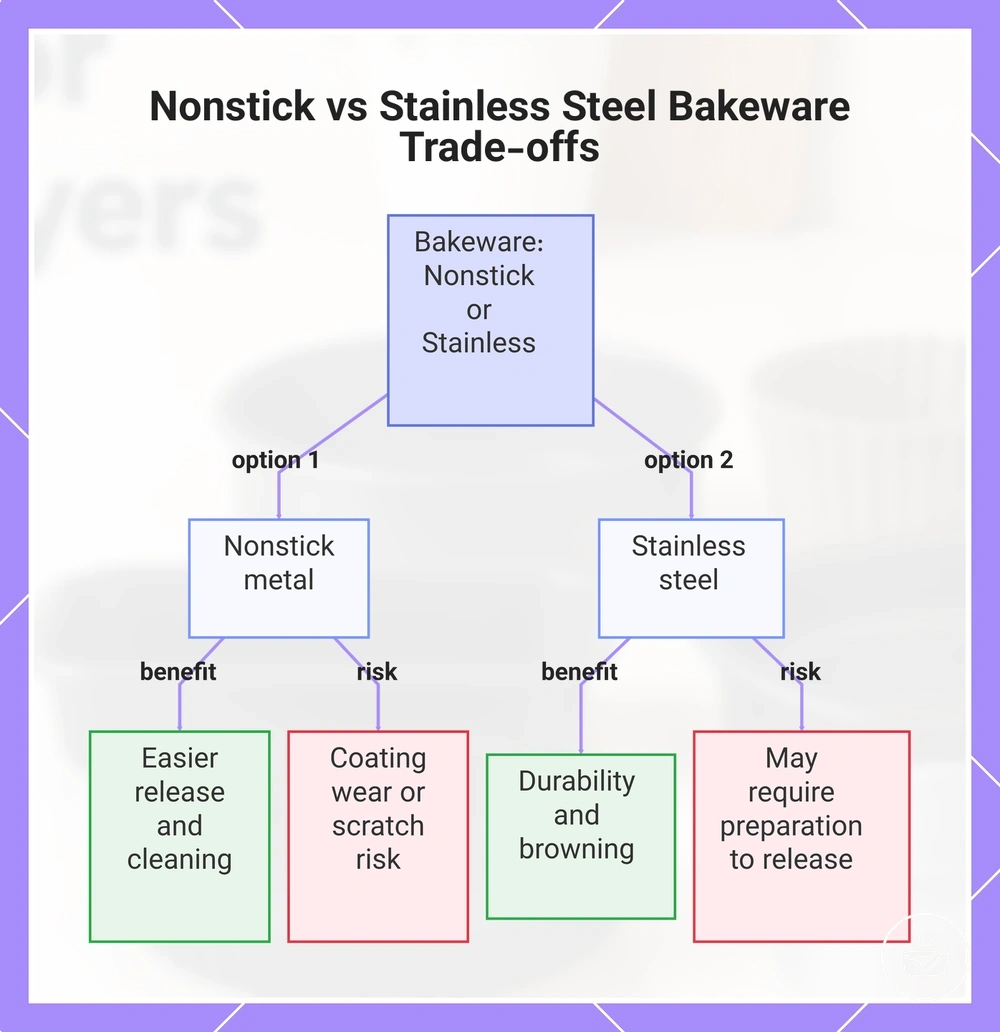
Food-grade silicone cups and flexible molds
Food-grade silicone cups and flexible molds can add value when easy release, flexible handling, and portioned baking are the main priorities. Their baking performance depends on an appropriate heat rating, silicone thickness, stability, and the shape of the mold rather than the material alone. They work best when the silicone piece matches both the intended food and the available space in the air fryer.
Use this checklist to confirm that food-grade silicone cups and flexible molds suit the baking task:
- Check that the food-grade silicone product has an appropriate heat rating for the intended use.
- Choose a silicone thickness that provides enough stability for the batter or food being baked.
- Confirm the flexible mold sits securely so it remains stable during handling and cooking.
- Make sure the silicone cups or flexible molds fit the basket without reducing airflow or becoming crowded.
- Match the mold shape to the intended food because flexibility, thickness, and shape can influence release, browning, and cleaning.
Flexible molds often make food release and cleaning easier, but browning and stability may vary with the heat rating, silicone thickness, fill level, and recipe. Selecting a food-grade silicone piece that fits both the air fryer and the intended food can help produce more consistent baking results without assuming silicone performs better than metal in every situation.
Safety and airflow checks for set pieces
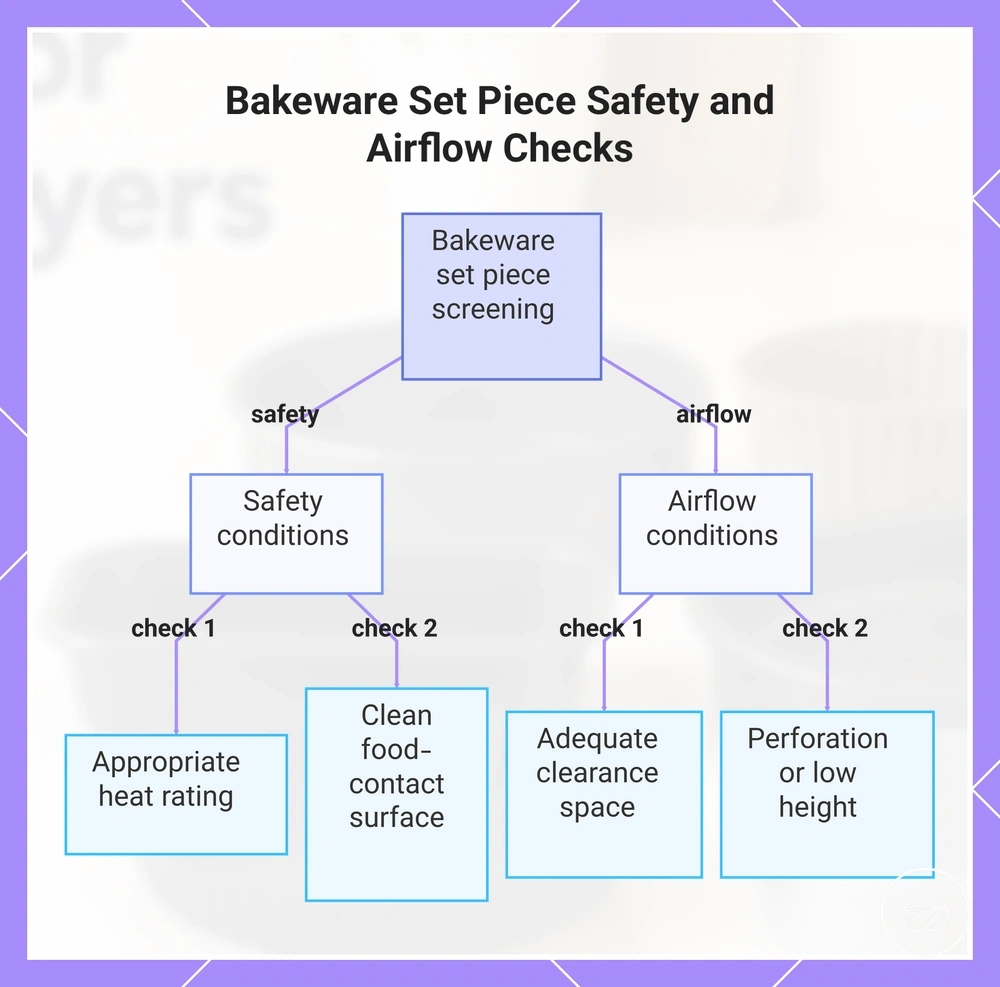
Safe use of bakeware set pieces depends on checking the heat rating, food-contact surface, clearance, and airflow before cooking. A set piece may be heat-safe but still reduce cooking performance if its size, height, or solid area restricts air circulation. Screening these conditions together provides a practical way to assess both safety and everyday use.
Large solid surfaces, excessive height, or limited clearance can reduce airflow and may affect browning or cooking consistency even when the piece is suitable for food contact. Perforation and adequate airflow space can help maintain circulation when the accessory fits the appliance correctly. Use the checklist below to screen each set piece before use.
- Confirm the piece has an appropriate heat rating for the intended cooking conditions.
- Check that the food-contact surface and any coating are clean and in good condition.
- Leave enough clearance around the set piece to preserve airflow space.
- Consider whether perforation or a large solid area will influence air circulation.
- Check that handles and the overall height do not interfere with basket clearance or airflow.
- Select the piece only if it supports practical use without unnecessarily restricting circulation.
A heat-rated accessory may still be impractical if it covers most of the cooking surface or limits airflow because of its height or solid design. By contrast, a heat-rated piece with adequate perforation and clearance may better preserve circulation when it fits the appliance. Treat heat-safe labeling and practical airflow as separate screening checks before regular use.
This chart shows the two main screening categories for safe and effective use of bakeware set pieces.
Heat-safe containers and food-contact claims
Heat-safe containers and food-contact claims should be verified rather than assumed. Check the stated temperature rating, material disclosure, food-contact information, and manufacturer guidance before using a container in an air fryer. Acceptable use depends on clear product information, the coating condition, and the intended cooking context.
The checklist below helps organize temperature rating, material disclosure, coating condition, and manufacturer-use context before deciding whether a set piece is suitable:
- Confirm the container has a stated temperature rating or is identified as heat-safe for the intended use.
- Check the food-contact statement and material disclosure to understand the intended contact surface and use.
- Inspect the coating condition for signs of wear or damage before cooking.
- Compare the manufacturer guidance with the appliance and cooking method instead of assuming every heat-rated or oven-safe container is appropriate.
When label details are incomplete, the coating condition is uncertain, or manufacturer guidance does not clearly match the appliance, treat the claim with caution. A stated heat-safe rating can support acceptable use only when the container condition and intended cooking context also align with the product information.
Solid trays and pieces that can block airflow
A solid tray can fit inside an air fryer while still restricting airflow if its footprint, height, or design leaves too little clearance for air circulation. Physical fit and airflow performance are separate checks because a tray insert that fits the basket may still influence browning or the overall cooking outcome. Use the checklist below to evaluate clearance around and under the piece before judging cooking performance.
The checklist below helps assess whether a solid tray or solid pan is likely to preserve airflow:
- Check that there is enough side clearance between the tray footprint and the basket walls.
- Confirm there is enough under-clearance for air circulation beneath the tray insert.
- Consider how much of the basket is covered by the solid surface.
- Look for perforation where appropriate, as it may help maintain air circulation compared with a fully solid surface.
- Check whether food coverage leaves enough spacing for airflow around the tray.
A large footprint, excessive height, limited perforation, or restricted spacing can reduce airflow even when the tray fits physically inside the basket. Depending on the appliance design and food load, reduced air circulation may influence browning or the cooking outcome, so assess both physical fit and airflow clearance before using a solid tray.
When a bakeware set is worth buying
A bakeware set is worth buying when most of its usable pieces fit your air fryer, match your baking frequency, and provide suitable material quality for the recipes you prepare. The overall value depends on usable pieces, fit match, material quality, and expected use rather than price alone. Compare these criteria together before deciding whether a set offers practical value.
If you bake frequently or a household prepares a range of recipes, a set with multiple usable pieces may provide better long-term value than selecting individual accessories one at a time. The decision table below compares common situations using fit match, material quality, duplicates, usable pieces, and baking frequency.
| Situation | Value signal | Caution |
|---|---|---|
| Frequent baking | More usable pieces can increase practical value. | Check material quality because durability and price variability may differ. |
| Mixed household use | A broader selection of usable pieces can suit different recipe needs. | Duplicates may reduce bundle value. |
| Small air fryer | A compact set with a good fit match may be more practical. | Larger pieces may remain unused if they do not fit. |
| Narrow recipe need | Single pieces may provide better value for limited use. | A full set can include low-use accessories. |
Unusable pieces and duplicates can reduce bundle value even when a set includes many accessories. A poor fit match may leave part of the set unused, while differences in material quality and price variability make direct value comparisons less certain. Consider how many pieces you will actually use before choosing a bundle.
Value is often lower when you bake infrequently, use only a few recipes, or need only one or two accessories. In these situations, single pieces may provide a closer match to your needs. If you want to compare complete sets with individual accessories, see best air fryer bakeware for additional guidance.
Here are product examples that may make comparison easier. Before buying, always review the compatibility criteria, essential features, and product details.
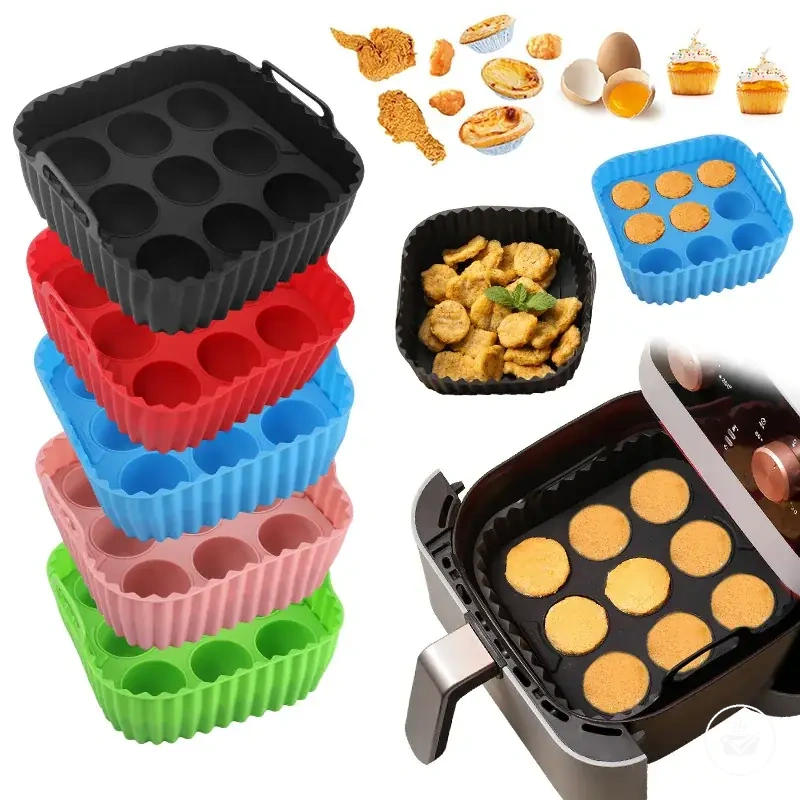
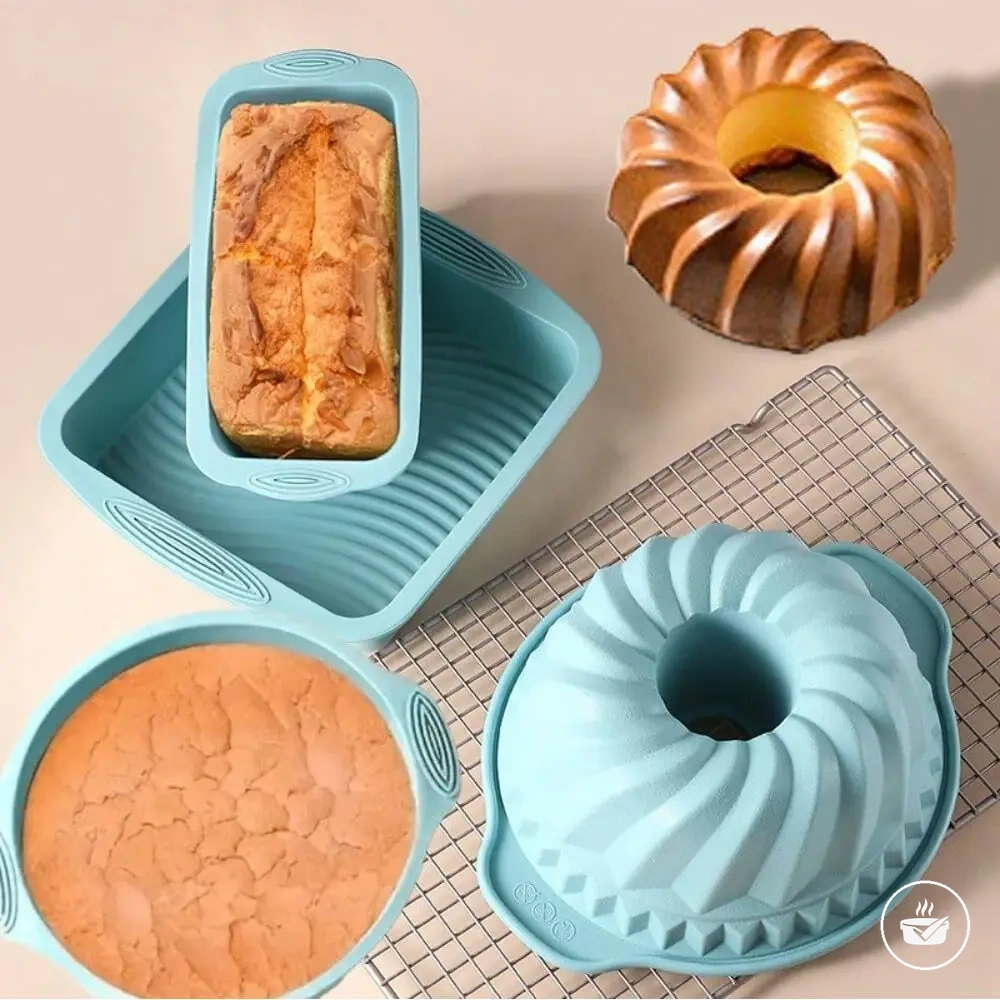
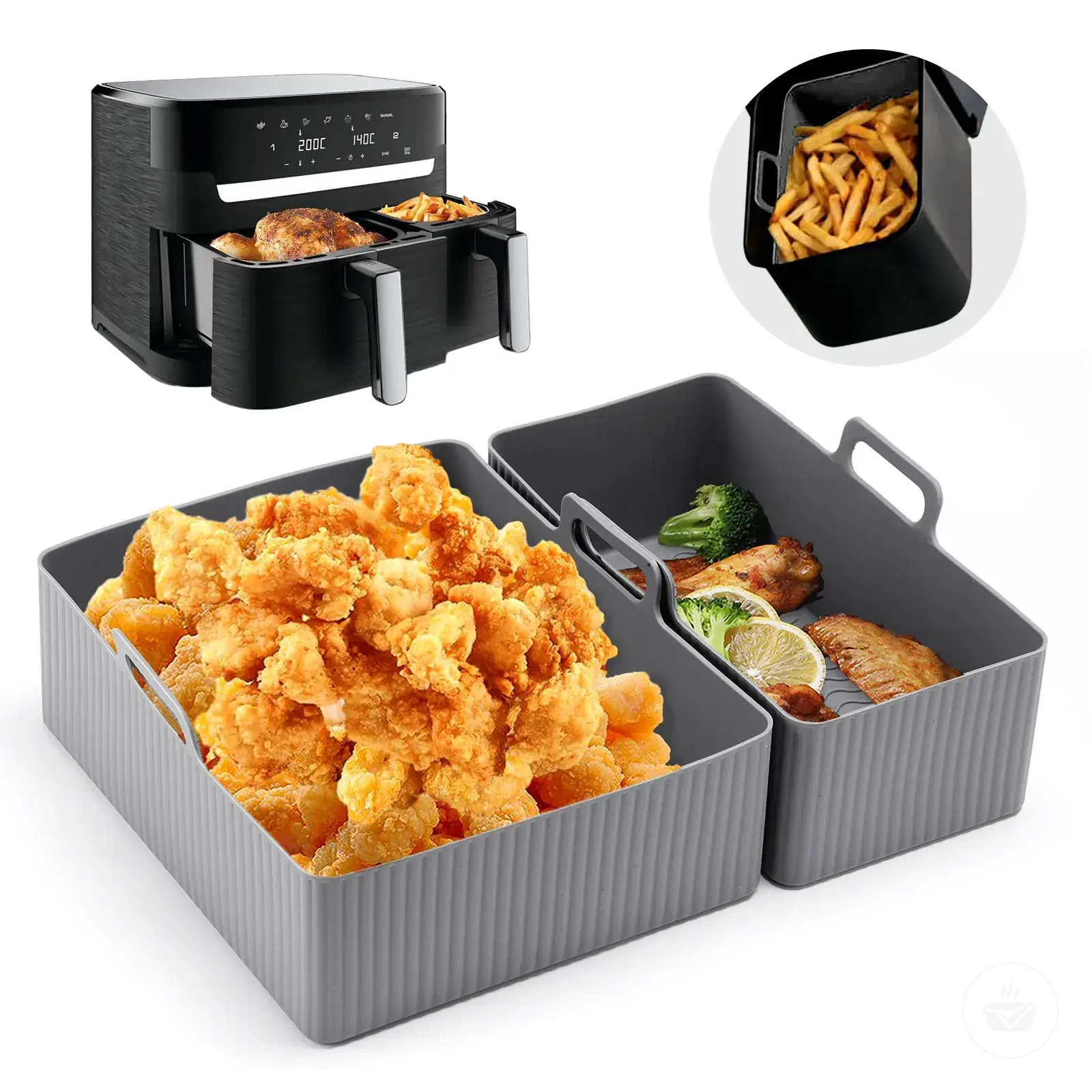
Piece count versus usable pieces
Piece count can overstate value when many items in a set are small, duplicate, or rarely used. A larger bundle is not automatically more useful if only a few pieces fit your air fryer and match your baking frequency. Judge the set by usable pieces, not item count alone.
Use this mini-checklist to separate essential, occasional, duplicate, low-use, and poor-fit pieces:
- Essential pieces: Keep pieces that match regular recipes and have a strong fit match.
- Occasional pieces: Count them as useful only when your baking frequency supports them.
- Duplicate pieces: Treat repeated items as lower value unless multiple portions are useful.
- Low-use pieces: Identify filler accessories that add count without adding much practical value.
- Poor-fit pieces: Ignore pieces that do not fit the basket, drawer, or storage space well.
Duplicate pieces and filler accessories can inflate the bundle count without improving everyday use. Separate essential pieces from occasional pieces, then decide which items you would keep, use rarely, or ignore.
When single pieces are a better choice
Single pieces are a more practical choice when you already know the exact pan, cup, or tray you need. If you have fit certainty and a clear material preference, an individual piece can provide better value than a full bakeware set that includes accessories you may not use. This approach is most suitable when your purchase is driven by a specific need.
The comparison below contrasts the two decision paths using fit certainty, material preference, use frequency, and storage needs.
| Choose a set when | Choose single pieces when |
|---|---|
| You prepare a wide variety of recipes regularly. | You need one specific pan, cup, or tray. |
| Your baking frequency supports multiple accessories. | You already have fit certainty for an individual piece. |
| You expect to use different piece types over time. | You have a clear material preference for a separate pan or accessory. |
| You have enough storage for a full bakeware set. | You want to avoid duplicates and store only the pieces you will use. |
If your recipe needs are limited, single pieces may provide better value than a full bakeware set. If your cooking habits or household needs change, that decision may also change. Broader product-quality comparisons belong outside this local set-value decision.
What to avoid in air fryer bakeware sets
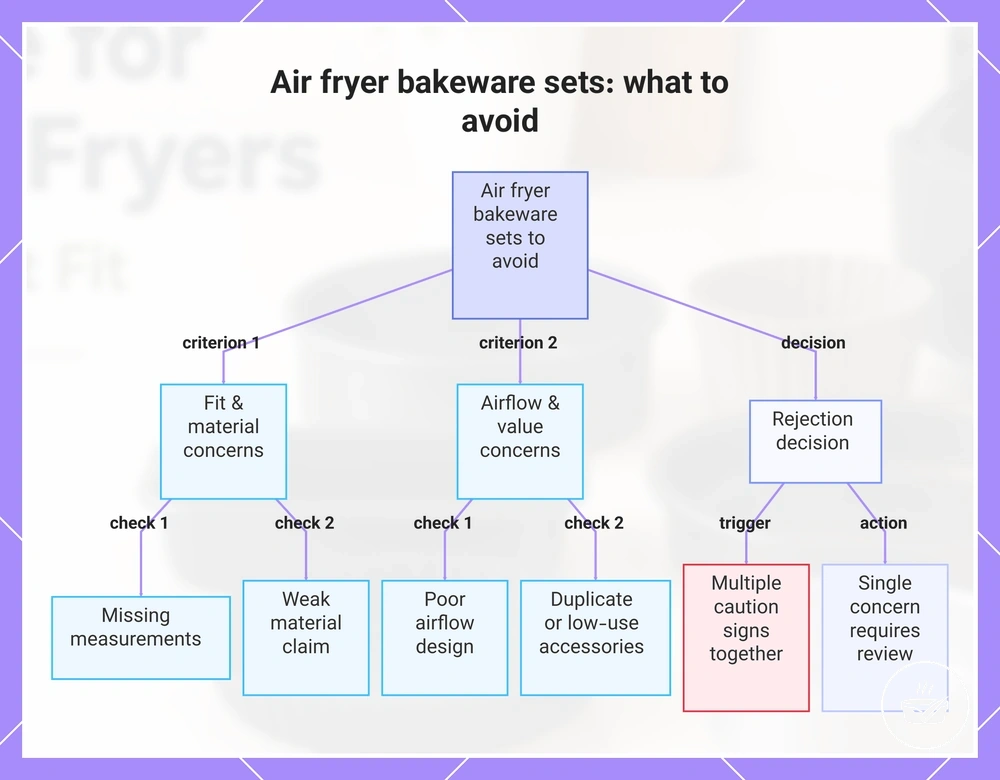
Avoid air fryer bakeware sets that leave important questions unanswered about fit, materials, airflow, or practical use. Missing measurements, a weak material claim, poor airflow design, a low-use accessory, or a duplicate piece can all justify closer review. Use the checklist below to organize fit, usefulness, airflow, material claims, and safe handling risks.
Poor fit can make a set harder to use, especially when measurements are missing or handling space is unclear. A weak material claim creates uncertainty when the heat rating or intended use is not stated, and poor airflow can affect cooking results when solid pieces crowd the basket. Use these checks as rejection criteria when the risk is not resolved by the product information.
- Skip sets with missing measurements when you cannot confirm fit or safe handling.
- Question a weak material claim if the heat rating or intended use is unclear.
- Check whether solid trays or oversized pieces may reduce airflow.
- Treat a duplicate piece as lower value unless it matches your routine.
- Look for low-use accessories that inflate the bundle without matching your recipes.
- Make a rejection decision when multiple caution signs appear together.
A bundle can look generous while still offering limited value if it contains duplicate pieces or accessories you are unlikely to use. Before deciding, compare the included items with your cooking needs and review how to choose air fryer bakeware using the same criteria. Keep the selection boundary focused on fit, usefulness, and practical value.
Avoid a set when missing measurements, unclear material information, poor airflow design, and low-use accessories create multiple caution signs together. A single concern may only require closer review, but several combined issues can support a rejection decision. Filter out weak sets using practical criteria instead of bundle size or marketing claims.
Here are product examples that may make comparison easier. Before buying, always review the compatibility criteria, essential features, and product details.
This chart shows the key criteria to evaluate air fryer bakeware sets and the decision rule for rejecting weak sets.
Poorly fitting pieces
Poorly fitting pieces reduce usefulness because they can create wasted value and make insertion, removal, and everyday handling less convenient. Handling and airflow consequences may also depend on basket shape, piece design, and available clearance. Use the checklist below to verify the measurements before deciding whether a piece is suitable.
Check these local fit-failure signals before choosing a piece:
- Compare the outside width with the available basket space.
- Include handle width when checking insertion and removal clearance.
- Check the depth against the available basket height.
- Measure the rim because it can increase the overall outside dimensions.
- Leave enough clearance for comfortable removal and to help reduce airflow consequences.
When the measurements, rim, handles, depth, and clearance match the available space, the piece is more likely to fit comfortably. If these conditions do not align, poor fit can reduce value and make insertion, removal, and handling less practical.
Low-use accessories that inflate the bundle
Low-use accessories can inflate the perceived value of a bakeware set without improving everyday baking decisions. An inflated bundle may appear more comprehensive, but its practical value depends on baking relevance, frequency of use, and whether the core pieces support your cooking routine. The grouped list below separates useful occasional tools from filler accessories.
Evaluate accessories by how often you expect to use them, the cleaning burden, the storage burden, and whether the core pieces already justify the set.
- Useful occasional tools: Accessories with clear baking relevance for specific recipes. If the frequency of use justifies the cleaning burden and storage burden, they are generally worth keeping.
- Low-use fillers: Filler accessories, extras, or add-ons that increase the size of an inflated bundle more than its everyday usefulness. If they add cleaning or storage burden without matching your baking habits, they are usually better treated as lower-value items.
- Ignore-unless-needed items: Rarely used pieces that may suit particular households but are not essential for every kitchen. If the core pieces, such as pans, cups, or racks, already justify the set, these accessories should not determine the purchase decision.
Keeping the focus on baking relevance, frequency of use, cleaning burden, storage burden, and the value of the core pieces helps create a fair keep-or-ignore decision. This approach filters filler accessories without assuming every extra has the same value for every household.