Air Fryer Bakeware Types and Baking Accessories
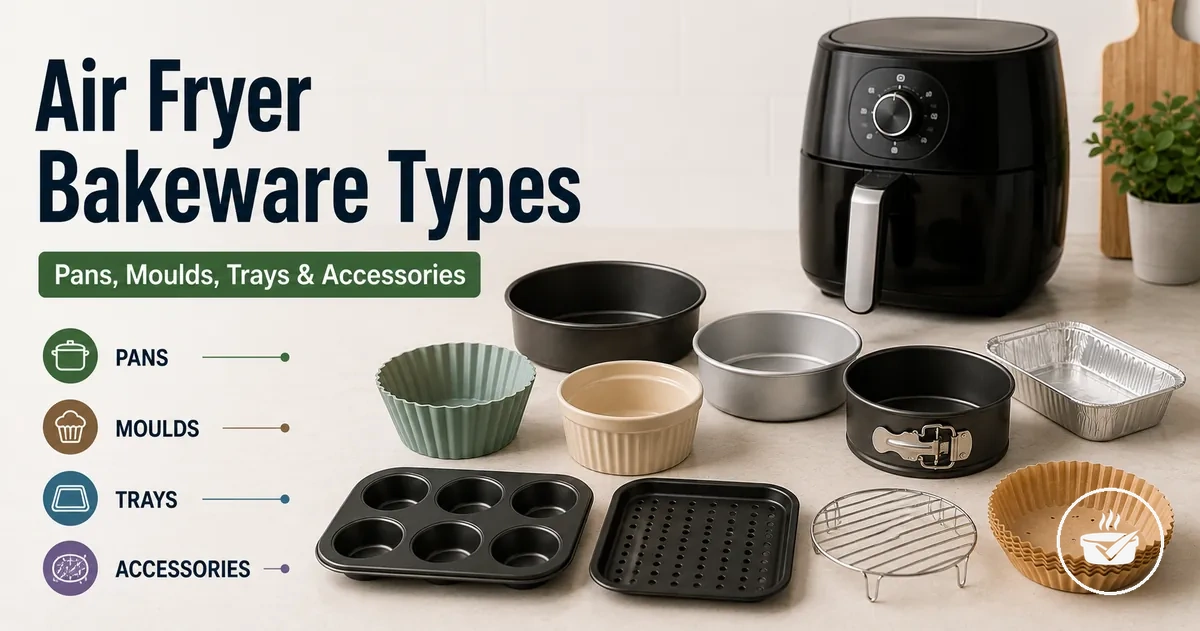
Air fryer bakeware is the group of heat-safe baking pieces designed to hold or shape food inside an air fryer, while baking accessories mainly support placement, lifting, or airflow during cooking. This page explains the broad categories so readers can understand how piece type, shape, depth, fit, and baking job influence suitability before comparing individual products. Air fryer bakeware pieces and baking accessories are separate but closely related groups.
People often compare a cake pan, cake barrel, muffin cups, loaf pan, baking tray, rack, mold, and complete sets because each piece serves a different baking purpose and may suit different basket layouts. A deeper baking pan may suit one recipe, while a rack may provide additional support or improve airflow depending on the appliance. Individual pieces and sets can also overlap in usefulness without serving exactly the same role. For broader category guidance, visit the air fryer bakeware hub.
Suitability depends on the piece type, fit, heat-safe construction, airflow, and the food being prepared. A baking mold or accessory piece may be suitable in one air fryer model but not another if its size or shape limits air circulation or differs from the manufacturer's guidance. Baking performance can vary with the appliance, recipe, and condition of the bakeware, so fit and heat tolerance should be considered before use.
When readers encounter terms such as cake barrel, muffin cups, loaf pan, baking tray, rack, or mold, the goal is to understand each category rather than every available product. Bakeware pieces, baking accessories, liners, and regular ovenware may appear similar, but they have different roles and should be distinguished before moving into the detailed definitions that follow.
What Counts as Air Fryer Bakeware and Baking Accessories
Air fryer bakeware and baking accessories are heat-tolerant pieces used inside an air fryer for containment, shaping, support, or airflow. Air fryer bakeware is the food-contact category that holds batter or other ingredients during baking, while baking accessories mainly support, lift, or position food. The distinction separates containment from support.
Air fryer bakeware includes baking pieces that directly contain or shape food, while baking accessories assist by providing support, elevation, or improved airflow around food. What Counts as Air Fryer Bakeware and Baking Accessories depends on whether the piece contains, shapes, supports, or lifts food. This function-based distinction helps classify each item before considering material, size, or model compatibility.
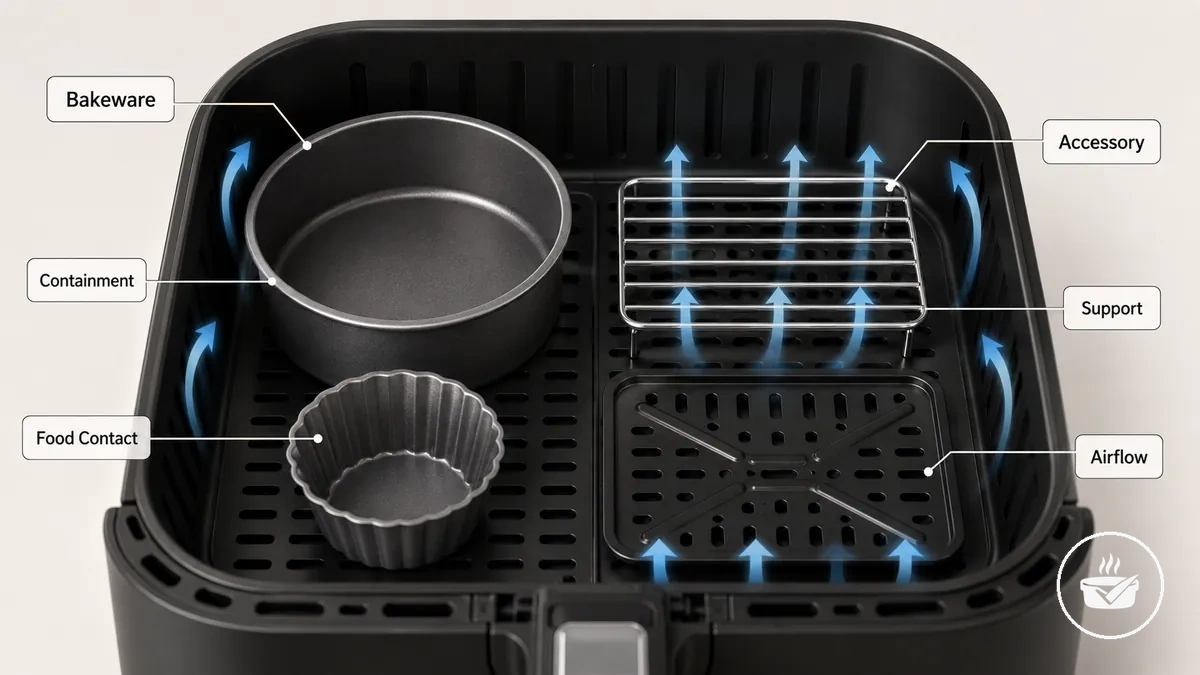
- Air fryer bakeware: Food-contact baking pieces used for containment or shaping, such as a cake barrel, baking dish, or muffin cup.
- Baking accessories: Support items such as a cooking rack or tray insert that elevate food or encourage airflow.
- Classification: Whether a piece is bakeware or an accessory depends on its primary function.
A cake barrel is bakeware because it contains batter during baking, while a rack is an accessory because it elevates food and supports airflow. A baking piece may only be suitable when its fit matches the air fryer basket and its material rating aligns with manufacturer guidance. Liners and regular ovenware are related categories but remain outside this function-based definition.
A common misconception is that any oven-safe piece belongs in every air fryer. Heat tolerance, fit, basket size, material rating, and manufacturer guidance may all influence whether a baking piece or accessory is appropriate for a particular model. For broader compatibility guidance, see what bakeware works in an air fryer.
Core Air Fryer Bakeware Pieces
Core air fryer bakeware pieces are grouped by function rather than brand, helping users choose the right piece for shaping, containing, or exposing food to hot air. The main differences relate to shape, depth, surface exposure, and food-contact function rather than product names. Together, these core pieces support containment, portioning, and surface exposure.
Core Air Fryer Bakeware Pieces are easier to compare when grouped by their visible form and intended baking role. The table below organizes each piece type by its main attribute, likely food use, and a fit or airflow consideration that may vary with the basket, food, or air fryer model.
| Piece type | Main attribute | Best-fit baking job | Fit or airflow caution |
|---|---|---|---|
| Cake pan / cake barrel | Deep containment for batter | Cakes and similar baked mixtures | Depth and basket clearance may influence airflow |
| Muffin cups / mold | Individual portion format | Small baked portions | Fill level and spacing may affect air circulation |
| Loaf pan | Long, narrow containment | Loaf-style baking | Fit depends on basket dimensions and clearance |
| Baking sheet / pizza pan | Wide, shallow surface exposure | Foods that benefit from an exposed top surface | Large coverage may reduce airflow if clearance is limited |
| Baking dish | General food containment | Baked dishes and similar recipes | Suitability depends on basket fit and manufacturer guidance |
Core Air Fryer Bakeware Pieces are being compared by visible form and function before examining each family in more detail.
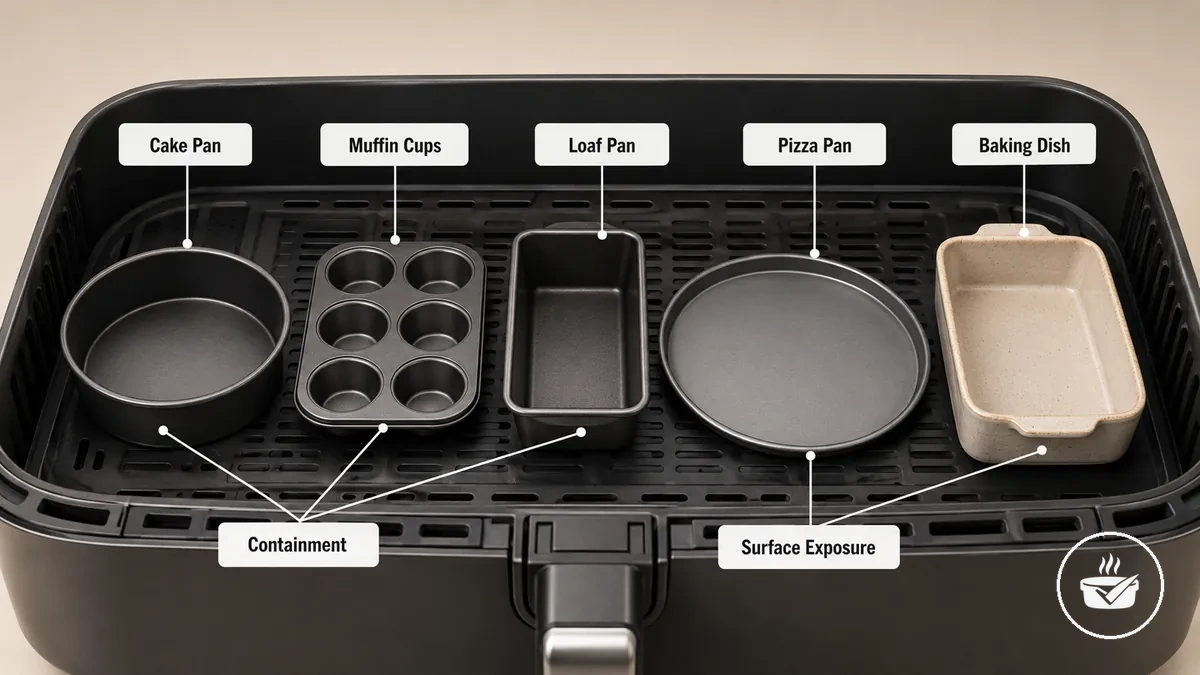
Each row links a piece type to its primary attribute, likely food use, and a practical consideration for fit or airflow instead of ranking products. Browning, containment, and food removal may vary with the baking piece, basket clearance, and air fryer model. The following H3 sections examine each core piece family individually without repeating the full comparison.
Cake Pans, Cake Barrels, and Baking Dishes
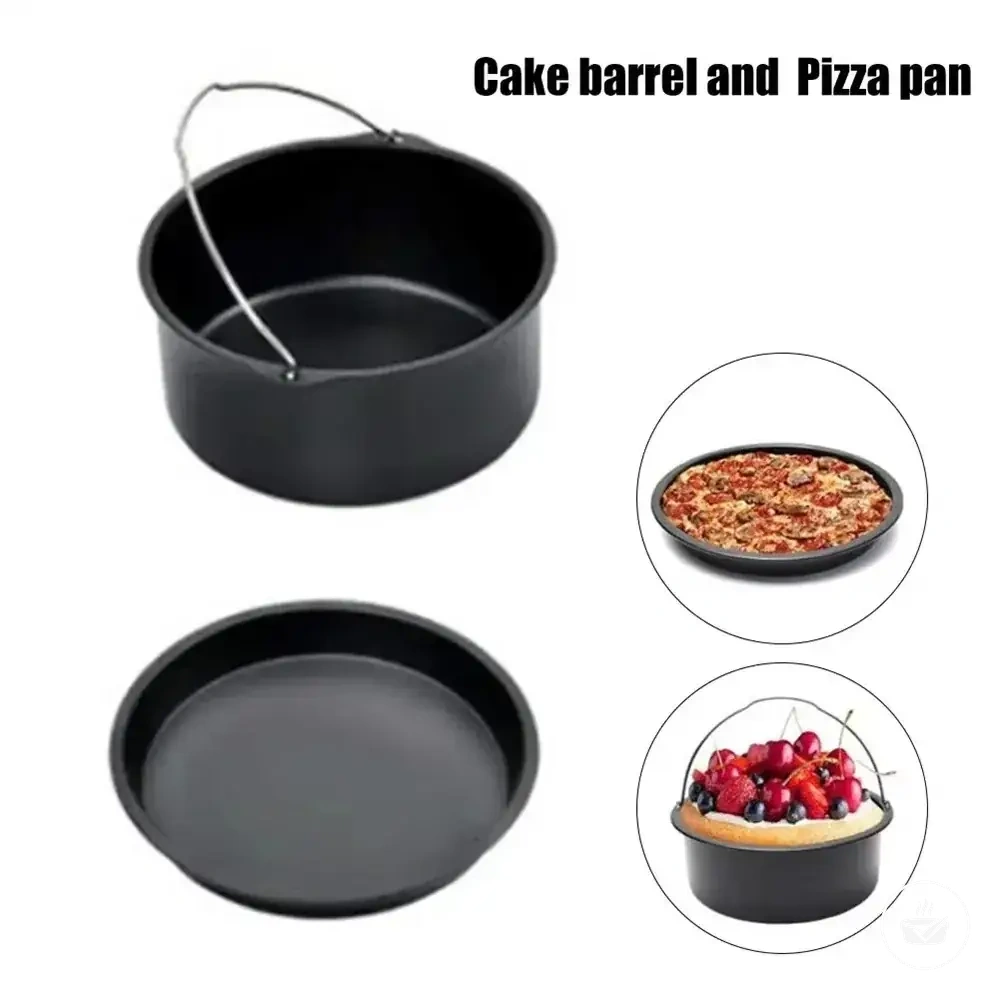
Cake pans, cake barrels, and baking dishes are deeper bakeware pieces that hold batter or other moist mixtures during air fryer baking. Their depth, wall height, and shape support containment while allowing room for the mixture during baking, although results may vary with the recipe and appliance. Taller wall height mainly helps improve batter containment.
Cake Pans, Cake Barrels, and Baking Dishes are labeled below by depth, sidewall, and containment to highlight their main functional differences before comparing local attributes.
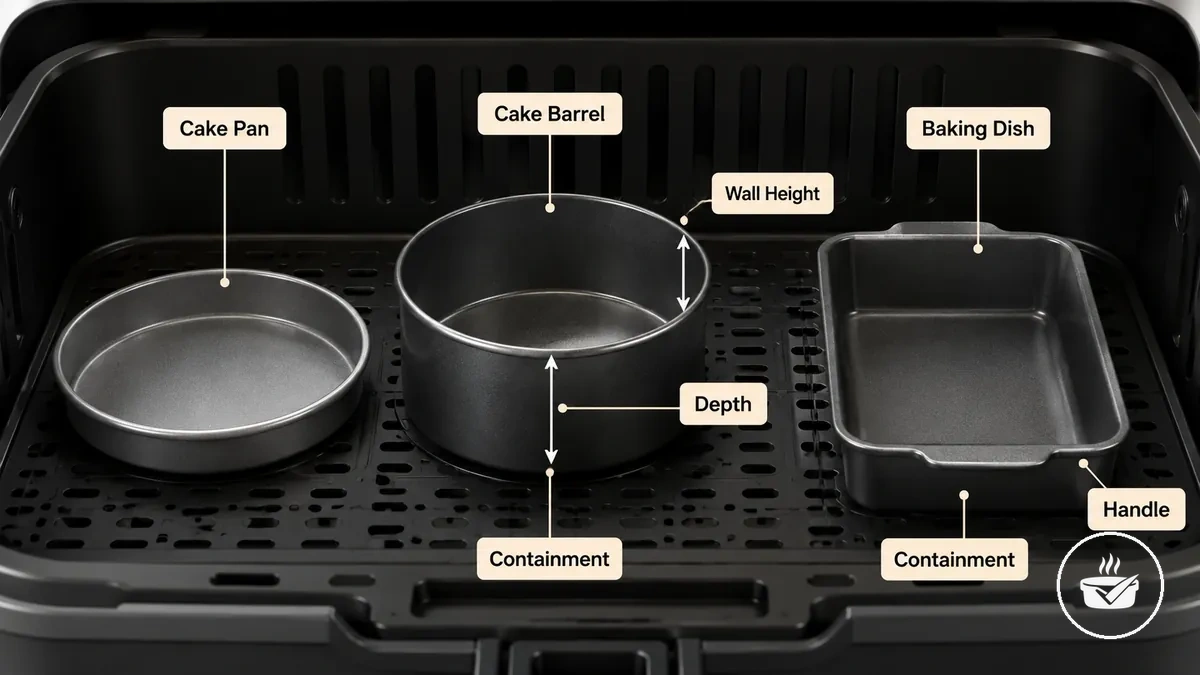
- Depth: A cake barrel is generally deeper than a shallow cake pan, which can provide greater containment for taller batters when basket clearance allows.
- Wall shape: Wall height and sidewall shape influence containment, while shallower forms typically provide more surface exposure.
- Removal feature: A handle or lip on a cake barrel or baking dish may make lifting and removal easier after baking.
- Fit: Fit depends on basket dimensions and available clearance, so deeper pieces should leave enough space for airflow.
When baking cakes, brownies, casseroles, or other moist bakes, these contained forms help keep the mixture in place throughout baking. A baking dish may suit recipes served from the same dish, while a cake pan or cake barrel can make release more convenient depending on the surface finish and recipe. Browning, release, and overall fit may vary with the batter, pan shape, surface, and air fryer model.
Muffin Cups, Cupcake Molds, and Small Baking Molds
Muffin cups, cupcake molds, and small baking molds divide batter or egg mixtures into individual portions for air fryer baking. Their cavity size, fill level, and stability help define the shape of each portion, while proper support reduces the chance of cups shifting during baking. Stability and fill level are important because smaller cups can move more easily when they are lightly supported or overfilled.
Muffin Cups, Cupcake Molds, and Small Baking Molds are shown below by cavity, fill level, and spacing to clarify how portion size and basket layout affect individual portions.
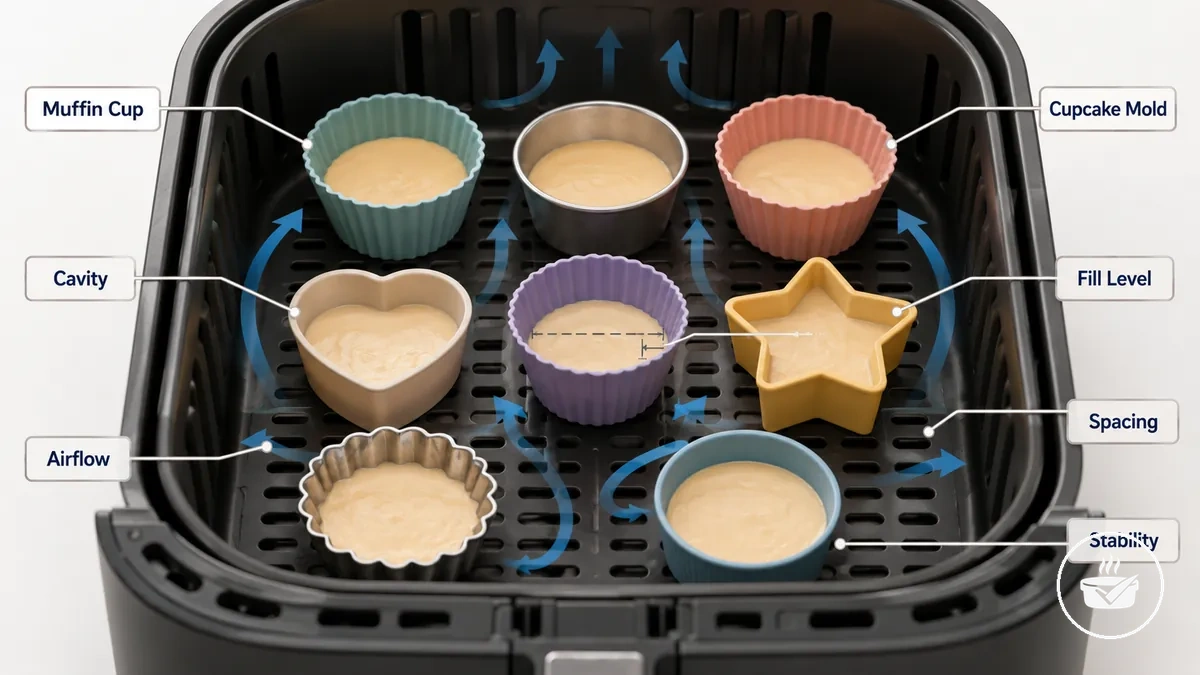
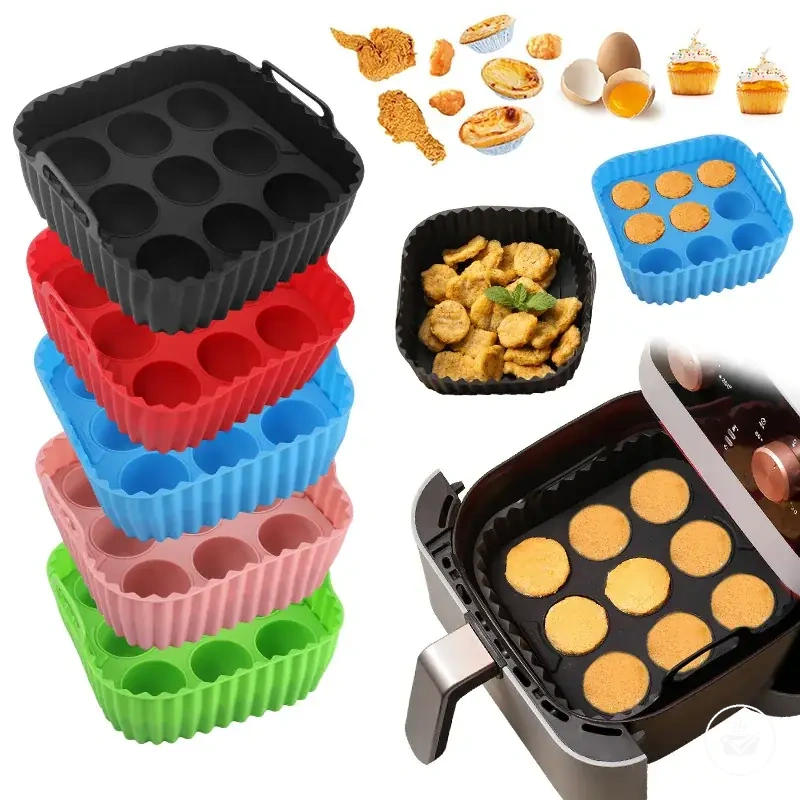
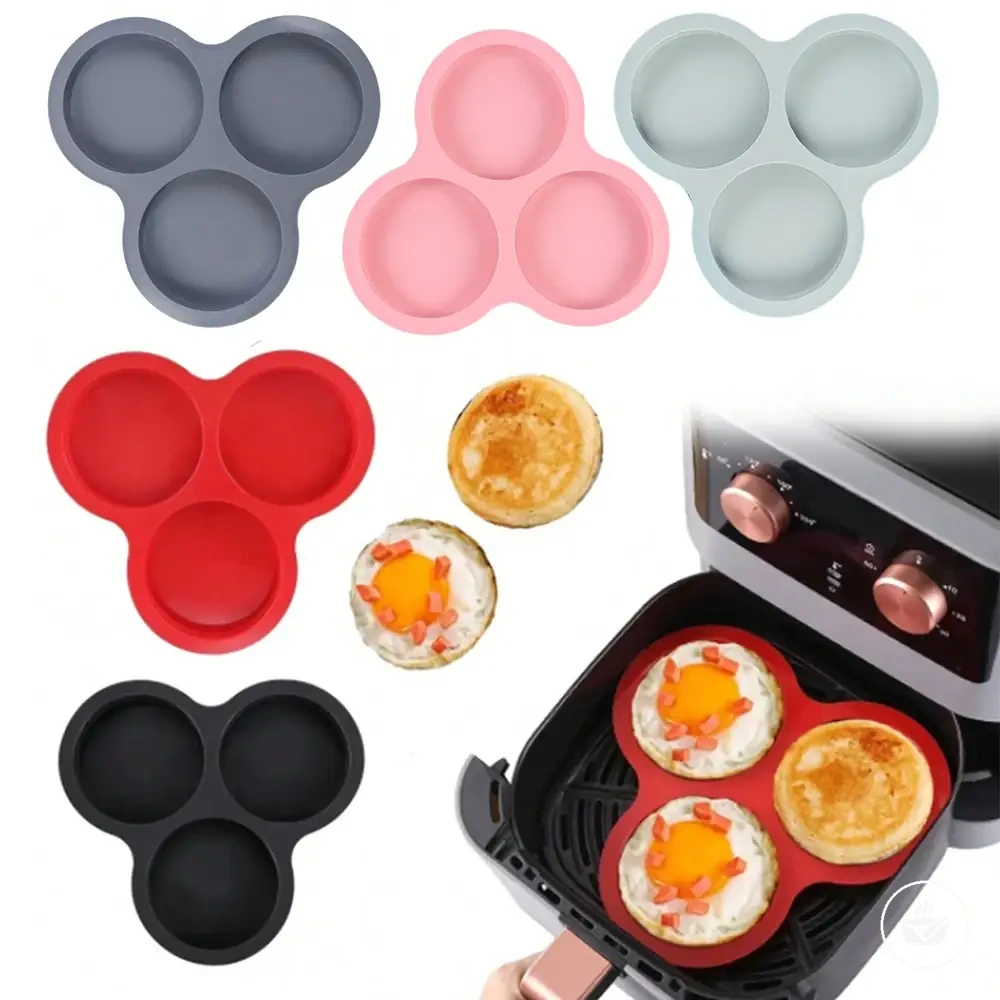
These portion molds are commonly used for muffins, cupcakes, egg bites, and other small bakes that benefit from separate servings. Silicone cups are one example of reusable portion molds, but their suitability may depend on heat rating, thickness, basket fit, and manufacturer guidance. Release, stability, and airflow can also vary when cups are crowded together or when the mold does not suit the air fryer model.
The following attributes help distinguish portion molds:
- Cavity size: The cavity determines portion size and influences how much batter or egg mixture each cup can hold.
- Fill level: Leaving space above the mixture may help reduce overflow as the contents expand during baking.
- Cup stability: Stable cups are generally less likely to shift than flexible or lightly supported cups during cooking.
- Reusable or disposable: Reusable silicone cups and disposable baking cases can differ in support and release behavior.
- Airflow spacing: Spacing small baking molds apart may help maintain airflow around each portion when basket space permits.
Loaf Pans and Bread Tins
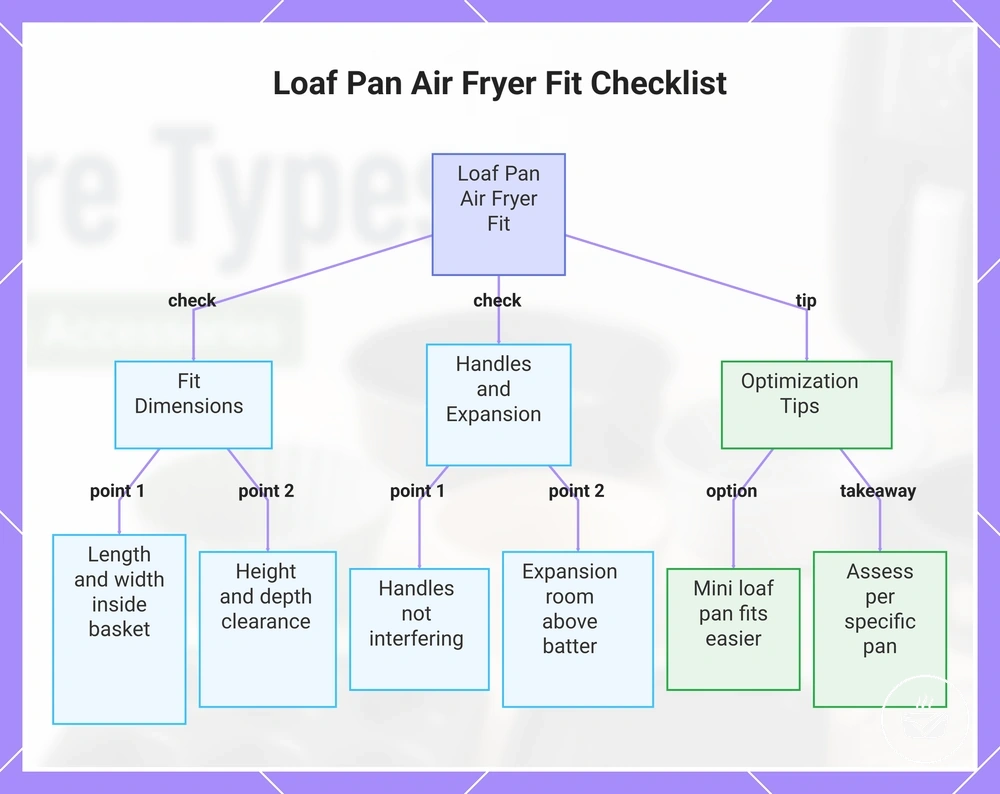
Loaf pans and bread tins work well in an air fryer only when they have compact dimensions, stable walls, sufficient basket clearance, and enough vertical clearance above the batter or dough. A loaf pan that fits in length and width may still be unsuitable if its depth or handle reduces the available space inside the basket. Adequate vertical clearance helps allow room for dough expansion during baking.
Check these points before using a loaf pan or bread tin in an air fryer:
- Length and width: The loaf pan should fit inside the basket without pressing against the sides.
- Height and depth: Leave enough vertical clearance for batter or dough expansion while baking.
- Handle clearance: Handles or raised edges should not interfere with the basket shape or make removal more difficult.
- Mini loaf option: A mini loaf, mini bread pan, or small loaf mold may fit more easily than a regular oven loaf pan.
- Expansion room: Allow space above the mixture because rise can vary with dough type, pan material, and air fryer power.
Mini loaf pans are commonly chosen for banana bread, meatloaf, and other dense batters when a compact baking format is preferred. A bread tin with compact dimensions may be easier to position and remove than a regular oven loaf pan, but baking results can still depend on pan depth, basket clearance, dough expansion, material, and air fryer power. Fit and baking performance should therefore be assessed for the specific pan and appliance rather than assumed from the pan style alone.
This chart lists the essential fit checks and baking considerations for using a loaf pan or bread tin in an air fryer.
Flat Trays, Baking Sheets, and Pizza Pans
Flat trays, baking sheets, and pizza pans are shallow bakeware pieces that increase surface exposure instead of providing deep containment. Their shallow design can promote more direct browning, while rim height and perforation influence food support, removal, and handling. Rim height and perforation are key differences when comparing these formats.
Flat bakeware differs by rim height, perforation, diameter, and surface area:
| Format | What it changes |
|---|---|
| Rimmed tray | A raised rim may help contain food or drippings but provides a slightly higher edge around the cooking surface. |
| Rimless tray | A low-profile edge can make food removal easier but offers less spill control. |
| Perforated pizza pan | A perforated surface may allow more airflow beneath food, while crumbs can pass through the openings and cleanup may differ. |
| Solid flat pan | A solid surface fully supports food and catches drips, although browning characteristics may differ from a perforated design. |
Pizza-style bakes, cookies, crisping, and reheating often use a flat tray, baking sheet, or pizza pan when broad surface exposure is preferred over deeper walls. Browning and food removal can vary with rim height, perforation, food type, and surface design. Basket width, drawer shape, pan diameter, and clearance should all be checked before assuming a shallow tray or pizza pan is suitable for a particular air fryer.
Racks, Crisper Trays, and Insert Accessories
Racks, crisper trays, and insert accessories elevate or separate food instead of containing batter. These accessories differ by elevation, perforation, stacking ability, and contact surface, which influence how food is supported during cooking. Their primary purpose is support and separation rather than containment.
Racks, Crisper Trays, and Insert Accessories can be compared by their functional role before selecting a suitable accessory:
| Accessory | Function | Useful when | Main caution |
|---|---|---|---|
| Rack | Provides elevation with a reduced contact surface | Separating food from the basket base or creating extra height | Fit depends on basket height, stability, and clearance |
| Crisper tray | Uses a perforated surface to support food | Foods that may benefit from greater surface exposure | Crumbs may collect in the perforations, increasing the cleaning burden |
| Mesh tray | Supports food across an open contact surface | Smaller foods that need even support | Mesh openings may retain residue after cooking |
| Stackable insert | Adds another cooking level through stacking | When basket height allows layered cooking | Overcrowding may reduce airflow between layers |
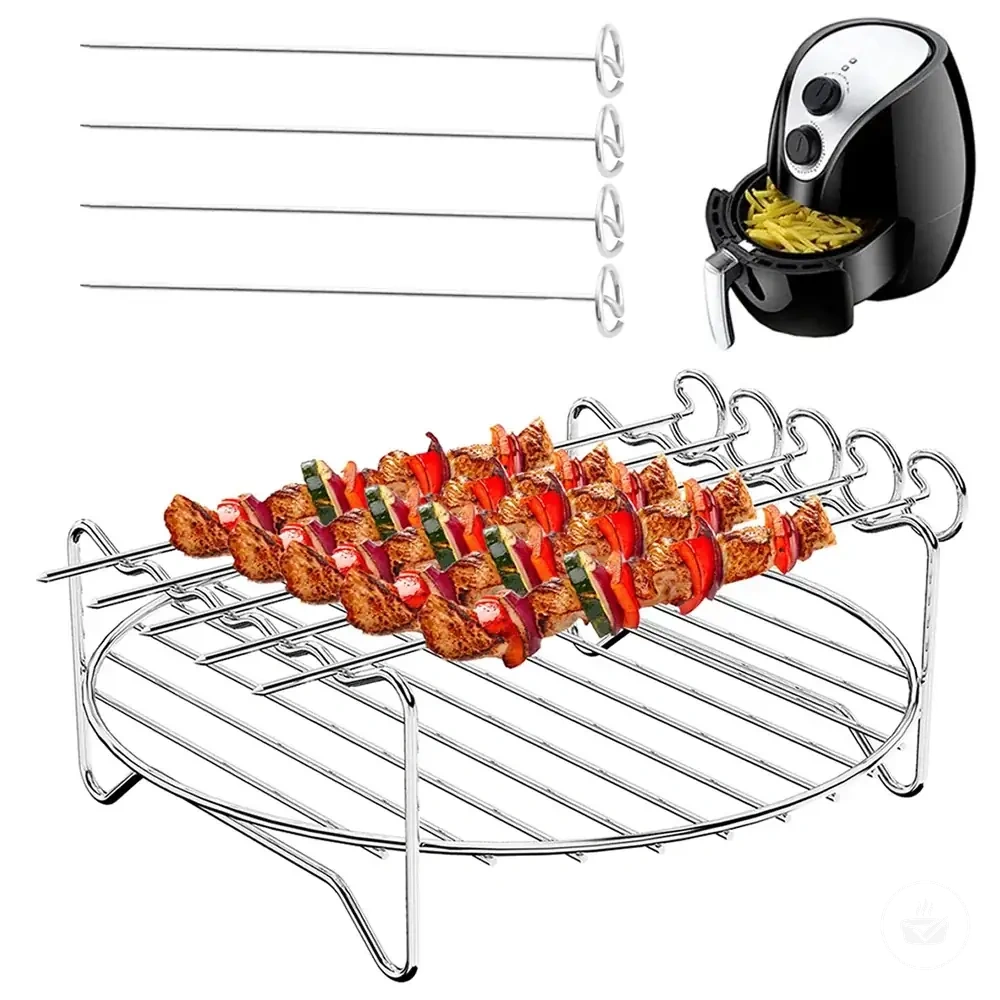
When crisping, draining, or preparing food on multiple levels, a rack, crisper tray, or insert can help organize the cooking space without replacing bakeware. Stacking accessories may create additional cooking levels, while perforated designs can support airflow around parts of the food. However, layering too many accessories can restrict airflow, so preserving open space between levels remains important.
These accessories are most effective when they fit securely and preserve airflow around the food. A raised rack or tray insert may improve food separation, but results depend on basket shape, food placement, and available clearance. Mesh and perforated accessories can also increase the cleaning burden because residue may collect in small openings, and unstable accessories should be checked before cooking.
Shape, Depth, and Portion Format Differences
Shape, depth, and portion format determine how bakeware contains food, exposes it to circulating air, and fits inside an air fryer. Round, square, rectangular, shallow, deep, perforated, and multi-cavity forms each influence containment, surface exposure, usable capacity, and basket clearance in different ways. Geometry is the primary frame for understanding bakeware behavior.
Shape, depth, and portion format can be compared by the attribute they change before selecting a bakeware style:
| Format | Attribute changed | Condition | Likely effect |
|---|---|---|---|
| Round, deep | Containment and wall height | Thicker batters or deeper mixtures | May retain more moisture while browning depends on airflow, clearance, and food type |
| Square or rectangular | Basket fit and usable capacity | When the form matches the basket shape | May use available space more efficiently, depending on clearance |
| Shallow, flat | Surface exposure | Foods spread in a thinner layer | May encourage greater surface browning and easier release |
| Perforated | Airflow through the contact surface | When airflow beneath food is beneficial | May increase surface exposure while allowing crumbs to pass through |
| Multi-cavity | Portion format | Individual servings with controlled fill level | Can simplify portioning, although spacing may affect airflow and removal |
Deep formats prioritize containment, while shallow formats emphasize surface exposure. A deeper form may better support batter containment, whereas a shallow form may expose more of the food to circulating air. Browning and moisture can vary with food type, fit, airflow, and wall height rather than depth alone.
Portion format determines how food is divided before baking. A multi-cavity design creates individual portions with separate cavities, while a single cavity holds one larger batch. Cavity spacing, fill level, and basket clearance may influence airflow and how easily baked items release after cooking.
A common misconception is that material determines baking behavior more than geometry. Shape, depth, and portion format usually have the primary influence, while material acts as a secondary modifier of heat behavior. When material becomes part of the selection criteria, see materials for air fryer bakeware after evaluating geometry first.
Fit and Airflow Limits Across Bakeware Types
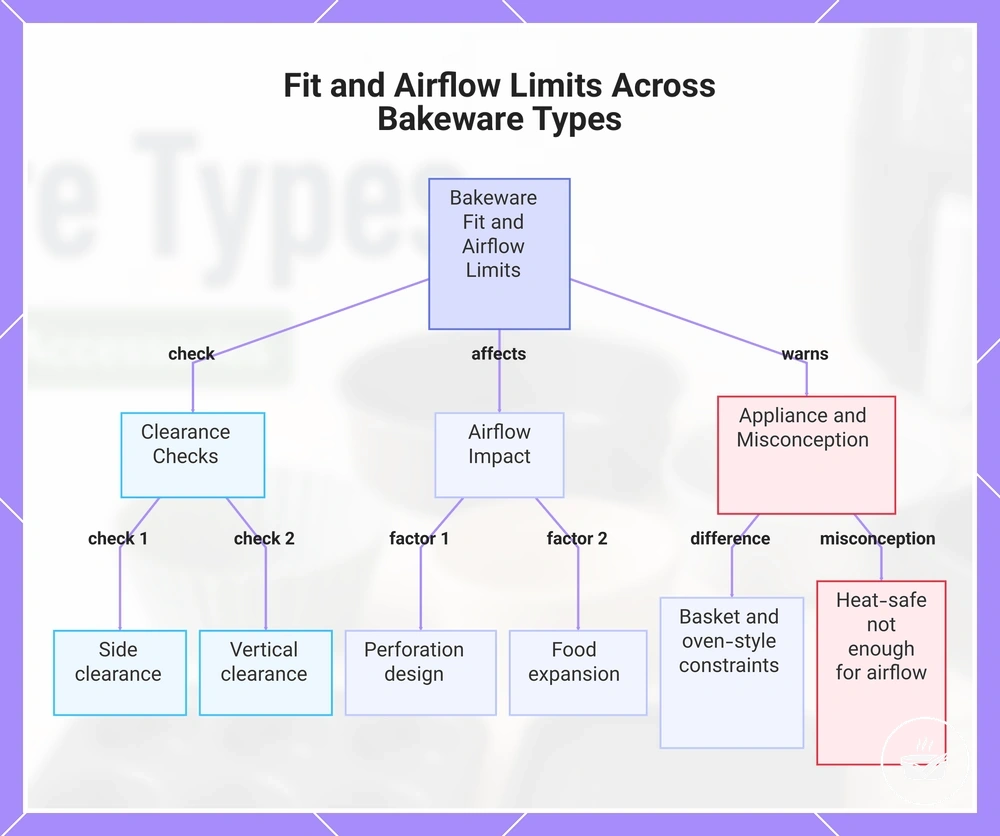
Bakeware type works well only when it fits the basket or oven cavity while leaving enough space for air movement. Fit depends on the bakeware shape, available clearance, and the way food expands during cooking. Leaving adequate clearance helps maintain airflow around the bakeware and food.
Fit and airflow limits depend on clearance, handle height, side gaps, perforation, and food expansion. Use this checklist to connect fit conditions with airflow and baking performance:
- Width: Check that the bakeware fits inside the basket or oven cavity without pressing against the sides.
- Height: Verify that handle height and bakeware depth leave enough vertical clearance for food expansion.
- Side gaps: Leave usable side gaps so air can continue moving around the bakeware during cooking.
- Perforation or solid surface: A perforated design may support air movement differently from a solid surface, depending on the bakeware type and cooking conditions.
- Food expansion: Consider how rising batter or expanding food may reduce available air space during cooking.
Basket-style air fryers are often constrained by drawer dimensions and side clearance, while an oven-style air fryer may provide a different oven cavity layout and rack position. The same bakeware type may fit one appliance but not another because clearance, handle height, and available air space vary by model. Check the appliance manual and manufacturer guidance when evaluating compatibility rather than assuming the same fit across different air fryers.
A common misconception is that heat-safe bakeware will always perform well. Heat-safe construction does not necessarily mean the bakeware preserves airflow if its size, shape, or placement blocks air movement inside the basket or oven cavity. A piece can be heat-safe yet still perform poorly when it limits airflow under normal cooking conditions.
This chart outlines the essential fit checks, airflow factors, and a common misconception about bakeware compatibility in air fryers.
Food-to-Bakeware Matching for Common Baking Jobs
The baking job should determine the bakeware type before cooking begins. Batter consistency, portion size, desired browning, and available clearance all influence which suitable piece may work well. The main decision is whether the food needs containment or surface exposure.
| Baking job | Bakeware type to consider | Why it fits | Main caution |
|---|---|---|---|
| Muffins or cupcakes | Muffin cups | Support individual portion size and batter containment | Fill level, spacing, and clearance may affect airflow |
| Cakes or brownies | Cake pan | Provides contained depth for batter during baking | Fit and food expansion depend on the available basket space |
| Loaf-style bakes | Loaf pan | Supports deeper mixtures that expand upward | Depth and vertical clearance should be checked before use |
| Pizza-style flat bakes | Pizza pan or flat tray | Increases surface exposure that may encourage browning | Large pans may reduce airflow if they occupy most of the basket |
| Reheating or crisping baked items | Flat tray or pizza pan | Supports broad surface exposure for the food | Performance depends on airflow and available clearance |
For thicker batters, cakes, muffins, and loaf-style bakes, containment usually takes priority over surface exposure. Muffin cups divide batter into controlled portion sizes, while a cake pan or loaf pan contains larger mixtures during baking. Food expansion, pan depth, and basket clearance may influence the final outcome, so fit should be checked before cooking.
Flat bakes, pizza-style items, and reheated baked foods usually benefit from greater surface exposure rather than deeper containment. A pizza pan or shallow tray can expose more of the food to circulating air, although browning may vary with food thickness, pan design, and air fryer power. Airflow remains an important condition when selecting a flatter bakeware type.
Timing and temperature adjustments belong in the cooking method rather than the bakeware selection itself. Once the baking job has been matched to a suitable piece, see baking in an air fryer with bakeware for guidance on using the selected bakeware under different cooking conditions.
Food-to-bakeware matching is a selection process based on containment need, surface exposure, portion size, airflow, and clearance. Choosing a bakeware type by these decision signals is usually more useful than selecting by product style alone because results can vary with food, fit, material, and the air fryer model.
The products below are useful examples for comparing available options. Before buying, check that the compatibility criteria, key features, and product details match your needs.
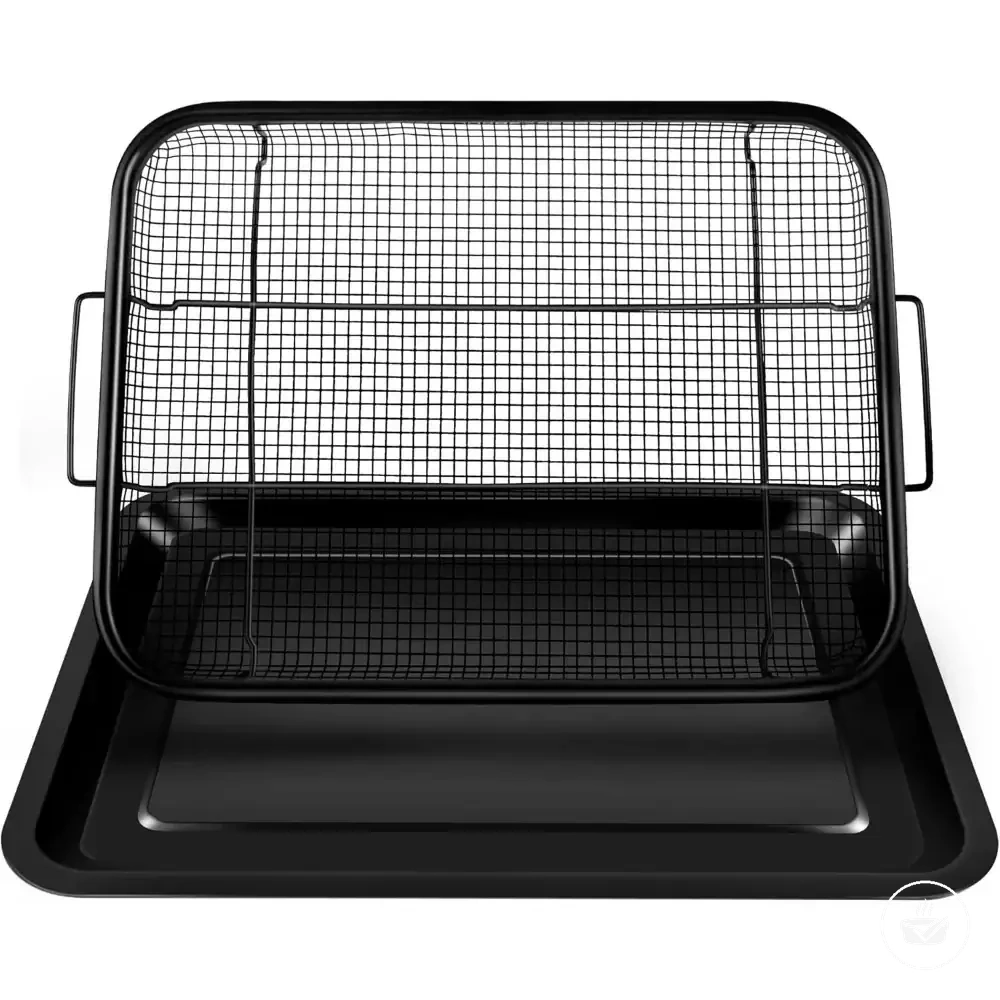
How Bakeware Set Pieces Map to Individual Bakeware Types
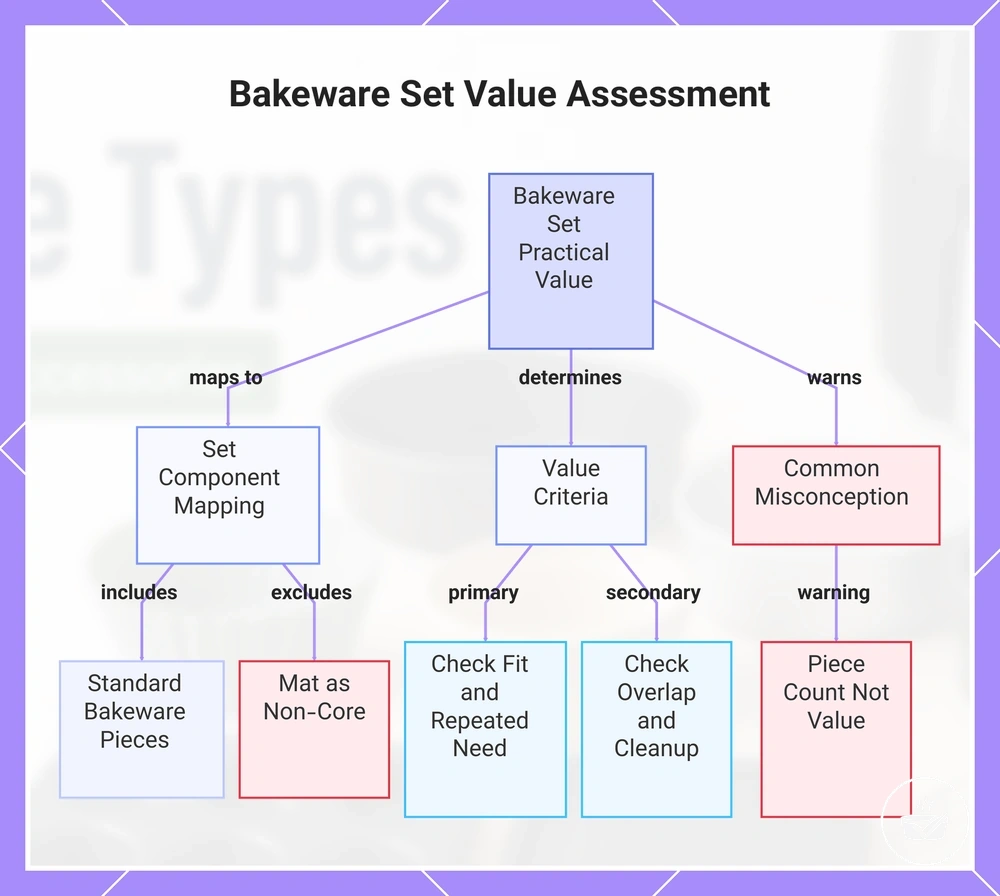
Bakeware set pieces are useful only when the included pieces match real baking needs, not when the piece count is high. A smaller set with reusable pieces that fit the basket may be more practical than a larger baking kit with overlapping functions. The main risk is overlap between pieces that appear different but serve the same purpose.
Common set components usually map back to individual bakeware types. A cake pan or cake barrel supports contained batters, a muffin mold divides batter into portions, a loaf pan supports deeper loaf-style bakes, and a rack or tray supports elevation or surface exposure. A mat can sit near liner-adjacent use, but it should be judged by function rather than treated as a core bakeware type. Bakeware set value depends on usable fit and repeated need rather than piece count alone.
- Usable fit: Check whether each piece fits the basket with enough clearance for practical use.
- Repeated need: Prioritize pieces that match baking jobs performed often, not pieces included only to raise piece count.
- Duplicate function: Compare each set component with existing bakeware to identify overlap.
- Cleaning burden: Consider whether racks, trays, molds, or mats add cleanup work that reduces practical value.
- Storage: Large or awkward pieces may be less useful if storage space is limited.
- Existing pieces: A set may be unnecessary when it mostly repeats a cake pan, muffin mold, loaf pan, rack, or tray already owned.
The dedicated air fryer bakeware sets context is useful when the main question is whether a baking kit has enough usable pieces for the appliance and cooking habits. This section only maps set components to individual bakeware types and filters obvious redundancy. Deeper set selection should stay criteria-led rather than piece-count-led.
A common misconception is that a higher piece count automatically means better value. Bakeware set pieces should be judged by fit, repeated use, cleaning burden, storage, and overlap with existing pieces. Product examples should support decision-making only after these criteria are clear.
The products below are useful examples for comparing available options. Before buying, check that the compatibility criteria, key features, and product details match your needs.
This chart shows how to evaluate bakeware set pieces by mapping them to individual types, applying key criteria, and avoiding the piece-count fallacy.