
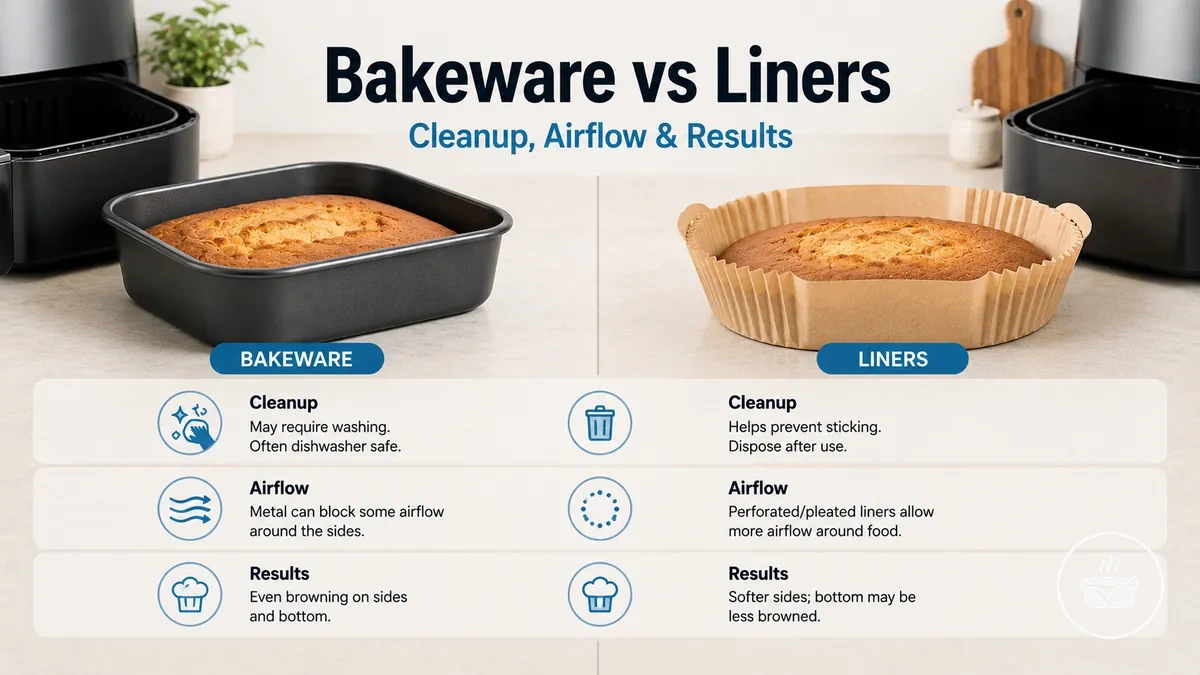
Air fryer bakeware vs liners
Air fryer bakeware and air fryer liners serve different jobs, so the right choice depends on what the food needs. Air fryer bakeware gives batter, soft food, and layered food more structure through a pan or tray. Air fryer liners act more like a surface barrier that can reduce cleanup effort and catch drips or residue. The better choice depends on cleanup, airflow, safety, and food structure.
A common confusion is whether a silicone liner, parchment liner, perforated liner, or baking pan can do the same job. A silicone basket may help with reusable cleanup, while parchment paper or liner sheets may suit lighter mess control when placed correctly. A perforated liner may leave more airflow exposure than a solid liner, but crisping and browning can still vary by basket shape, food weight, and fit. Air fryer bakeware may support baking results better when food needs depth or walls. That makes one-size-fits-all advice too broad for this comparison.
Air fryer bakeware vs liners is mainly a tradeoff between support, surface protection, airflow, and safe placement. Liners can help with cleanup, but they may affect airflow or crisping when they cover too much of the basket or move during cooking. Bakeware can improve shape support for foods such as batter-based bakes, but fit, material, heat rating, and placement still control safety and results. The comparison starts with how each option works inside the air fryer before moving into cleanup, airflow, and baking outcomes.
How bakeware and liners work differently inside an air fryer
Air fryer bakeware and liners are different support surfaces inside the cooking chamber. Air fryer bakeware gives food containment and structure. Liners create a surface barrier for the basket base rather than a shaped cooking vessel.
Air fryer bakeware usually means a pan or tray with walls, depth, or a stable base that can hold food in shape. A liner usually means paper, silicone, or a liner sheet placed over the basket surface to catch residue, drips, or sticking. Bakeware can reduce direct air exposure when a solid base or tall wall blocks surface contact, while liners can create an airflow tradeoff when they cover holes or shift during use. The air fryer bakeware guide treats bakeware as structural support, not just a cleanup layer.
How bakeware and liners work differently inside an air fryer matters most when food needs either shape support or basket protection. Batter, soft food, and layered food may need the containment of a baking pan or tray. Greasy or sticky food may only need a liner to reduce cleanup, if the liner fits and stays placed under food weight. How bakeware and liners work differently inside an air fryer becomes clearer when function, airflow exposure, and cleanup role are separated.
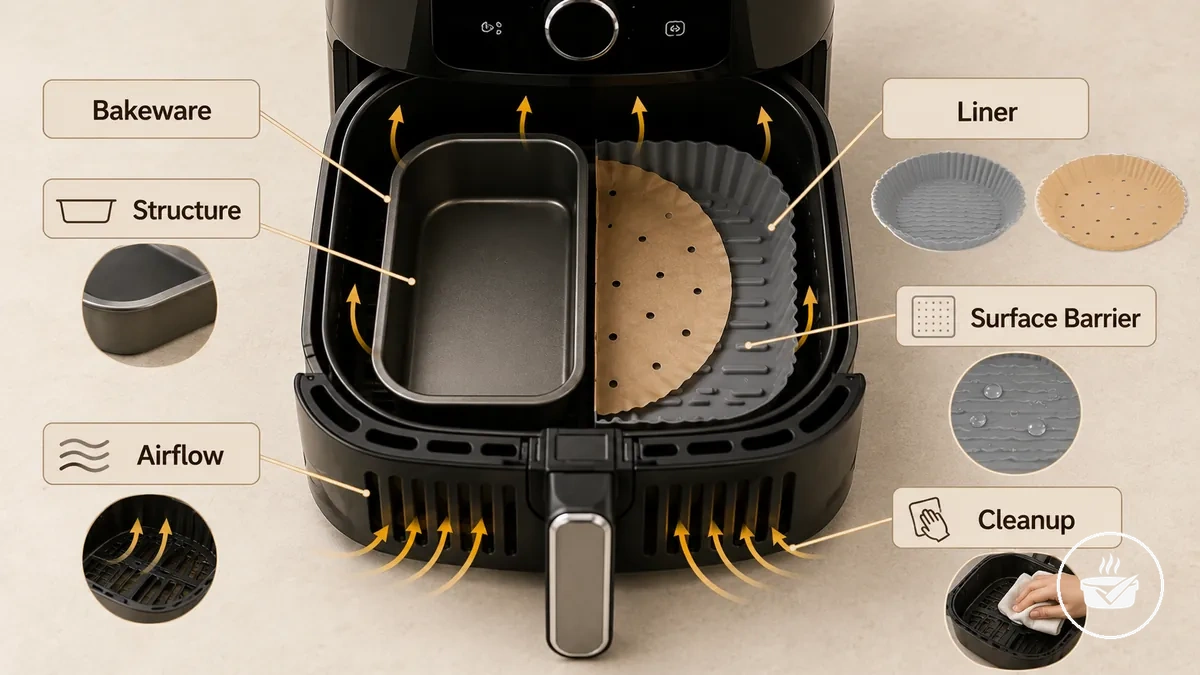
| Option | Main function | Airflow effect | Cleanup effect | When it fits |
|---|---|---|---|---|
| Bakeware | Provides containment, depth, and structure through a pan or tray | May reduce direct air exposure when the base or walls cover basket openings | Requires washing, especially when residue or baked batter sticks | Food needs walls, shape support, or a stable baking surface |
| Silicone liners | Create a reusable surface barrier over the basket base | May change airflow when the silicone basket covers holes or sits close to food | Can reduce basket mess but still needs washing after use | Food mainly needs drip control or residue separation |
| Parchment liners | Create a disposable paper barrier for surface contact | May affect air exposure when the liner covers the basket base or moves | Can catch crumbs, drips, or sticking residue | Food has enough weight to keep parchment paper placed safely |
| Perforated liners | Protect the basket surface while leaving holes for air movement | May preserve more air path than a solid liner when holes stay open | Can reduce residue while allowing some drips or crumbs through | Food benefits from a barrier but still needs more airflow exposure |
The common myth is that liners can replace deeper pans whenever the food fits in the basket. Liners do not replace structural bakeware when food needs depth, walls, or shape support, because a surface barrier does not provide the same containment as a pan. The regular bakeware comparison is the better boundary when the question is whether a separate pan or dish can be used in an air fryer.
Silicone, parchment, and perforated liners in the comparison
Silicone, parchment, and perforated liners in the comparison can change the overall decision because liner material and hole pattern influence cleanup, airflow, reuse, and stability in different ways. Compare the material together with the hole pattern to judge how each liner type may behave inside the same air fryer basket.
When cooking sticky food, a silicone liner may suit repeated use because it is a reusable liner that can be washed after cooking. A parchment liner is a disposable liner that can help collect crumbs or drips, while a perforated liner uses holes that may allow more airflow than a solid liner sheet. Silicone, parchment, and perforated liners in the comparison become easier to evaluate when the material and hole pattern are compared side by side.
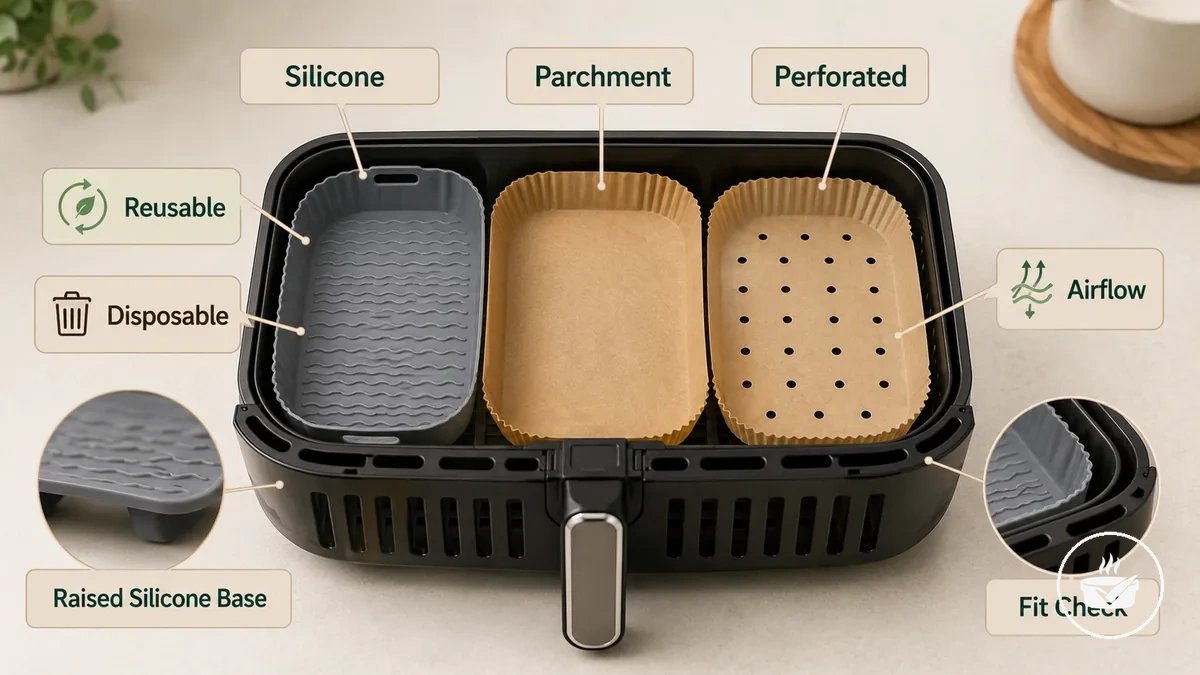
Silicone, parchment, and perforated liners in the comparison are best compared by attributes rather than by product names. The table below organizes material, reuse, hole pattern, airflow, and stability. These attributes help explain differences in cleanup and airflow.
| Liner type | Key attribute | Common condition | Effect on cleanup or airflow | Decision cue |
|---|---|---|---|---|
| Silicone liner | Reusable, flexible | Raised base or silicone basket design | Can simplify cleanup and may change airflow depending on fit | Useful when repeated use is preferred |
| Parchment liner | Disposable paper liner | Collects crumbs and drips | Can reduce residue; airflow depends on coverage and placement | Useful for quick cleanup |
| Perforated parchment | Hole pattern | Openings across the liner surface | May allow more airflow while still catching part of the residue | Useful when airflow is a higher priority |
| Raised silicone base | Elevated food contact | Grooved or raised surface | Airflow and grease movement may vary with design and food load | Check fit and basket space before use |
A common myth is that one liner material suits every cooking task. Heat-use suitability and food contact should follow the product label and instructions instead of broad material claims. The most suitable liner depends on fit, hole coverage, food load, and the balance between cleanup and airflow.
Cleanup tradeoffs between bakeware and liners
Cleanup tradeoffs between bakeware and liners depend on the type of food residue and how the food is cooked. A liner can catch drips or crumbs before they reach the basket, while bakeware contains residue inside a pan that still requires washing. The comparison centers on residue, sticking, and washing effort rather than a single cleanup outcome.
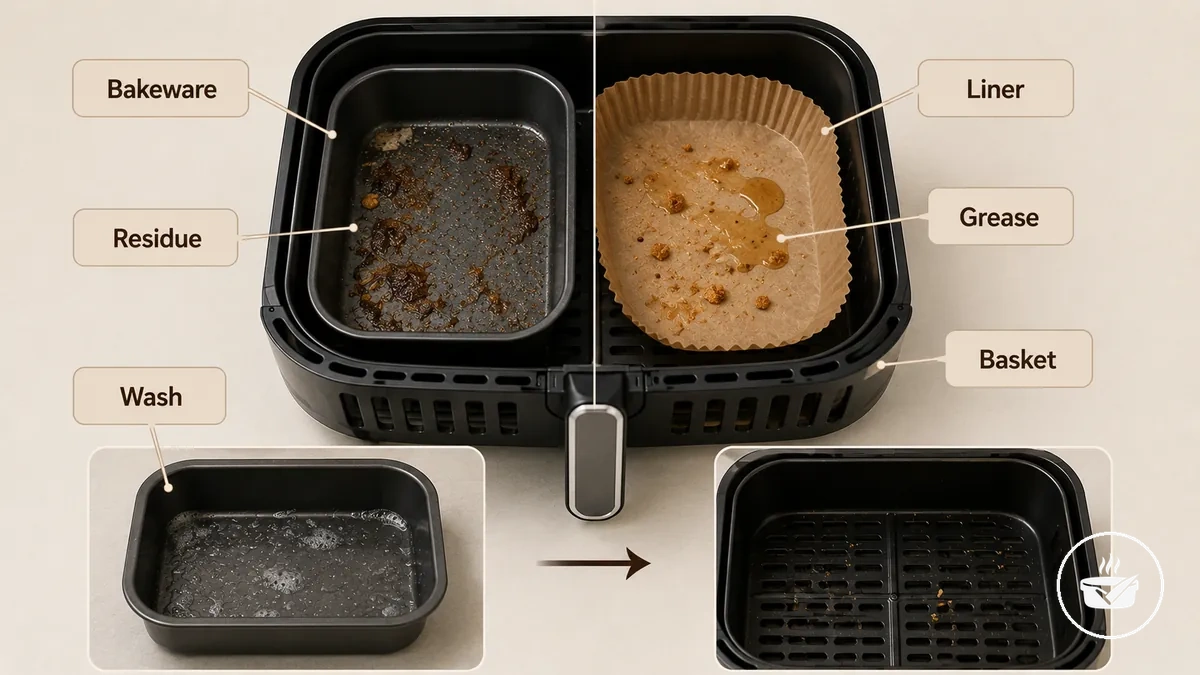
When cooking greasy foods, a liner may catch grease before it reaches the basket, while bakeware keeps grease inside the pan for later washing. Sticky sauces, sugar residue, and baked batter can still cling to a nonstick coating, and crumbly foods may leave less basket mess when a liner is placed correctly. Cleanup tradeoffs between bakeware and liners are easier to compare when residue control, washing effort, and repeat-use maintenance are viewed together.
Cleanup tradeoffs between bakeware and liners also depend on whether you choose a reusable liner or a disposable liner. A reusable liner reduces repeated waste but still needs washing after use, while a disposable liner can reduce basket mess before disposal. The comparison block below summarizes how residue type changes washing effort and reuse tradeoffs.
| Situation | Bakeware cleanup effect | Liner cleanup effect | Tradeoff |
|---|---|---|---|
| Greasy foods | Grease stays inside the pan and may require washing | Can catch grease before it reaches the basket | Less basket mess, but cleanup still remains |
| Sticky sauces | Residue may stick to the nonstick coating | Can reduce direct basket contact when positioned correctly | Cleaning effort varies with the amount of residue |
| Baked batter | Batter remains contained but may need soaking if baked on | Does not replace bakeware for batter support | Structure versus cleanup barrier |
| Crumbs | Crumbs stay inside the pan | Disposable liner can collect loose crumbs | Quick disposal versus repeat washing |
| Reusable silicone cleanup | Pan still needs washing after cooking | Reusable liner also requires washing after use | Lower waste versus additional wash time |
After cooking foods with baked batter or heavy residue, both the pan and the basket may still need careful washing. For more detailed maintenance guidance, see cleaning air fryer bakeware. The better cleanup approach depends on residue level, liner placement, coating condition, and whether you prefer repeat washing or disposable mess control.
Airflow, holes, and crisping differences
Airflow, holes, and crisping differences depend on how much of the basket surface is covered and where the food is placed. Bakeware walls, solid bases, and liners can change air circulation, but the effect varies with holes, food coverage, basket design, and placement. Air exposure is the main variable behind browning and crisping.
When a pan with high walls or a solid base covers more of the basket, air movement may reach some food surfaces differently than in a more open setup. A perforated liner leaves holes that can allow more air circulation than a solid liner, while heavy food coverage can reduce air exposure regardless of the accessory used. Airflow, holes, and crisping differences become easier to compare when surface coverage and air exposure are viewed together.
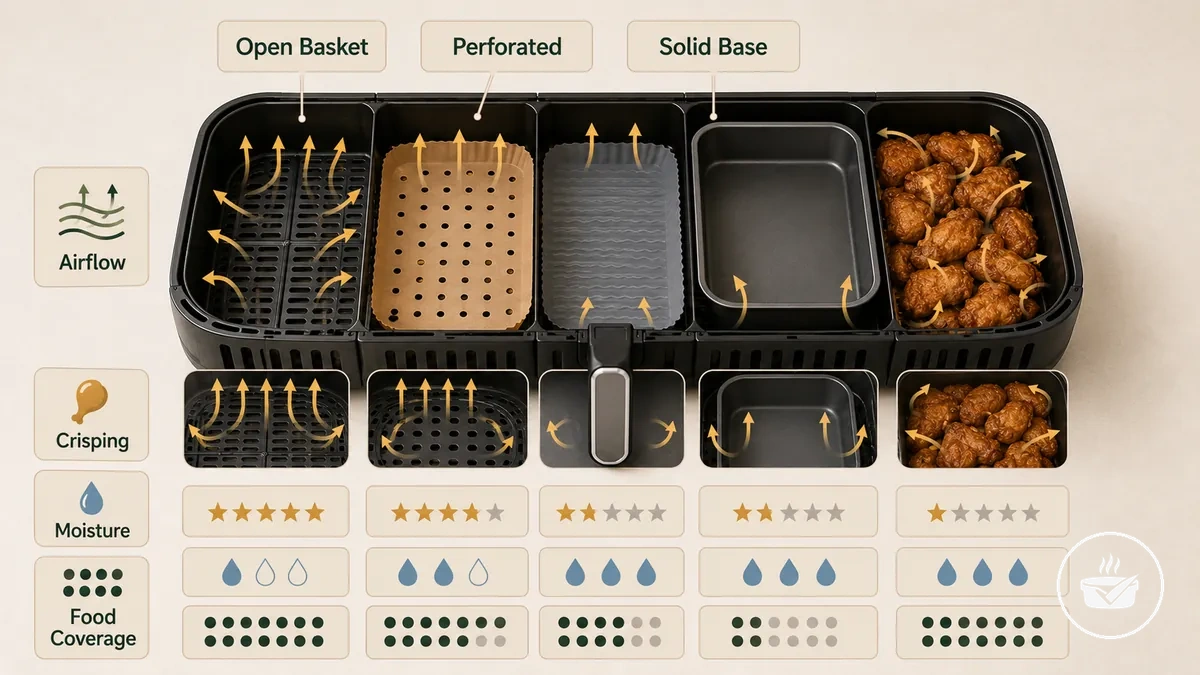
| Surface setup | Air path condition | Likely texture effect | Watch point |
|---|---|---|---|
| Open basket | More direct air exposure | May support more even browning | Food spacing still matters |
| Perforated liner | Air passes through perforations | May support crisping better than a solid surface | Hole coverage and placement vary |
| Solid liner | More blocked air path | May reduce air exposure beneath food | Coverage affects results |
| Pan or tray | Solid base with surrounding walls | Browning and crisping may differ across surfaces | Pan size and basket clearance matter |
| Crowded food | Restricted air circulation | May produce a softer texture | Moisture can remain between pieces |
A common myth is that liners or pans alone cause every crisping problem. In practice, food moisture and crowding can reduce browning even when air circulation remains reasonable. Airflow restriction should be considered alongside moisture and food coverage because texture depends on all of these conditions. The comparison-level airflow effect is only part of the result. For more detail about airflow when using bakeware, placement and basket clearance deserve separate attention.
When food has enough open space and the basket is not heavily covered, perforated surfaces may allow more air exposure than solid ones, but results still depend on basket design, food load, and placement. A solid base does not automatically prevent crisping, and a perforated liner does not guarantee a crispy texture because moisture and air circulation also influence even cooking. Detailed setup methods are outside the scope of this comparison.
Perforated liners and raised silicone bases
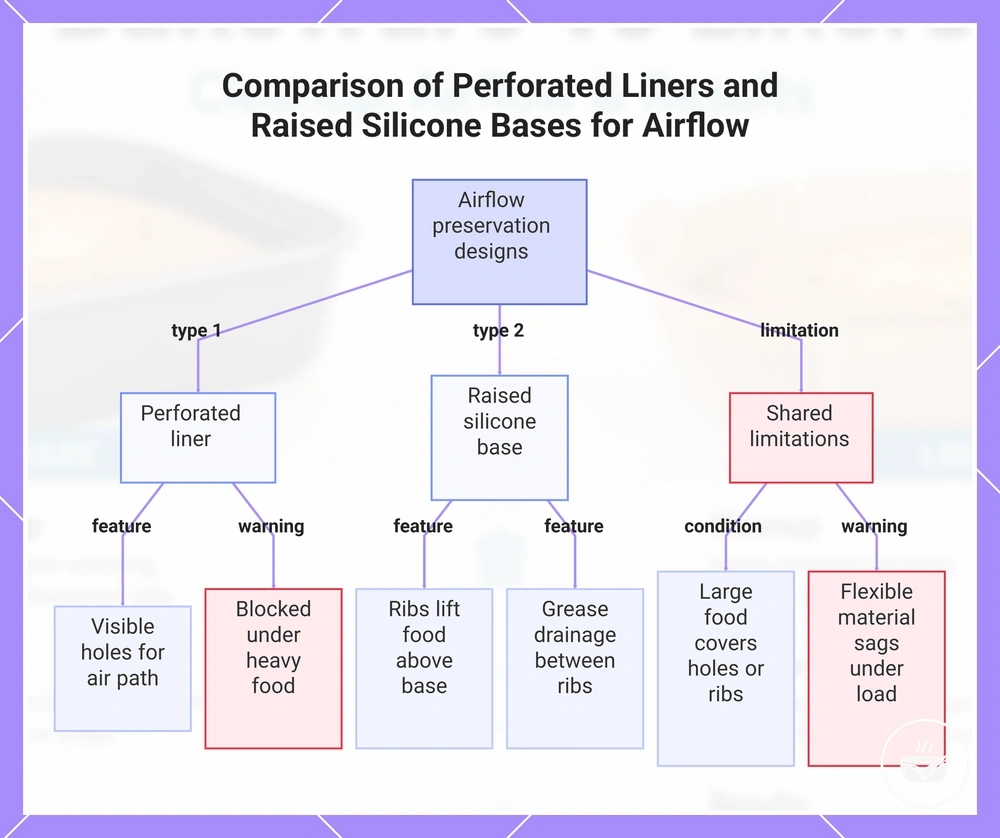
Perforated liners and raised silicone bases are designed to preserve more of the air path beneath food while separating it from the basket base. A perforated liner uses visible holes, while a raised silicone base uses ribs or raised ridges to create drainage gaps. Both designs aim to maintain airflow around the basket base, although the result still depends on food coverage and placement.
- Hole visibility: A perforated liner allows air to pass through visible holes, but blocked perforations under heavy food coverage may reduce local air movement.
- Base lift: A raised silicone base lifts food above the basket base with ribs, which may help preserve the air path when the raised ridges remain exposed.
- Grease drainage: Drainage gaps between the ribs may help grease move away from the food surface, although residue can still collect depending on the food.
- Food coverage: Large or tightly packed food can cover holes or raised ribs, reducing the intended air path and potentially changing crisping results.
- Flexibility: A flexible silicone basket or liner may sag under heavier loads, reducing clearance and altering airflow depending on placement. These designs can support air circulation, but they are not equivalent to an open basket.
This chart compares the design features and common limitations of two types of air fryer basket liners that aim to preserve airflow under food.
When liners reduce browning or even cooking
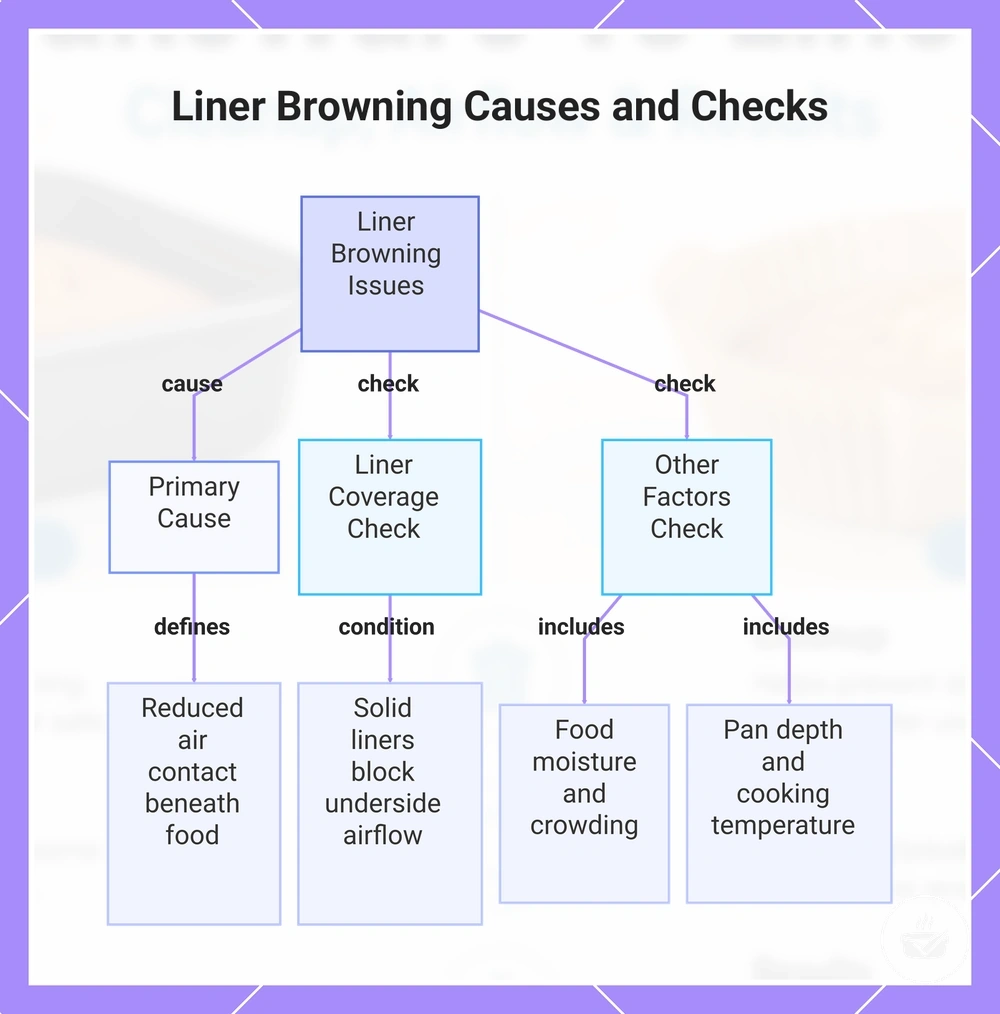
Liners can reduce browning or even cooking when liner coverage limits reduced air contact beneath the food. The effect is usually most noticeable on the underside and depends on food moisture, crowding, basket airflow, and how much of the basket surface is covered. Reduced air contact is the limiting condition rather than the liner itself.
If browning or cooking evenness is weaker than expected, check these local conditions before assuming the liner is the cause:
- Liner coverage: A solid liner that covers more of the basket base may reduce air contact beneath the underside, which can lead to lighter browning.
- Food moisture: Wet food can release more steam, which may leave a softer underside even when liner placement is appropriate.
- Crowding: Tight spacing can restrict basket airflow around the food and may reduce even cooking.
- Pan depth or batter moisture: A deeper pan, thicker batter, or higher moisture level can also influence heat exposure and the final result.
- Cooking conditions: Temperature, spacing, and liner coverage should be considered together because weaker browning may result from multiple conditions rather than the liner alone.
Separating liner restriction from food moisture, crowding, pan depth, and cooking conditions provides a more accurate explanation of weaker browning or cooking evenness.
This chart shows the primary cause of reduced browning with liners and the key conditions to check before blaming the liner itself.
Baking results when using bakeware or liners
Baking results usually depend on whether the food needs shape support or mainly needs easier release from the cooking surface. Bakeware generally provides structure, wall height, and support depth for batter-based foods, while liners mainly influence release, sticking, and surface contact. Moisture retention, browning, lifting, and texture can still vary with the recipe, fill level, support surface, and air fryer model.
Cakes and muffins usually benefit from pan walls that help maintain structure and shape as the batter rises. Pastries may respond differently depending on surface contact, while sticky foods often benefit from a liner that can improve release without replacing shape support. Crumbly foods may be easier to handle when they have enough support beneath them. Baking results when using bakeware or liners become clearer when structure, release, and texture are compared side by side.
| Food or outcome | Bakeware effect | Liner effect | Condition to check |
|---|---|---|---|
| Cakes | Pan walls provide structure and shape support | Mainly affects release from the cooking surface | Support depth and wall height |
| Muffins | Depth can help maintain lifting and shape | May improve release when surface contact is appropriate | Cup depth and surface contact |
| Pastries | Support surface may influence texture and browning | May reduce sticking while browning still depends on the recipe | Surface contact and moisture retention |
| Sticky foods | Pan shape contains the food | Can improve release and reduce sticking | Surface contact and residue |
| Crumbly foods | Provides support during handling | Can reduce direct contact with the basket surface | Shape support and food stability |
Baking results depend on the relationship between food type, support depth, wall height, and surface contact. Foods that rely on pan walls for structure generally suit bakeware, while foods that mainly need easier release may suit a liner. Browning, moisture retention, lifting, and sticking remain conditional because recipes and cooking conditions vary. Safe expectations come from matching the support surface to the food rather than expecting identical outcomes.
A common myth is that liners and bakeware produce the same baking results. In practice, bakeware primarily supports structure, while liners primarily influence release and surface contact. Selecting between them depends on the baking outcome you want to prioritize instead of expecting identical results from both options.
Safety and placement conditions for liners and pans
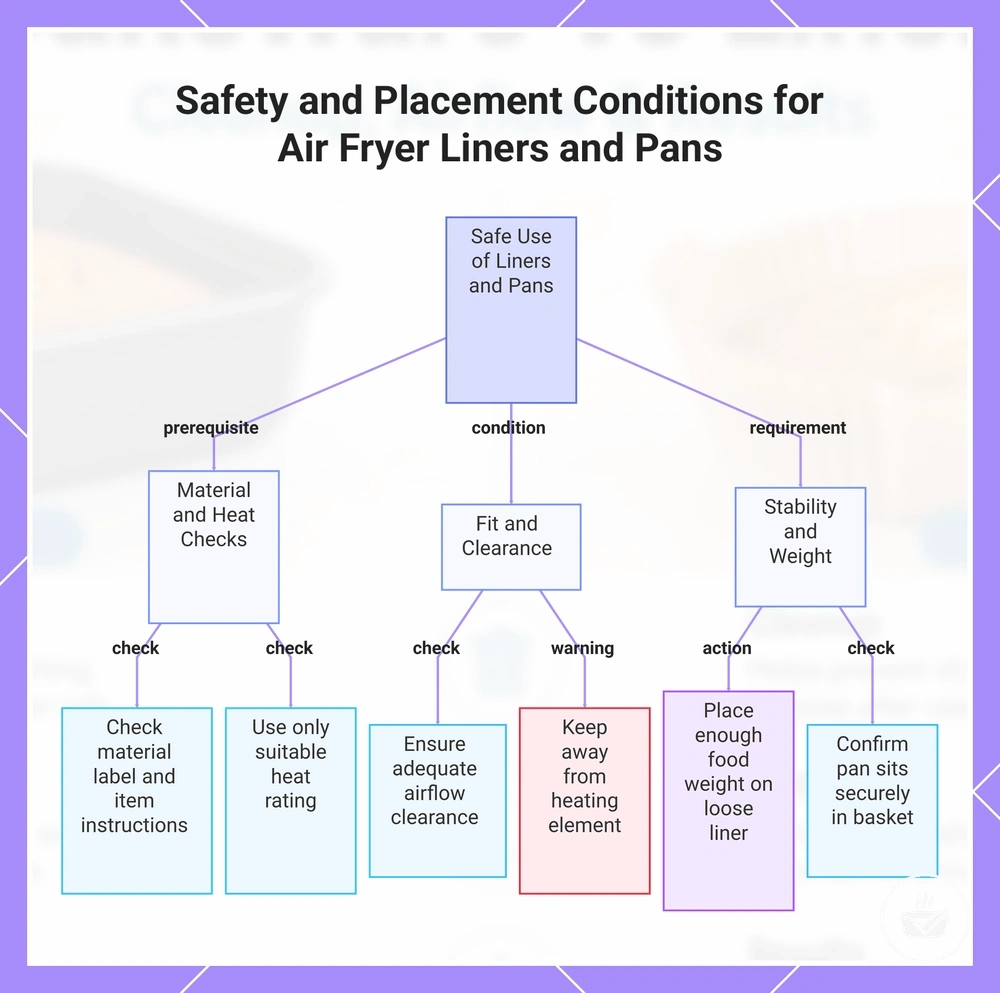
Safety and placement conditions for liners and pans depend on using an accessory with a suitable heat rating, proper fit, adequate airflow clearance, enough food weight to hold a liner in place, and no contact with the heating element. A liner or pan should remain stable throughout cooking, and the material label and item instructions should be checked before use. Following the item instructions is an essential part of safe use.
A loose liner may move when there is not enough food weight to hold it in place, while a pan with poor fit may reduce basket clearance or make handling less stable. Airflow clearance should remain sufficient around the accessory, and liners or pans should not contact heating parts. Use the checklist below to confirm the main placement conditions before cooking.
- Material label: Check the material label and item instructions before using the accessory.
- Heat rating: Use a liner or pan only when its heat rating is suitable for the intended cooking conditions.
- Basket clearance: Confirm that the pan fits securely while leaving adequate airflow clearance around it.
- Food weight: Place enough food on a loose liner to help reduce movement during cooking.
- Heating element: Keep liners and pans away from the heating element and other heating parts.
- Stable handling: Make sure the pan sits securely in the basket before and after cooking.
Loose movement or poor placement can increase the risk of heating-element contact or reduce handling stability. Checking fit, basket clearance, food weight, and placement before cooking can help reduce these risks. Safe use may vary by the accessory and appliance, so item instructions should take priority whenever they provide specific guidance.
A common myth is that every liner or pan is suitable for every air fryer. In practice, safe use depends on the material label, heat rating, fit, placement, and visible basket conditions rather than on the accessory type alone. This comparison provides practical safety checks without replacing the instructions supplied with the individual item.
This chart shows the main safety conditions to check before using a liner or pan in an air fryer, including material checks, fit and clearance, and stability requirements.
Heat limits, preheating, and heating-element contact
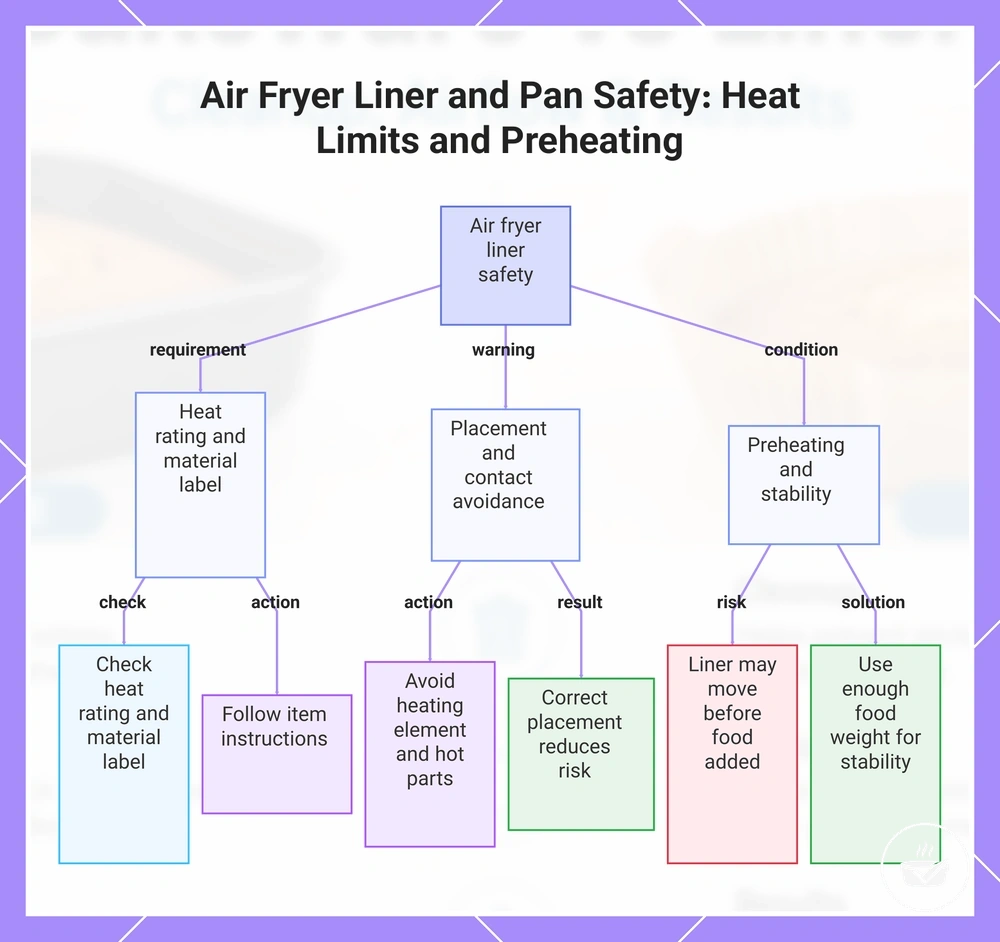
Heat limits and contact risk depend on the liner or pan's heat rating, material label, and placement inside the air fryer. A liner or pan should remain clear of the heating element and other hot components throughout cooking. Follow the item instructions because heat-use suitability depends on the accessory and appliance.
Caution:
- Heat rating: Check the heat rating and material label before using a liner or pan.
- Preheating: During preheating, an empty lightweight liner may move because of fan movement if it is not held in place.
- Heating element: Keep liners and pans away from the heating element and other hot components to reduce contact risk.
- Food weight: Use enough food weight to help keep a liner stable when this matches the item instructions.
Preheating creates a different condition because liner movement can occur before food is added. Correct placement, an appropriate heat-use rating, and avoiding contact with hot components help reduce contact risk, while food weight may improve liner stability during cooking when the item instructions support that use.
This chart shows the key safety requirements, preheating risks, and placement rules for using liners and pans in an air fryer.
Loose liners, food weight, and basket movement
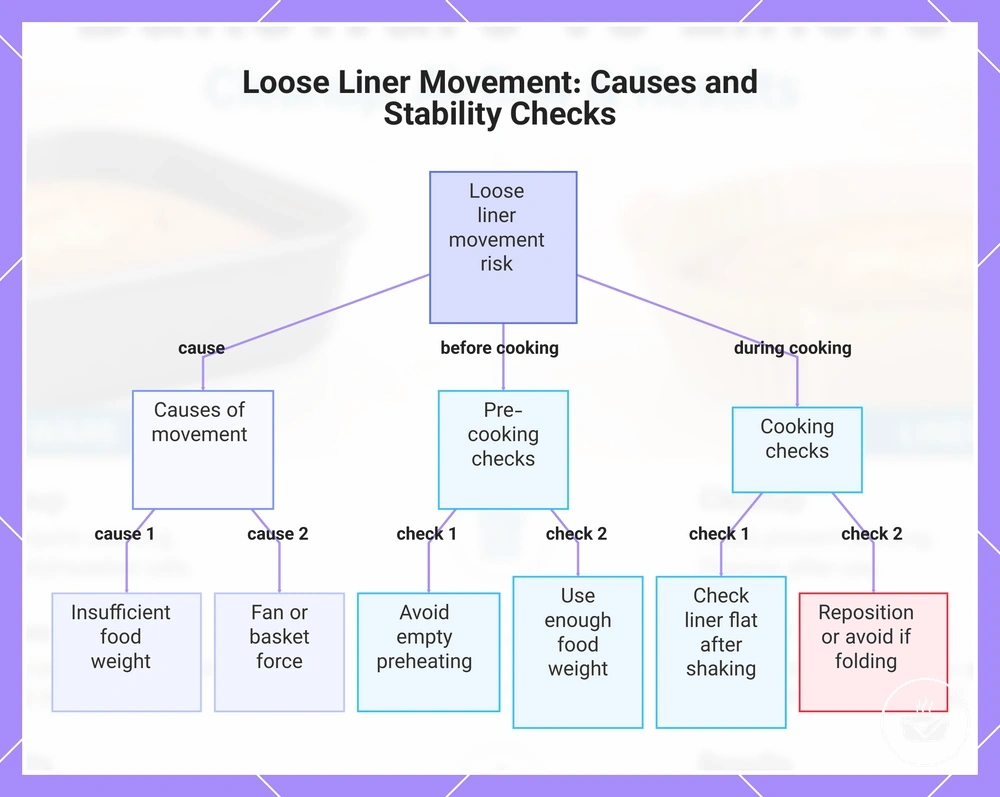
A loose liner can move inside the basket when food weight is not enough to keep it in place. Fan force, basket movement, and a liner that does not fit the basket shape may increase movement risk. Keeping the liner flat and covered by suitable food can help reduce liner movement under these conditions.
Check these conditions if a loose liner appears unstable during cooking:
- Preheating: Avoid placing an empty lightweight liner in the basket during preheating because it may move before food is added.
- Food weight: Use enough food weight to help hold the liner in place when this matches the item instructions.
- Liner size: Check that the liner fits the basket without raised or unsupported edges that may encourage liner shift.
- Basket shaking: After basket shaking, confirm that the liner remains flat and has not shifted or folded.
- Visible folding: If folding creates blocked airflow, uneven cooking, or contact risk, reposition the liner or avoid using it when it cannot remain flat and covered.
Basket shape, light foods, and placement can all affect liner stability, so movement risk depends on the combination of fit, food load, and appliance airflow. A silicone liner or parchment liner may behave differently under these conditions. Avoid using a liner when it cannot stay flat, remain covered by food where appropriate, or maintain stable placement during cooking.
This chart shows the main causes of loose liner movement in an air fryer and the key checks to maintain stability during cooking.
Food-grade materials, coatings, and non-stick claims
Food-grade materials and non-stick claims should be evaluated by checking the material label, coating condition, and intended heat-use claim before use. Food contact depends on the documented label claim, the surface condition, and the intended use rather than marketing language alone. Product documentation remains the controlling source for item-specific guidance.
- Label claim: Confirm that any food-grade or food-contact claim is supported by the material label or accompanying documentation.
- Coating condition: Inspect the coating for wear, peeling, or other visible damage because coating condition may affect sticking and the replacement decision.
- Heat-use claim: Check that any heat-use claim matches the documented instructions instead of assuming that silicone, parchment, or coated surfaces share the same suitability.
- Replacement decision: Avoid continued use or consider replacement when the coating is damaged or when food-contact or heat-use claims cannot be verified through the available documentation.
When coating wear or surface damage becomes visible, reassess food contact and non-stick claims before continued use. Dishwasher-safe, heat-safe, and similar claims should be treated as conditional unless they are supported by the item's documentation. Avoid relying on unsupported health, chemical, or permanent non-stick claims that cannot be verified through product documentation.
Choosing bakeware, liners, or both by cooking job
The right choice depends on the cooking job and the conditions inside the air fryer. Structure needs, cleanup priority, airflow exposure, food moisture, and safety fit determine whether bakeware, liners, or both are the more suitable option. Match the accessory to the food rather than expecting one solution for every recipe.
Different cooking jobs place different demands on support, residue control, and air exposure. A recipe that needs pan walls differs from one that mainly benefits from easier cleanup or reduced sticking. Choosing bakeware, liners, or both by cooking job is easier when the table organizes support need, cleanup priority, airflow, and safety fit.
| Cooking job | Main need | Better option | Condition to check | Caution |
|---|---|---|---|---|
| Batters or cakes | Structure support and pan walls | Bakeware | Suitable depth, fit, and safe placement | Support remains important for shape |
| Greasy foods | Cleanup priority and drip control | Liners | Food weight and stable placement | Airflow exposure may vary with coverage |
| Sticky foods | Cleaner food release | Liners | Material suitability and surface condition | Release depends on the food and liner type |
| Crisping-focused foods | Airflow exposure | Depends on the cooking job | Food moisture and basket coverage | Solid surfaces may reduce air exposure beneath food |
| Mixed bakeware-plus-liner use | Support with easier cleanup | Both | Fit, food weight, and basket clearance | Combined use depends on safe placement |
Bakeware is the stronger choice when structure needs and pan walls are required to support the food. Liners are more suitable when cleanup priority or easier food release is the main goal. Using both may suit cooking jobs that need structural support together with residue control, provided airflow exposure and safety fit remain appropriate.
Mixed-use situations can benefit from combining bakeware and liners when each serves a different purpose rather than replacing the other. Pan walls may provide support while a liner helps manage residue, but the final setup still depends on fit, food moisture, and available basket clearance. Use the cooking job and support need as the final decision cue before selecting an accessory.
The best selection comes from matching the cooking job to structure needs, cleanup priority, airflow exposure, food moisture, and safety fit instead of focusing on a single feature. If your main criterion is selecting the most suitable pan for structural support, see choosing the best air fryer bakeware before making the final decision.
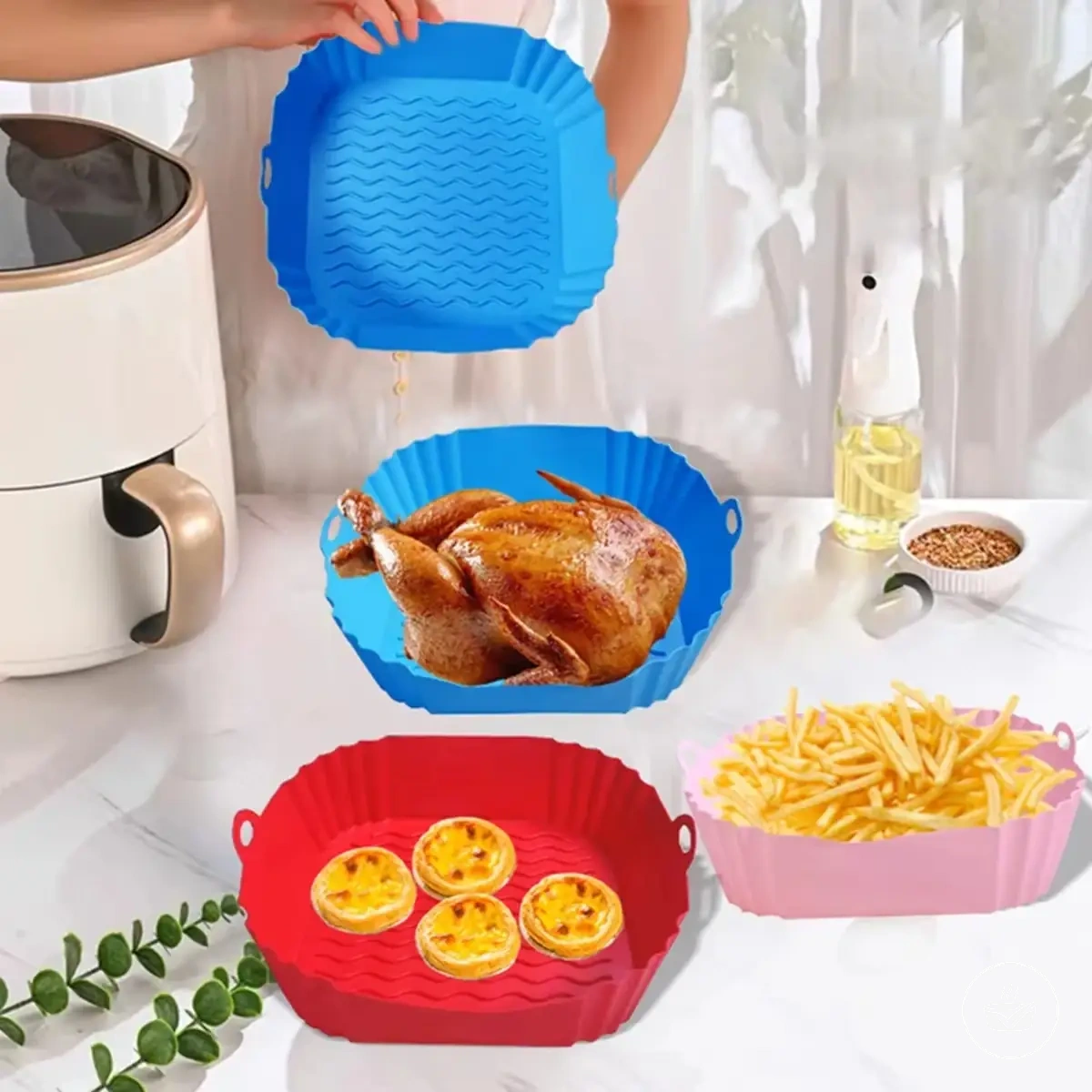
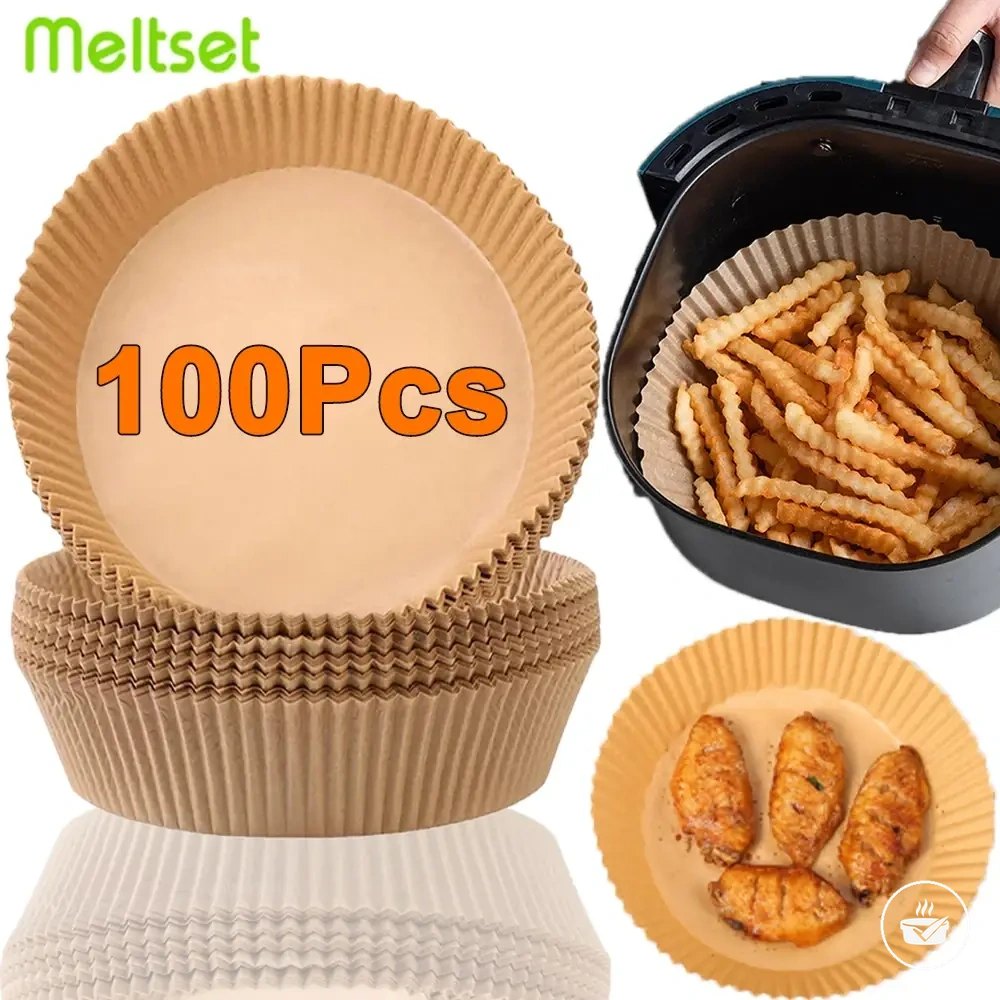
Here are product examples that may make comparison easier. Before buying, always review the compatibility criteria, essential features, and product details.
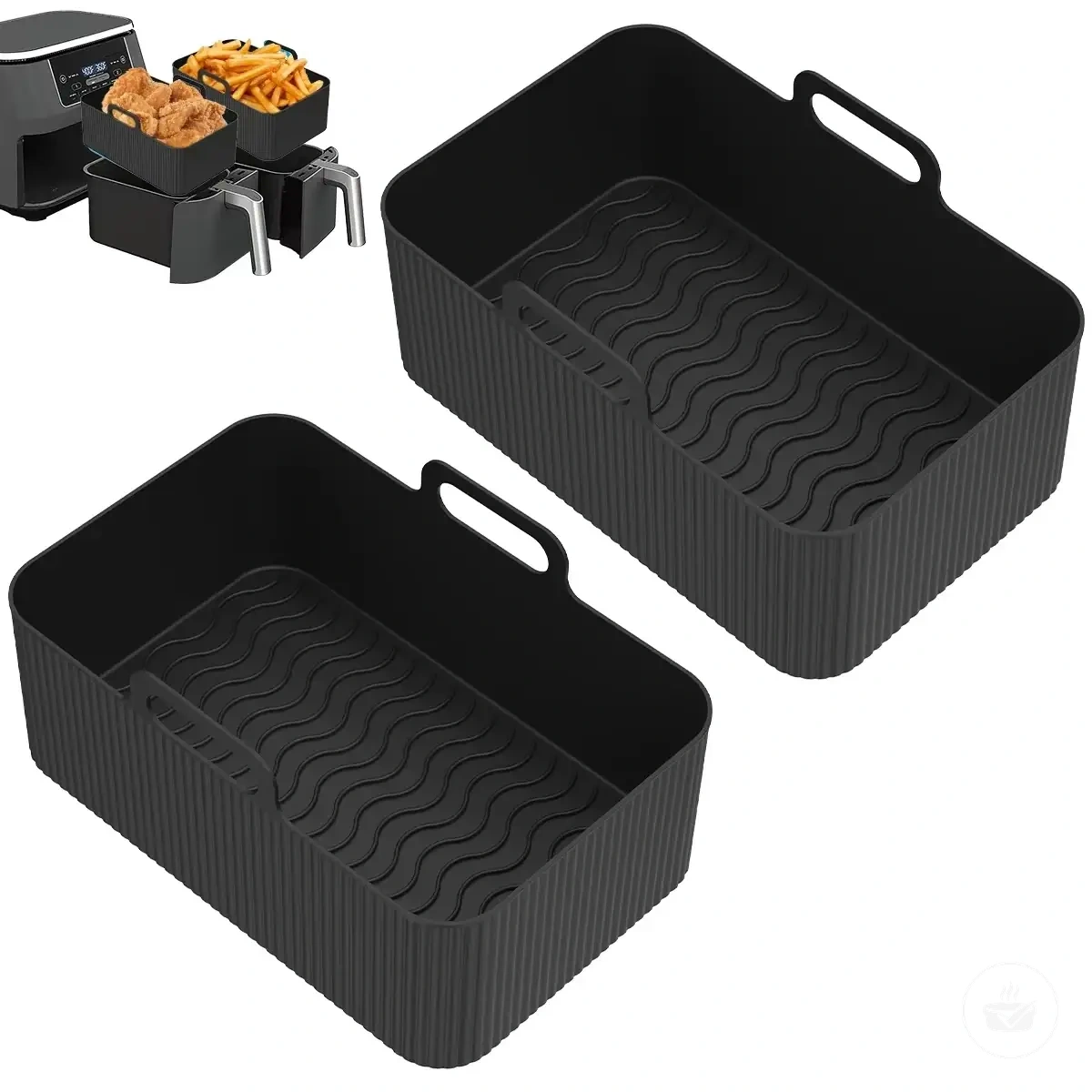
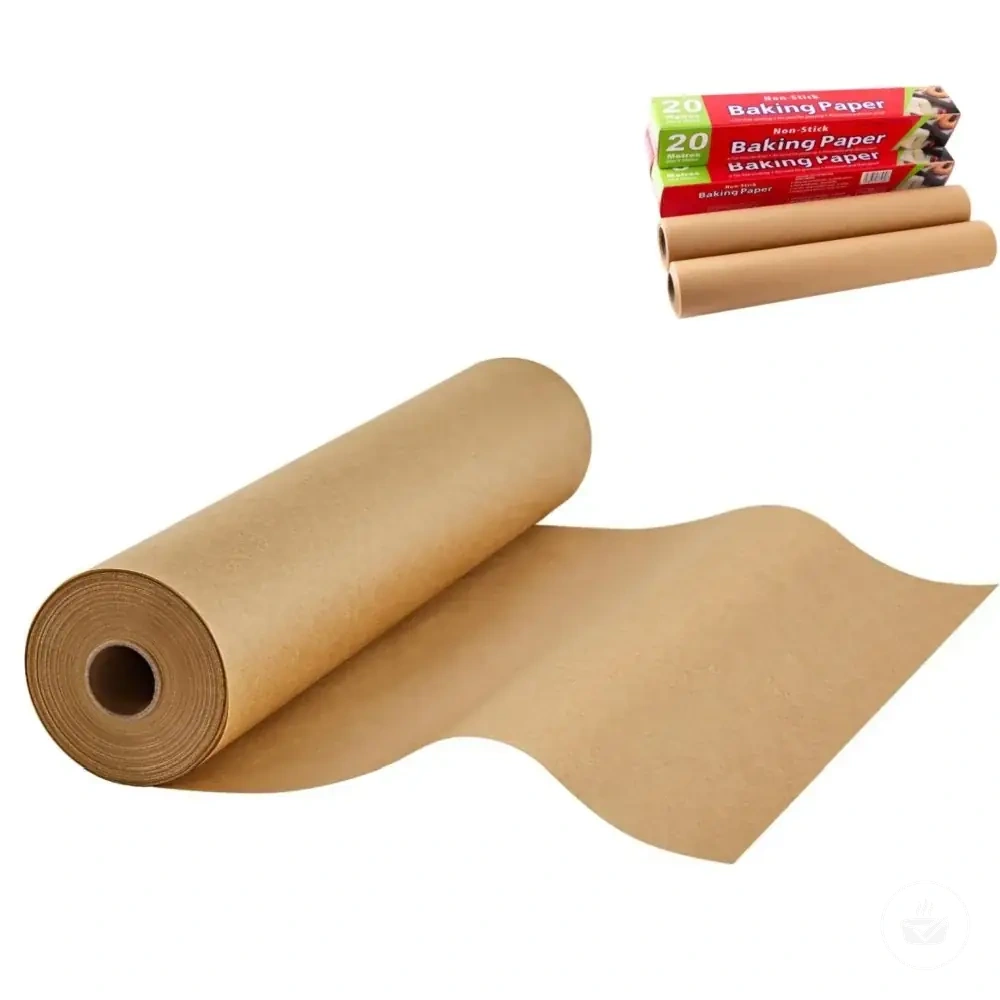
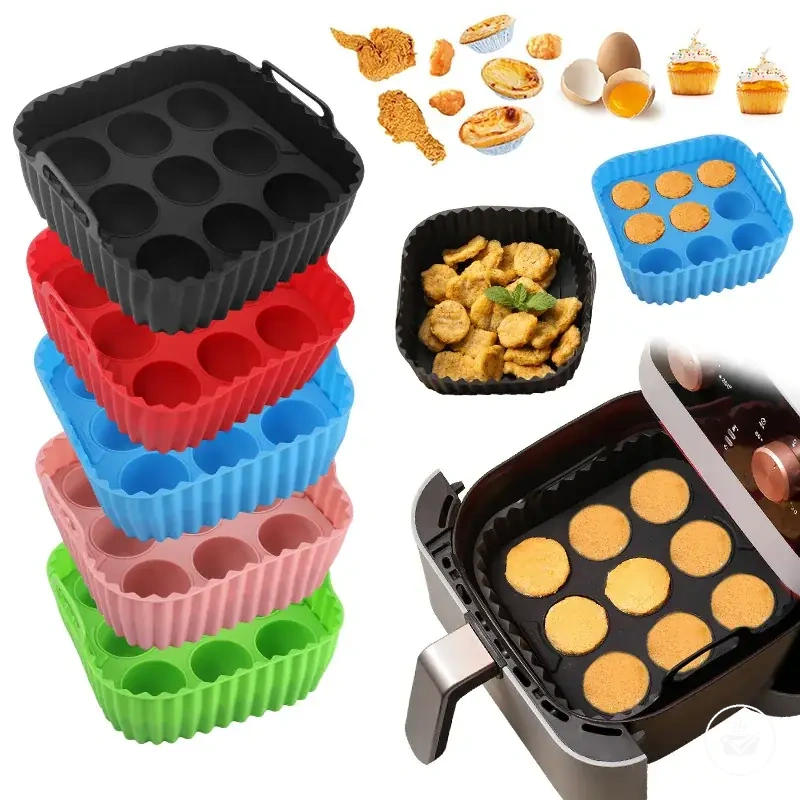
Use bakeware for structure, depth, and reusable baking support
Use bakeware when the cooking job requires structure, depth, pan walls, or reusable baking support. Bakeware provides rigidity and a reusable support surface that helps contain foods needing shape, while fit and basket clearance remain important. It is the better local choice when structure and depth determine the cooking result.
When preparing batter, cakes, muffins, or casseroles, bakeware supplies pan walls and depth that help keep the mixture contained, whereas a liner alone cannot provide structural support. A baking pan, tray, or mold offers rigidity and reusable support for foods that depend on shape, although browning and release may still vary with the recipe and cooking conditions. A liner can act as a surface barrier for easier release or cleanup, but it does not replace bakeware when the cooking job depends on structure, fit, and reusable support.
Use liners for drips, sticking, and lighter cleanup
Use liners when the cooking job prioritizes drips, sticking, and lighter cleanup instead of structural support. Liners act as a barrier surface between food and the basket, and they can help with residue control when the liner type, fit, and placement match the cooking task. Their main purpose is to support cleanup and food release rather than replace bakeware.
Choose liners according to the cleanup need and the type of food:
- Drips and grease: Liners can catch drips and grease, helping with residue control and potentially making basket cleanup lighter.
- Sticky coatings: Parchment or a liner sheet can help improve release when sticky coatings are more likely to cling to the basket.
- Crumbs: Liners can collect loose crumbs and provide basket protection by reducing direct contact with the basket surface.
- Reusable silicone: A silicone liner provides a reusable cleanup barrier but still requires washing after use.
- Perforation and fit: A perforated liner with suitable fit may preserve more airflow than a solid barrier, but airflow and crisping can still vary with food coverage and placement.
Use both only when fit and airflow remain safe
Use both only when bakeware plus a liner maintains safe fit, airflow, and stable placement inside the basket. The combined setup is appropriate only when clearance remains adequate, food contact stays suitable, and food weight keeps the liner stable. If any of these conditions cannot be confirmed, the combined setup should not be used.
Before combining bakeware and a liner, use this checklist:
- Clearance: Confirm that bakeware plus liner leaves enough clearance for airflow and does not create unnecessary overlap.
- Liner stability: Make sure food weight keeps the liner in place and that the combined setup remains stable during cooking.
- Vent openings: Avoid layering or positioning accessories in a way that blocks basket vents, crowds the basket, or conflicts with the item instructions.
- Food contact: Check that the liner material is suitable for food contact and fits the pan or basket without interfering with normal placement.
- Safe option: If fit, airflow, or clearance is uncertain, choose the simpler safe option instead of forcing both accessories together.