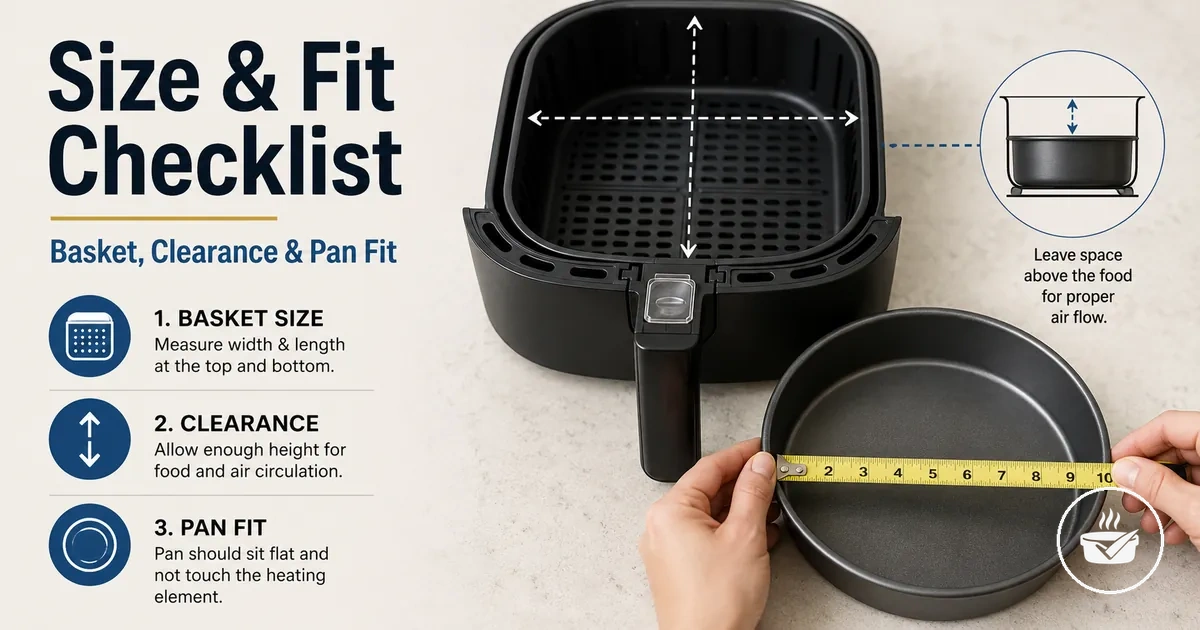
Air fryer bakeware size and fit checklist
Air fryer bakeware fit depends on measured usable space, not one universal pan size. A pan, tray, mould, or dish may physically enter the basket or drawer, but usable fit also requires enough room for stable placement, removal, and heat movement around the bakeware.
Capacity labels can mislead because they describe volume, while bakeware fit is controlled by internal width, depth, height, basket shape, corners, rims, handles, and the flat base area available inside the air fryer. For broader context before narrowing the fit checks, use the air fryer bakeware hub.
A sound size-and-fit decision starts with the actual air fryer interior and then compares those measurements with the bakeware’s full outside shape. Air fryer bakeware should be treated as a conditional fit choice: the same listed pan size can work in one model and feel too tight, too tall, or awkward to remove in another.
Fit factors that decide usable bakeware size
Usable bakeware size depends on multiple fit factors working together, not on a single pan measurement. Basket dimensions, pan shape, outer edges, clearance, and airflow all influence whether air fryer bakeware can fit comfortably and function as intended under the available space.
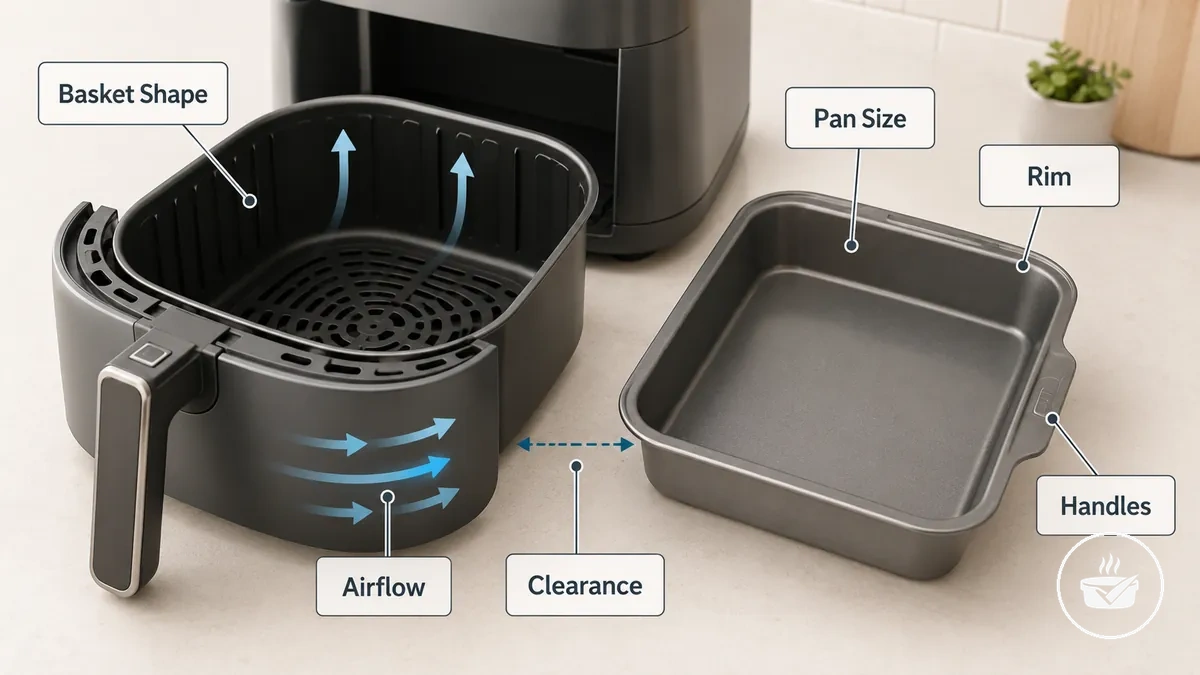
Pan-side and basket-side characteristics should be considered together instead of relying on one listed dimension. A pan's rim, handles, or depth may limit usable fit even when the base dimensions appear suitable. For example, outward-facing handles can require more space than the pan's stated width suggests.
- Basket shape: Rounded corners, tapered walls, and the flat base area can limit usable space.
- Pan dimensions: Outside measurements, including rims and handles, may matter more than the internal cooking area when assessing fit.
- Pan depth: A deeper pan may reduce available vertical space, depending on the air fryer design.
- Clearance: Available space around the pan can influence placement and removal.
- Airflow: Heat circulation may be reduced when bakeware occupies most of the available interior space.
Evaluating these fit factors together provides a more reliable basis for choosing usable air fryer bakeware than relying on a single measurement or a capacity label alone.
Air fryer basket measurements for pan sizing
Air fryer basket measurements should be taken from the usable interior because internal dimensions provide a more reliable basis for pan sizing than exterior dimensions. Whether a pan fits still depends on basket shape, curved corners, inserts, and the available flat base area, so internal measurements should be compared with the pan's outside dimensions rather than its stated capacity.
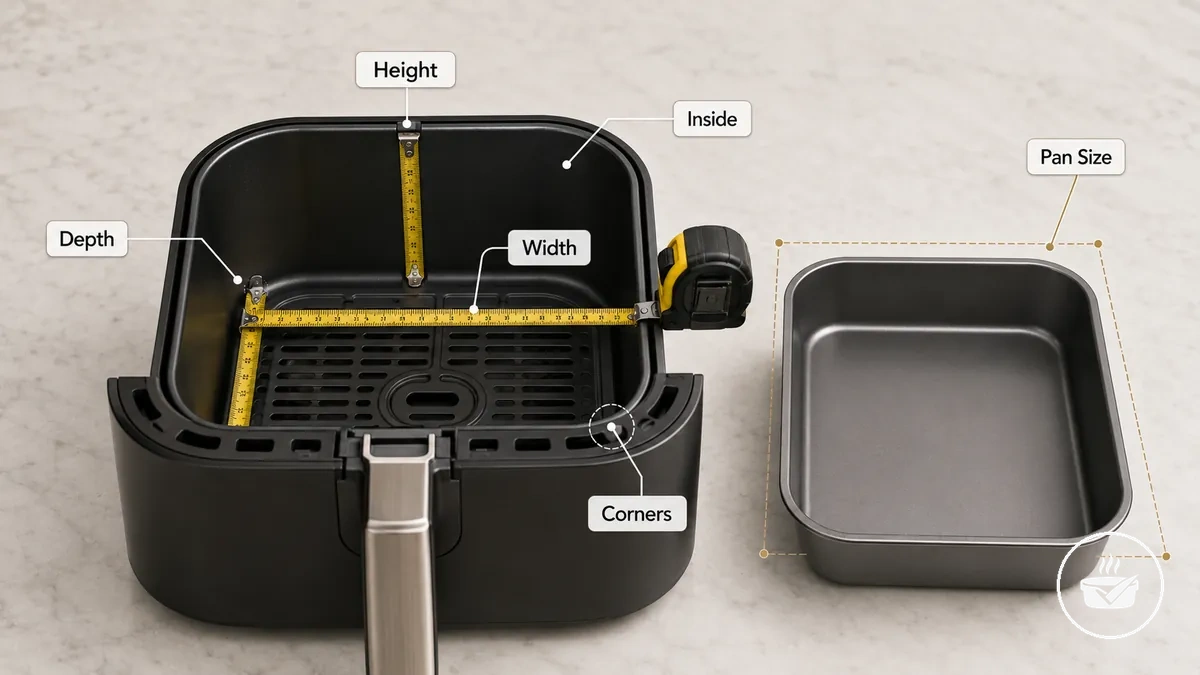
Measure the basket before selecting bakeware so each recorded dimension can guide pan sizing instead of relying on a single listed measurement.
- Measure the internal width across the usable cooking area because side walls or rounded corners may reduce available space.
- Measure the internal depth from front to back and compare it with the pan's full outside length.
- Measure the internal height to assess whether the pan and its contents may fit within the available vertical space.
- Record all measurements and compare them with the bakeware's outside dimensions, including rims and handles where applicable.
- Reject unsuitable matches when the usable base area or basket shape limits placement, even if the pan appears smaller than the basket. For example, a rectangular pan may still fit poorly if rounded basket corners prevent it from sitting flat.
Using basket measurements as a comparison method helps turn interior dimensions into a more reliable pan-sizing decision instead of relying only on visible size or capacity labels.
Internal width, depth, height, and usable base space
Internal width, depth, height, and usable base space should be checked together because each measurement defines a different fit limit. Internal width determines side-to-side space, internal depth determines front-to-back space, height determines available vertical room, and usable base space identifies the flat area that can support the pan.
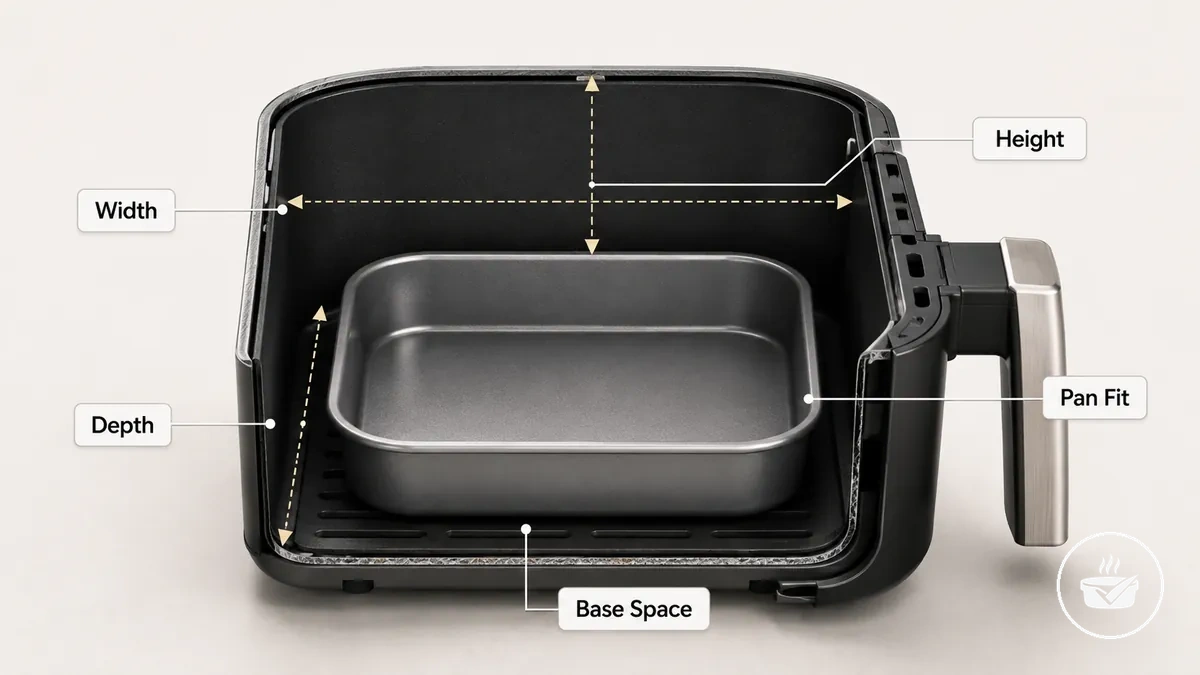
Checking each measurement separately provides a clearer fit assessment because no single dimension determines whether a pan can be used comfortably.
- Internal width: Determines whether the pan can fit between the basket walls, which may narrow if the walls taper.
- Internal depth: Determines whether the pan can fit from front to back within the usable interior.
- Height: Determines available vertical space. A pan may be too tall when its height reduces the space needed for placement or lifting.
- Usable base space: Refers to the flat surface that supports the pan. Rounded corners or raised basket features may reduce this area even when the basket appears larger from above.
Considering all four measurements together creates a more reliable pan-sizing decision because a pan that appears smaller than the basket may still fit poorly when the flat base area or basket shape limits stable placement.
Capacity labels versus usable basket dimensions
Capacity labels describe the overall volume of an air fryer basket, but they do not prove that a particular baking pan will fit. Usable basket dimensions remain the primary sizing reference because pan compatibility depends on the available internal space. Litre and quart ratings can provide general size orientation, yet the final fit should still be verified against the basket's usable dimensions.
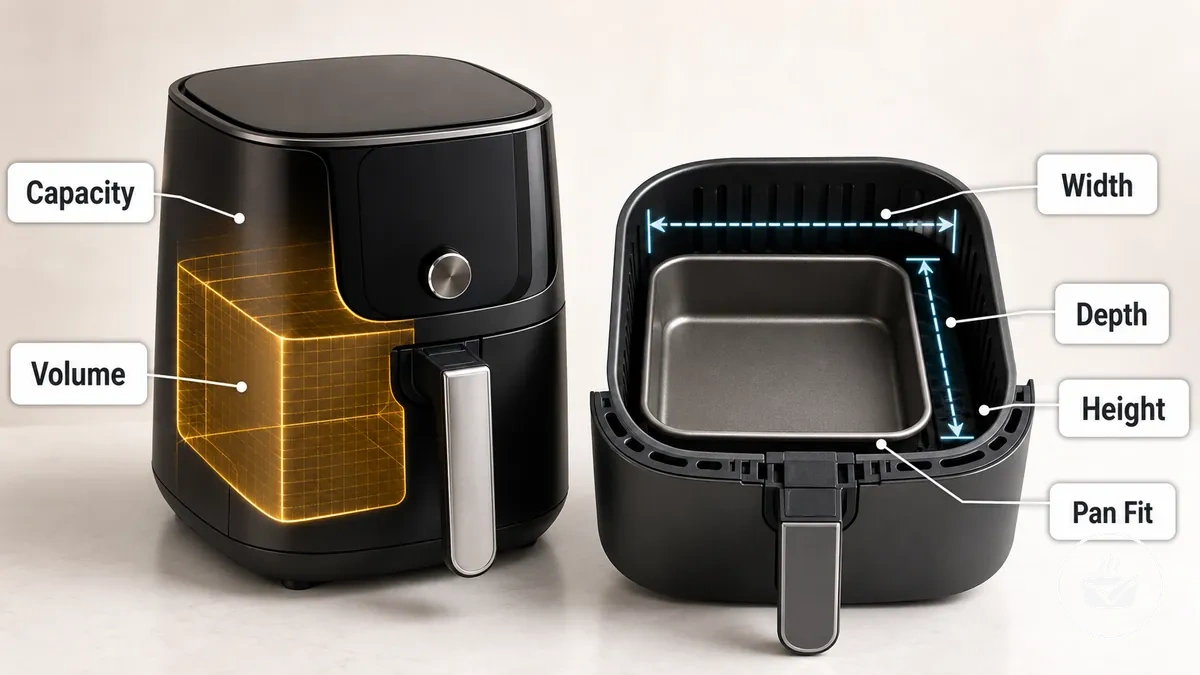
A capacity label indicates basket volume, whereas usable basket dimensions describe the physical space available for bakeware. Two air fryers with similar litre or quart ratings may still accommodate different pan sizes because their internal width, depth, height, or basket shape can differ.
- Capacity label: Describes basket volume and can provide a general size reference.
- Usable basket dimensions: Determine whether a pan may physically fit inside the basket.
- Similar capacities: Do not necessarily indicate identical pan compatibility because usable interior dimensions can vary by design.
- Sizing decision: Should be verified by comparing the pan's outside dimensions with the basket's usable interior.
Using capacity labels together with usable basket dimensions provides a more reliable sizing assessment. Capacity offers general context, while usable interior dimensions provide the practical basis for evaluating whether a baking pan is likely to fit comfortably.
Basket-style and oven-style measurement differences
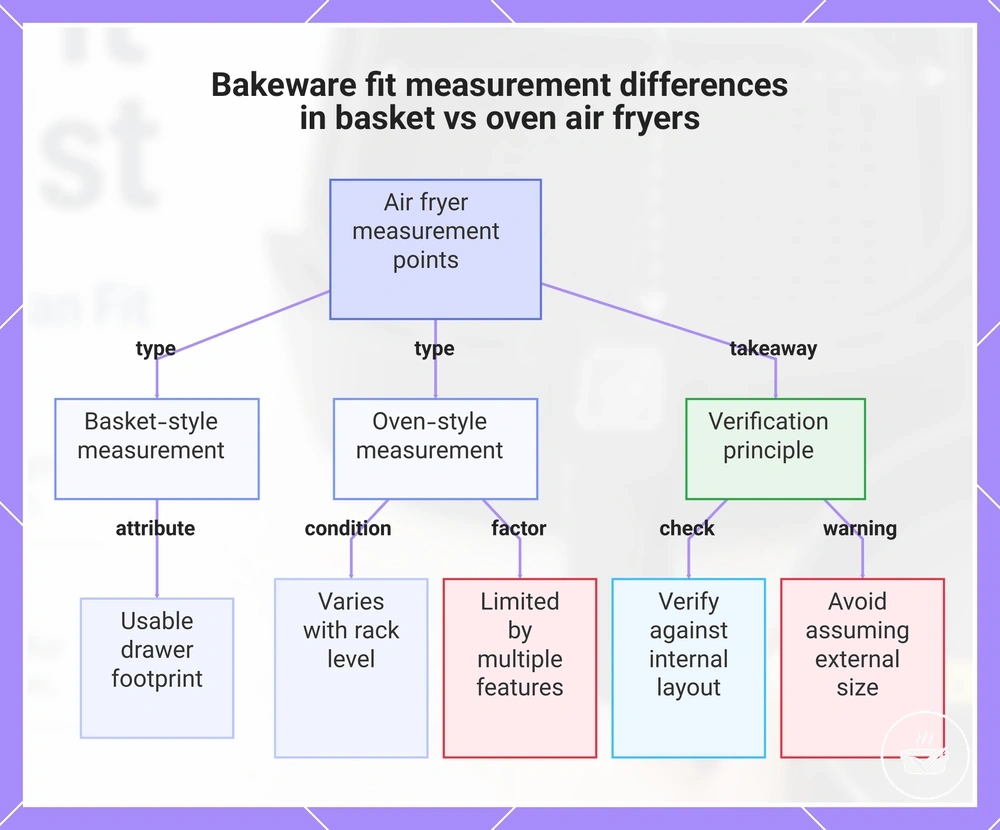
Basket-style and oven-style air fryers use different measurement points, so bakeware fit depends on checking the correct internal reference for each format. A basket-style air fryer is measured around the usable drawer footprint, while an oven-style air fryer may require verification of tray rails, rack height, and door clearance before assessing whether bakeware is likely to fit.
In a basket-style air fryer, the usable drawer footprint usually defines the available cooking space. In an oven-style air fryer, the available position can change with the selected rack level, and tray rails, rack height, door clearance, or heating-element location may limit the usable space. As a result, fit should be verified against the appliance's internal layout rather than its external size or format alone.
Understanding these format-specific measurement points helps keep sizing checks consistent without assuming that similar appliance dimensions provide the same usable interior. For broader guidance on selecting bakeware across appliance designs, see basket and oven-style compatibility.
This chart shows the different measurement points for bakeware fit in basket-style and oven-style air fryers, emphasizing that fit must be verified against internal layout rather than external size.
Pan shape and measurement checks
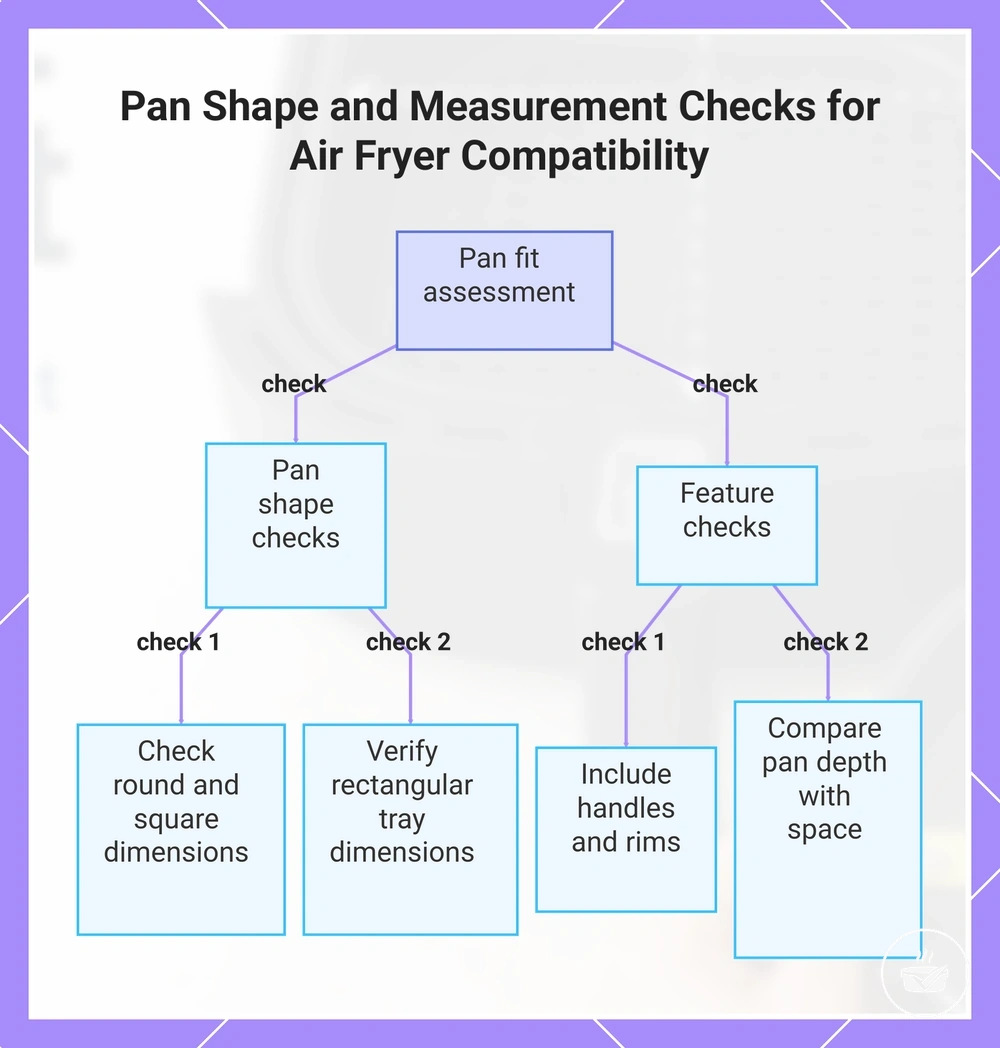
Pan shape and measurement checks start after the basket has been measured because external shape influences usable fit as much as the listed dimensions. A round pan, square pan, or rectangular tray may occupy the measured space differently, while rims, handles, and pan depth can change the overall footprint that must fit inside the air fryer.
Use the following checklist to compare the measured basket space with the bakeware's actual external shape rather than relying only on the listed diameter or length.
- Round pan: Compare the outside diameter with the usable basket space because the outer rim may extend beyond the cooking area.
- Square pan: Check the full outside width and length, especially where rounded basket corners may reduce the available space.
- Rectangular tray: Verify the complete outside dimensions because the tray shape may require more usable space than its nominal size suggests.
- Handles and rims: Include protruding handles and rolled rims in the overall measurement because these features can increase the required space.
- Pan depth: Compare the overall height with the available vertical space because deeper pans may require additional room depending on the appliance design.
These shape-specific checks help translate basket measurements into a practical fit assessment. A listed diameter or length may not represent the pan's full external footprint, so the complete outside shape should be verified before concluding that the bakeware is likely to fit.
This chart illustrates the key shape and feature checks needed to assess whether a pan will fit inside an air fryer, going beyond nominal dimensions.
Round cake pans and cake barrels
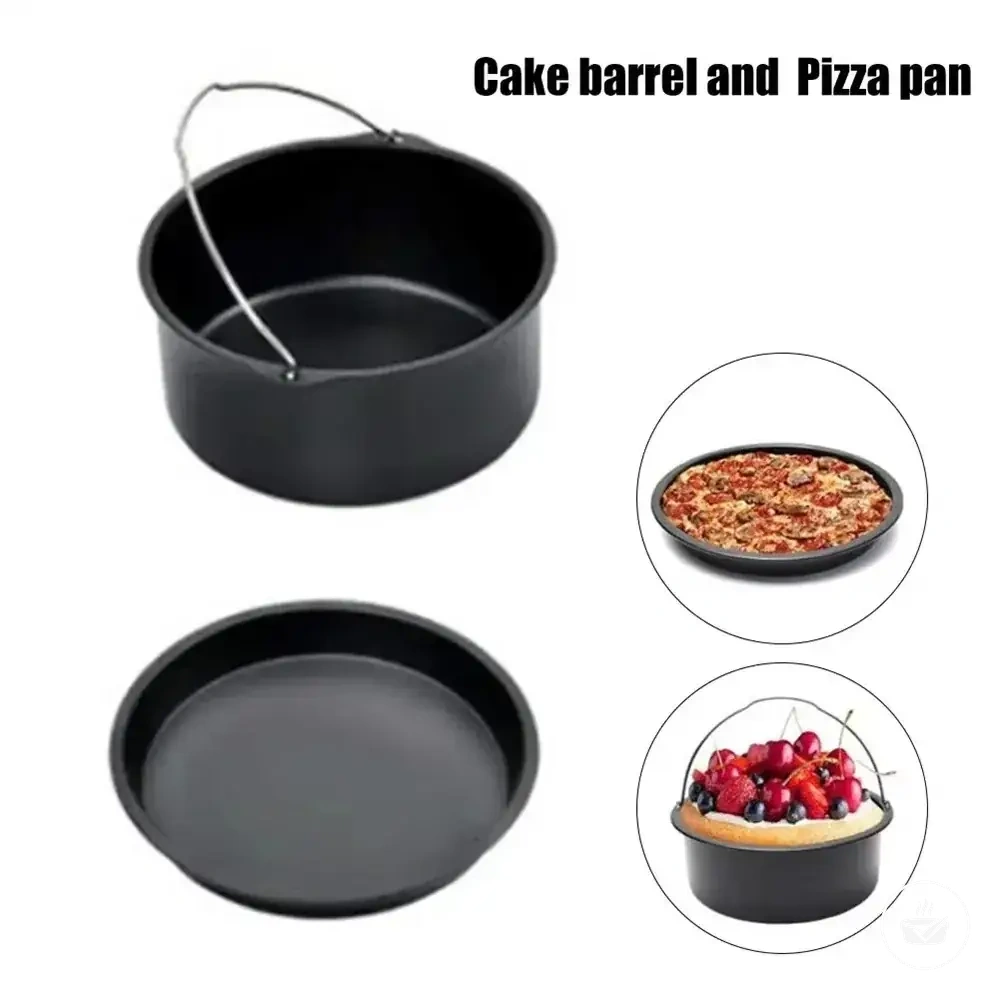
Round cake pans and cake barrels should be checked by their complete outside dimensions because diameter alone does not determine whether the bakeware is likely to fit inside an air fryer. The outside diameter, rim, depth, and available lifting space together determine whether the pan can sit flat and be removed comfortably after placement.
Use these checks when evaluating round bakeware:
- Diameter: Compare the full outside diameter with the measured basket footprint rather than the internal baking area.
- Rim: Measure any rolled or extended rim because it can increase the overall outside diameter.
- Handles: Include integrated handles in the total external measurement because they may affect placement or removal.
- Depth: Compare the pan height with the available vertical space because deeper bakeware may limit lifting clearance depending on the appliance design.
For example, a round cake pan may match the basket footprint by diameter but still be difficult to remove if its depth leaves limited lifting space. A cake barrel should be checked in the same way because both the circular footprint and the overall height influence whether it can sit flat and be removed safely.
Square baking pans and brownie pans
Square baking pans and brownie pans should be checked against the usable basket footprint because square corners require corner space that a round pan does not. Fit depends on the measured length, width, wall taper, and flat base area rather than the nominal pan size alone.
Use these checks when evaluating square bakeware:
- Corners: Compare all four outside corners with the usable basket footprint because rounded basket corners may reduce available space.
- Length and width: Measure the full outside dimensions instead of relying on the internal baking area.
- Flat base: Check that the pan can sit flat on the usable base without corner interference.
- Rim thickness: Include the outer rim because it can increase the pan's overall footprint.
- Wall taper: Consider whether tapered basket walls or pan sides change the available space near the top of the basket and affect removal.
A square baking pan with the same nominal width as a round pan may require more usable basket space because its corners extend farther into the basket footprint. Verifying the complete outside shape helps determine whether the pan can sit flat and be removed comfortably.
Rectangular trays and small sheet pans
Rectangular trays and small sheet pans should be checked by orientation first because length and width determine whether the bakeware is likely to fit inside the air fryer basket. Rotating the tray may change how it enters the basket, but usable fit still depends on the remaining clearance for stable placement and removal.
Use these checks when assessing rectangular bakeware:
- Orientation: Compare both lengthwise and widthwise placement because one direction may better match the basket footprint.
- Length and width: Measure the complete outside dimensions rather than the internal cooking surface.
- Rim height: Include the outer rim because it contributes to the tray's overall dimensions and may influence removal space.
- Handle extension: Measure any integrated handles or projecting edges because they can increase the required basket space.
A rectangular tray that appears to fit after being rotated may still offer limited usable clearance if its length, width, or projecting features leave little room around the basket. Checking orientation together with the tray's complete external dimensions provides a more reliable sizing assessment.
Handles, rims, and pan depth
Handles, rims, and pan depth should be included in the external measurement because listed base dimensions may exclude protruding or vertical features. These added dimensions can affect whether a pan fits inside the air fryer basket and whether there is enough lifting space for removal.
Check these features before comparing a pan with the measured basket dimensions:
- Handles: Include any integrated or projecting handles because they can extend beyond the pan's base and require additional basket space.
- Rims: Measure the outer rim because rolled or extended edges add to the overall external size.
- Pan depth: Compare the total height with the available vertical space because deeper pans may reduce lifting space, depending on the basket design.
- External measurement: Verify the pan's complete outside dimensions rather than relying only on the listed base size.
A pan does not necessarily become unsuitable because it has large handles, a wide rim, or greater depth. These features should be compared with the basket dimensions and available clearance to determine whether the pan can fit and be removed comfortably.
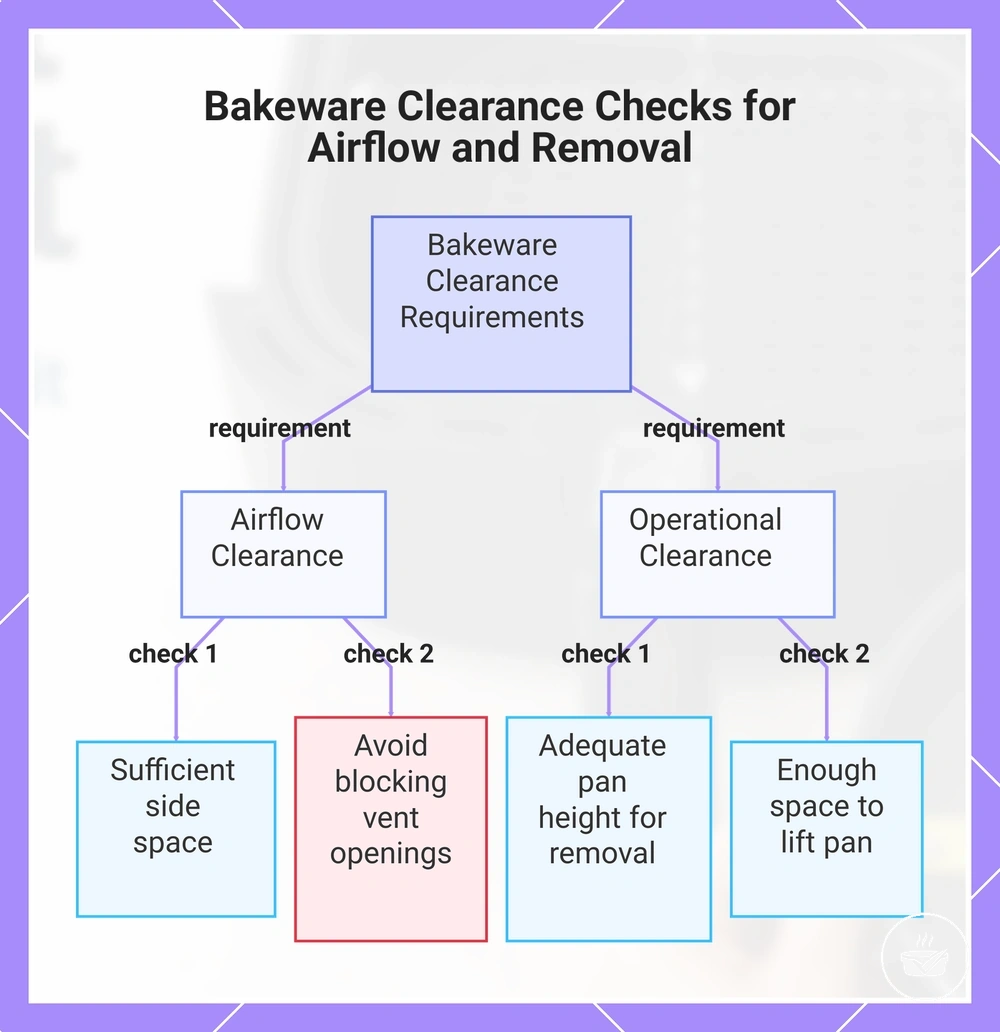
Clearance around bakeware for airflow and heat
Clearance around bakeware depends on more than physical fit because airflow and heat movement require usable space inside the air fryer basket. A pan that fits tightly may restrict airflow or reduce removal space, although the effect can vary by basket design, vent position, pan height, and food load.
Check the space around the bakeware as well as its external dimensions. Side clearance helps support airflow around the pan, while top clearance helps ensure the bakeware can be positioned and removed without unnecessary obstruction.
- Side clearance: Leave sufficient surrounding space so the pan does not sit tightly against the basket walls.
- Top clearance: Verify that the pan height leaves adequate room within the appliance's internal layout.
- Blocked vents: Avoid placing bakeware where it may obstruct vent openings or reduce air movement, when applicable to the appliance design.
- Removal space: Check that enough clearance remains to lift and remove the pan comfortably after cooking.
Usable fit depends on both basket dimensions and available clearance around the bakeware. For additional guidance on airflow when using bakeware, see the dedicated guide.
This chart shows the main clearance categories to check when using bakeware in an air fryer, focusing on airflow and safe pan removal.
When bakeware is too large, too deep, or too tight
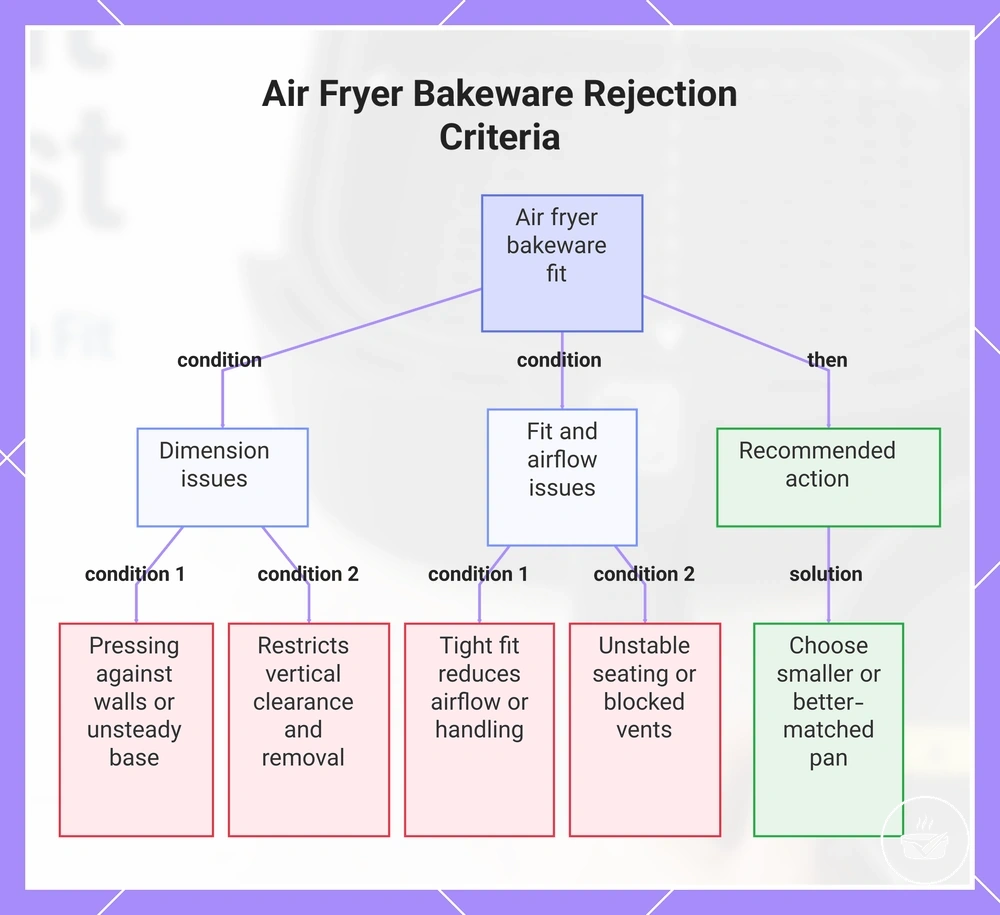
Bakeware should be rejected when it cannot sit securely inside the air fryer basket, leaves inadequate clearance, or makes removal unnecessarily difficult. A pan that physically enters the basket is not necessarily suitable if it fits too tightly, reduces usable clearance, or limits airflow around the bakeware.
Use these practical criteria before selecting or using a pan:
- Too large: Avoid bakeware that presses against the basket walls or cannot rest flat on the usable base.
- Too deep: Reconsider pans whose height leaves limited vertical clearance or makes lifting and removal difficult.
- Too tight: Reject bakeware that leaves very little surrounding space when the fit may restrict airflow or handling.
- Borderline fit: A pan that only fits after careful positioning may still be unsuitable if it reduces usable clearance for airflow or removal.
- Unstable seating or blocked vents: Choose a different pan when the bakeware cannot sit securely or may obstruct air movement, depending on the appliance design.
These visible fit conditions provide practical stop rules before use or purchase. If bakeware appears oversized, excessively deep, or uncomfortably tight for the available basket space, a smaller or better-matched pan is usually the more appropriate choice.
This chart shows the main conditions for rejecting bakeware in an air fryer, including dimension issues, fit and airflow problems, and the recommended action.
9 x 13 dishes and full-size tray edge cases
A 9 x 13 dish or full-size tray usually needs careful verification because nominal size does not confirm usable fit inside an air fryer. Physical entry is different from usable fit, and large bakeware may still fail if the outer rim, handle width, rails, or door clearance limits placement or removal.
Check the full outside dimensions rather than relying only on the named size. A 9 x 13 dish may have an outer rim or handles that extend beyond its nominal dimensions, while a full-size tray may be limited by the internal basket footprint or oven-style rail position.
In basket-style air fryers, diagonal or rotated placement should only be considered if the pan can still sit flat and leave usable clearance. In oven-style air fryers, rails and door clearance should be verified because a tray that enters the cavity may still be restricted by the support position or closing space.
Treat large dishes and full-size trays as edge cases rather than default bakeware choices. If the external size, rim, handle width, or appliance format makes placement tight or removal difficult, a smaller pan is usually the more practical sizing decision.
Size-fit checklist before buying air fryer bakeware
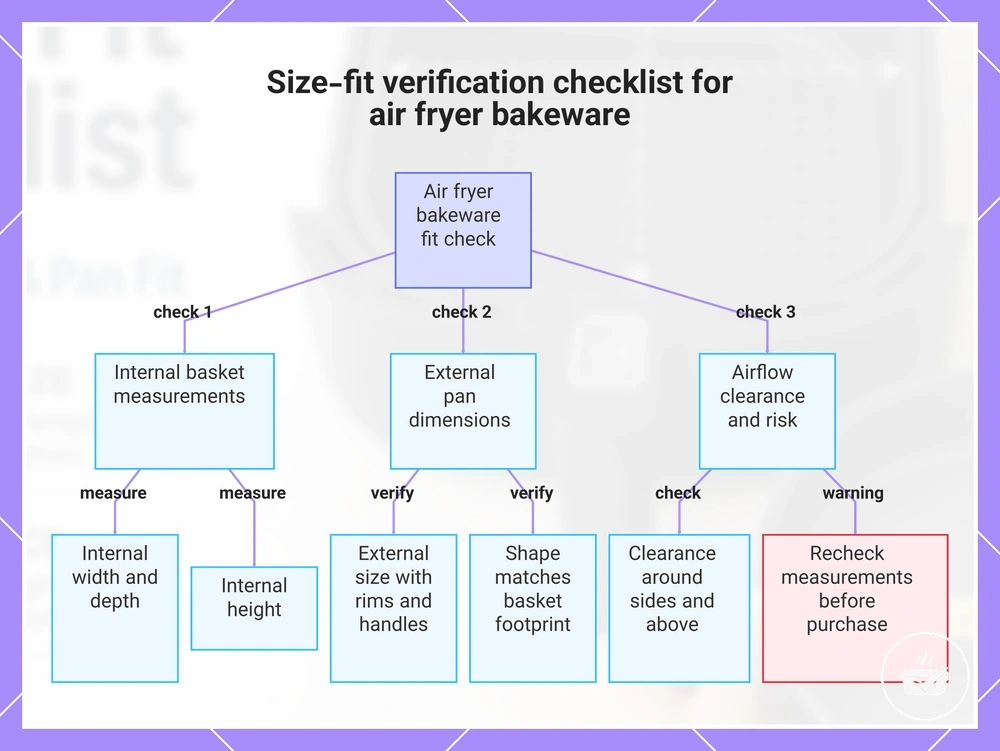
Size-fit verification should be completed before buying air fryer bakeware because pan compatibility depends on basket measurements, pan outer dimensions, and available clearance rather than the listed pan size alone. Verifying these criteria first can help reduce the likelihood of choosing bakeware that does not fit your air fryer.
- Basket measurements: Measure the usable internal width, depth, height, and base space.
- Pan outer dimensions: Compare the complete external size, including rims and handles, with the measured basket space.
- Airflow space: Check that the pan leaves usable clearance around the sides and above, where applicable.
- Pan shape: Verify that the shape matches the available basket footprint rather than relying only on its nominal size.
- Return risk: Recheck all measurements before buying because a pan that appears to fit by specification may still provide insufficient usable clearance. If you are selecting small air fryer bakeware, confirming dimensions is especially important.
Complete this checklist before making a buying decision. When basket measurements, pan shape, and available clearance all match your air fryer model, continue with how to choose air fryer bakeware for broader selection guidance.
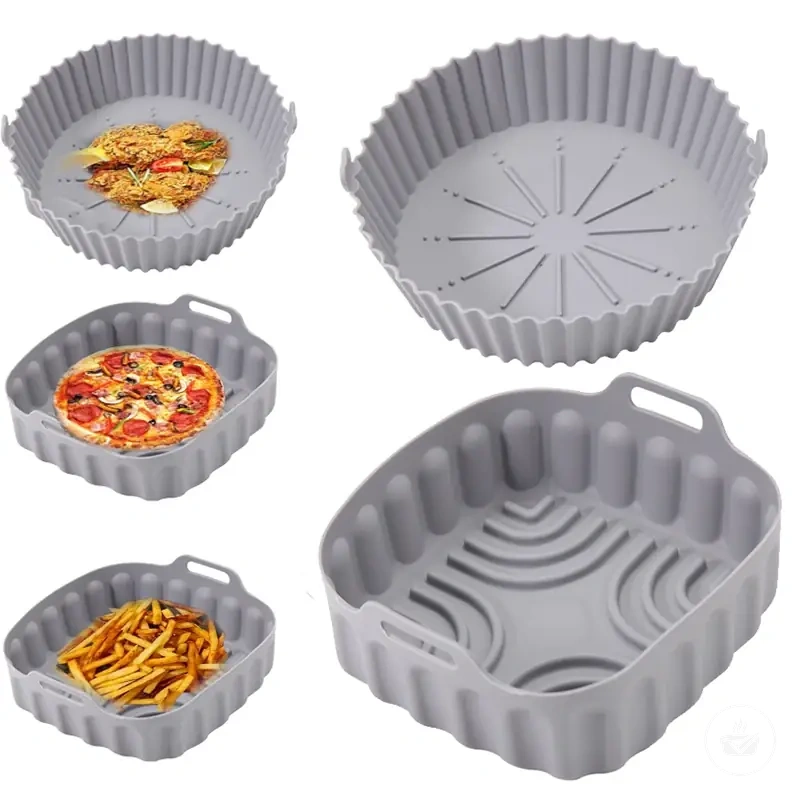
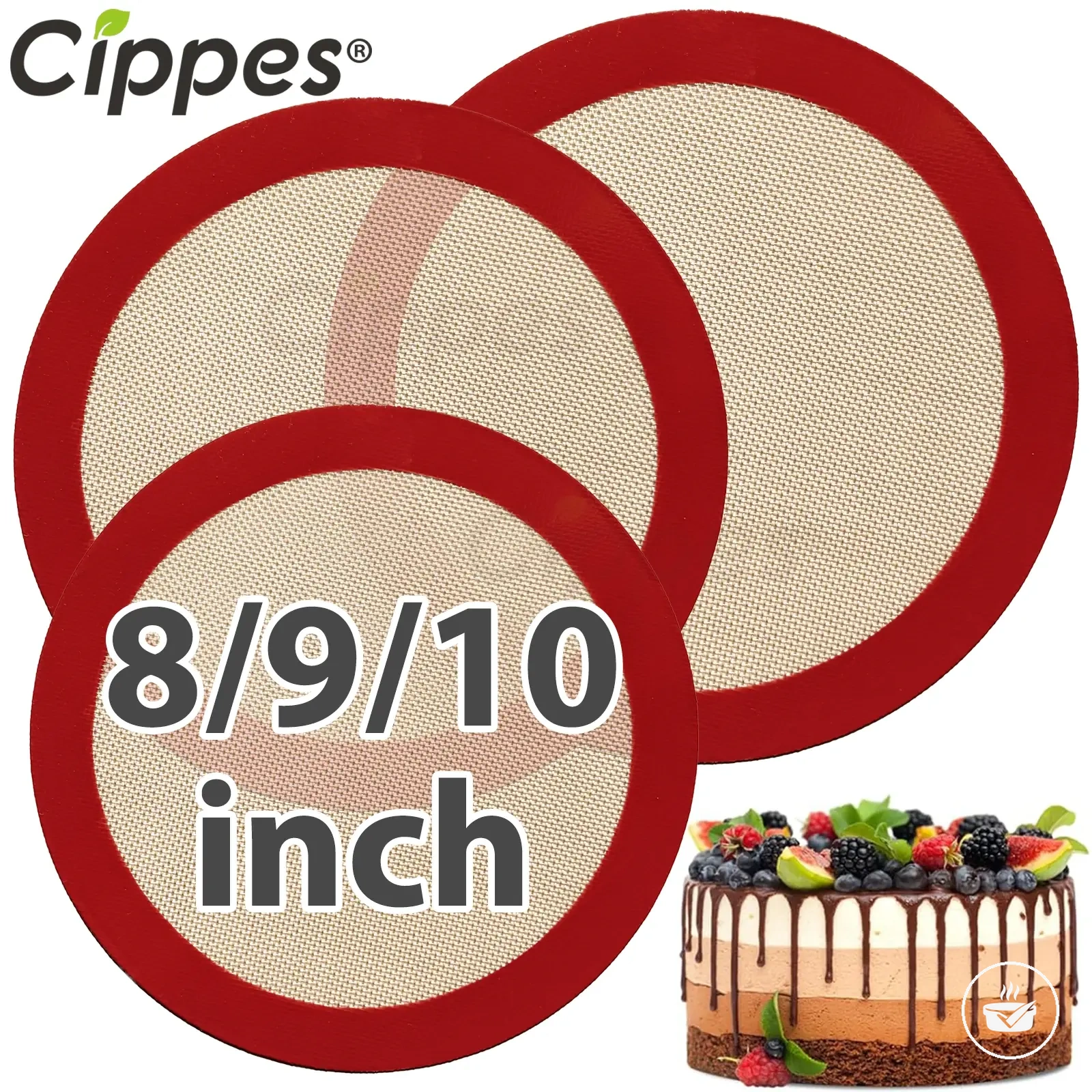
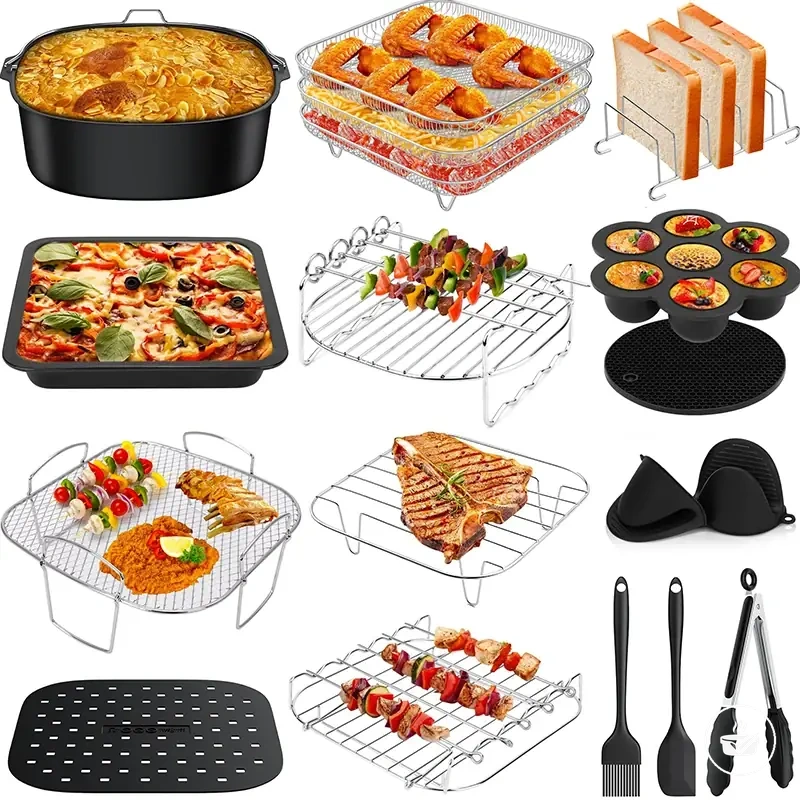
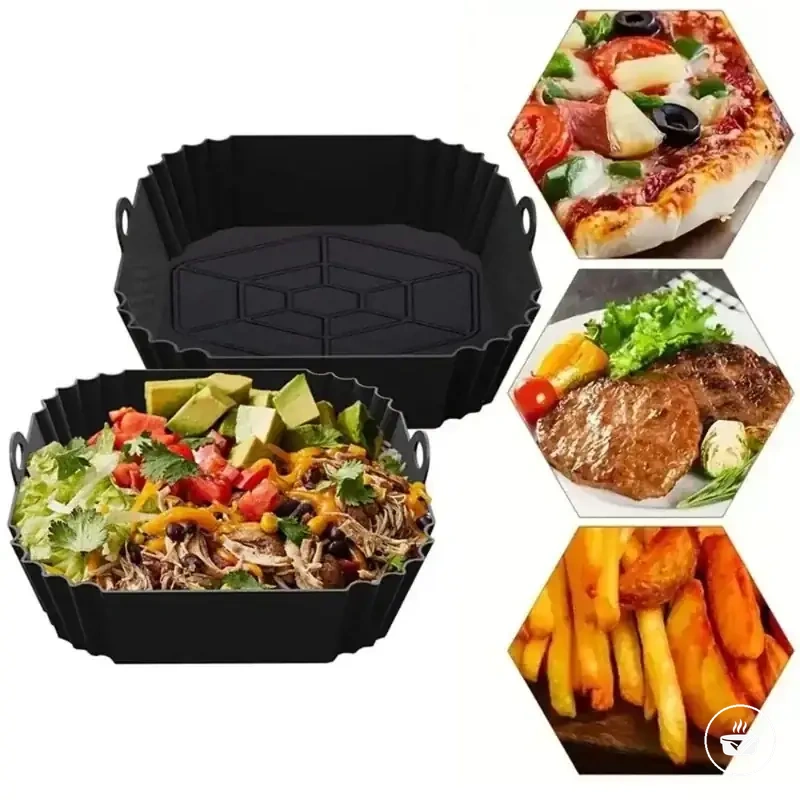
Here are product examples that may make comparison easier. Before buying, always review the compatibility criteria, essential features, and product details.
This chart shows the three main verification steps to ensure air fryer bakeware fits your model before purchase.