
Air fryer bakeware compatibility for basket and oven-style air fryers
Air fryer bakeware compatibility depends on the appliance format, usable cavity space, heat tolerance, and airflow. Air fryer bakeware must fit the cooking area without restricting normal use. Compatibility is determined by fit, heat tolerance, and airflow rather than by an air fryer label alone.
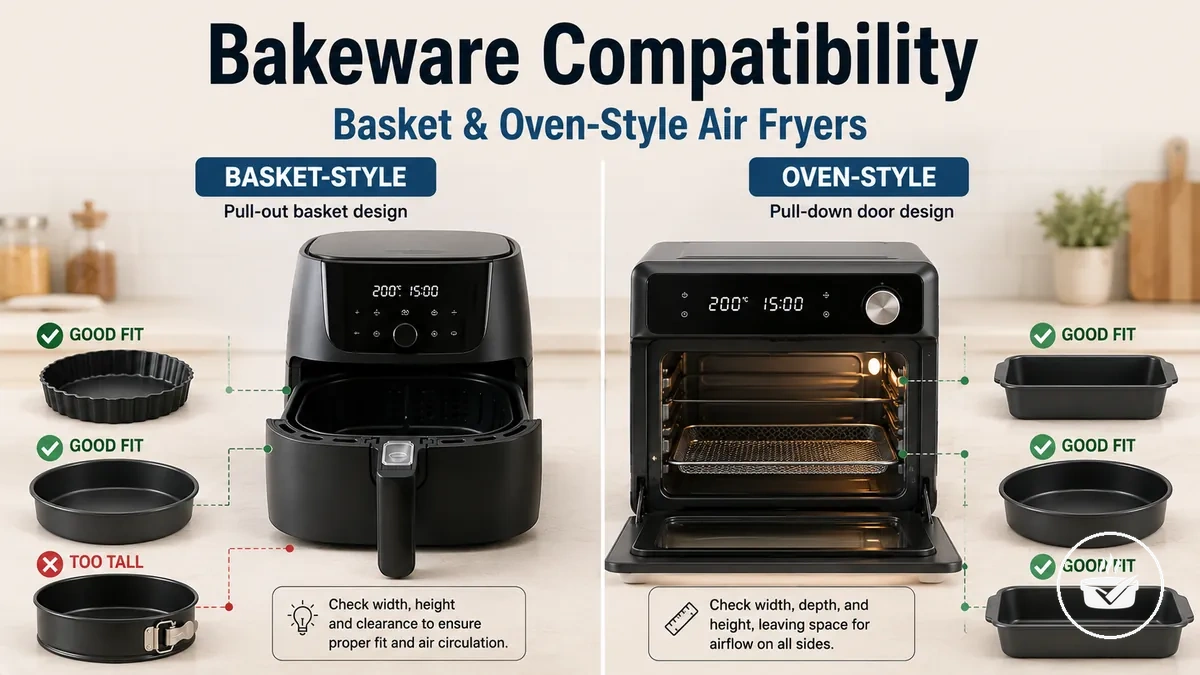
A basket air fryer and an oven-style air fryer create different compatibility conditions. A basket drawer limits the available footprint, side gap, and removal space, while an oven-style cavity may depend on tray rails, rack level, depth, and overall cooking cavity size. A container described as oven-safe or air-fryer-safe may still require clearance and airflow checks before it qualifies as a compatible option.
Air fryer bakeware compatibility is a criteria-based decision rather than a single product feature. A safe container should match the appliance format while leaving enough space for circulation. The following checks provide the foundation before moving into fit and clearance in greater detail.
The checklist below explains what to verify before deciding whether air fryer bakeware is compatible with your appliance.
- Check the usable cavity space instead of relying only on the appliance description.
- Confirm the bakeware provides enough clearance for insertion, removal, and normal airflow.
- Match the material and heat tolerance to the intended cooking conditions.
- Keep the airflow path open to reduce the chance of blocked circulation.
- Compare the expected cooking outcome, as browning and crisping may vary with bakeware fit and airflow.
What compatibility means for air fryer bakeware
Air fryer bakeware compatibility is the match between the bakeware, the appliance cooking cavity, heat tolerance, and airflow requirements. It defines whether the bakeware qualifies for use under the conditions of a specific air fryer. Fit, heat tolerance, and airflow work together to determine compatibility.
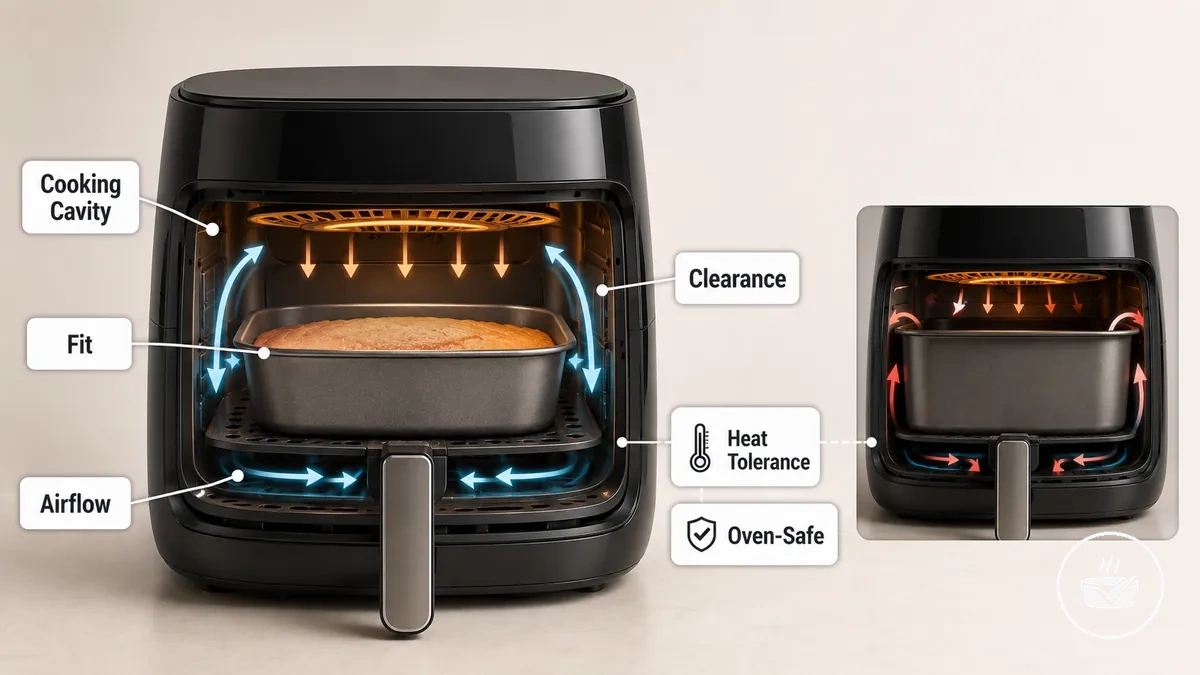
Air fryer bakeware compatibility is not determined by a single label. An oven-safe rating is necessary in many cases, but it does not confirm compatibility on its own when fit or airflow requirements are not met. For a broader overview of air fryer bakeware, compatibility still depends on cooking cavity fit, clearance, and airflow.
A common misconception is that any oven-safe dish is automatically compatible with an air fryer. In practice, compatible bakeware must fit the cooking cavity, provide enough clearance for handling, and preserve airflow around the food. A piece that blocks circulation may contribute to uneven cooking even if it tolerates heat. Oven-safe status is therefore necessary but not sufficient when physical fit or airflow conditions are not satisfied.
Air fryer bakeware compatibility depends on combined conditions rather than a single label:
- Verify that the bakeware fits the cooking cavity with enough handling clearance.
- Confirm the heat rating is appropriate for the intended cooking conditions and appliance guidance.
- Leave enough airflow gap so circulating air is not unnecessarily blocked.
- Check that the bakeware can be inserted and removed safely without interfering with normal appliance use.
Basket and drawer air fryer bakeware compatibility
Basket air fryer bakeware compatibility depends on usable floor space, side clearance, pan height, and removal access. A baking pan may fit one drawer air fryer but not another with a different basket shape. Check the removable basket itself instead of relying on capacity labels. The main fit filters are footprint, height, handle clearance, and airflow gap. The image below labels the drawer, pan, side gap, and removal access.
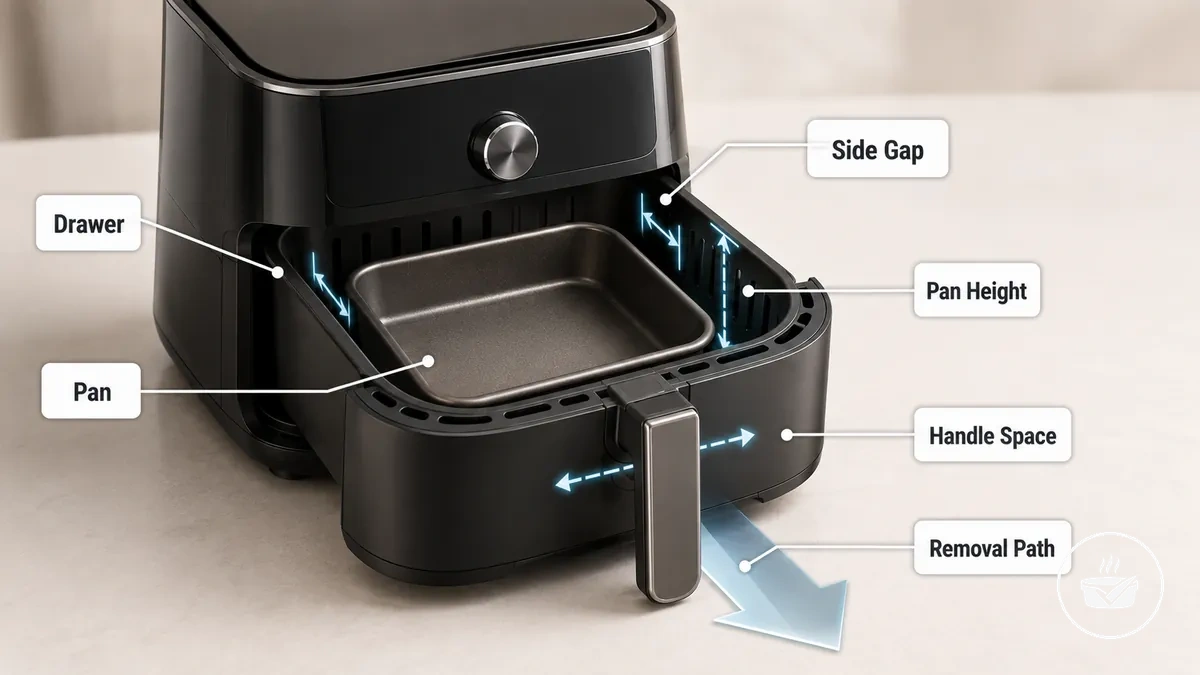
A drawer-style air fryer may have rounded corners or tapered walls that reduce the usable footprint. A baking pan that matches the base more closely can leave more usable floor space than one with square corners that touches the basket walls. The practical fit depends on the internal shape as well as the usable floor space.
Pan height also affects compatibility because the bakeware must slide into the basket and be removed without difficulty. Tall sides or projecting handles may reduce handling space even when the base fits. Confirm enough handle clearance before using the removable basket.
Basket and drawer compatibility depends on usable internal space rather than a single measurement. Use this checklist to verify fit before purchase:
- Compare the pan footprint with the usable basket floor.
- Check whether the basket corner shape leaves enough side clearance.
- Confirm the pan height allows the basket to close normally.
- Make sure handles or rims leave enough handling clearance for controlled removal.
- Leave an airflow gap around the pan instead of filling the basket wall to wall.
- Ensure the pan can be inserted and removed without catching on the basket.
Compact, single-drawer, and dual-drawer layouts can change the available space even when their stated capacities appear similar. A compact basket may require a smaller baking pan because the usable footprint or height is more limited. If you are comparing smaller drawer-style models, see bakeware for small air fryers for a more focused example.
Pan footprint and drawer clearance
Pan footprint is the first local fit filter for basket and drawer air fryers. A pan should sit flat, slide into the drawer cleanly, and leave usable edge space around its base. The listed outside size alone may not reflect the usable footprint because basket walls and a tapered drawer can change the available space. Check the pan width, length, diameter, and corners before judging compatibility.
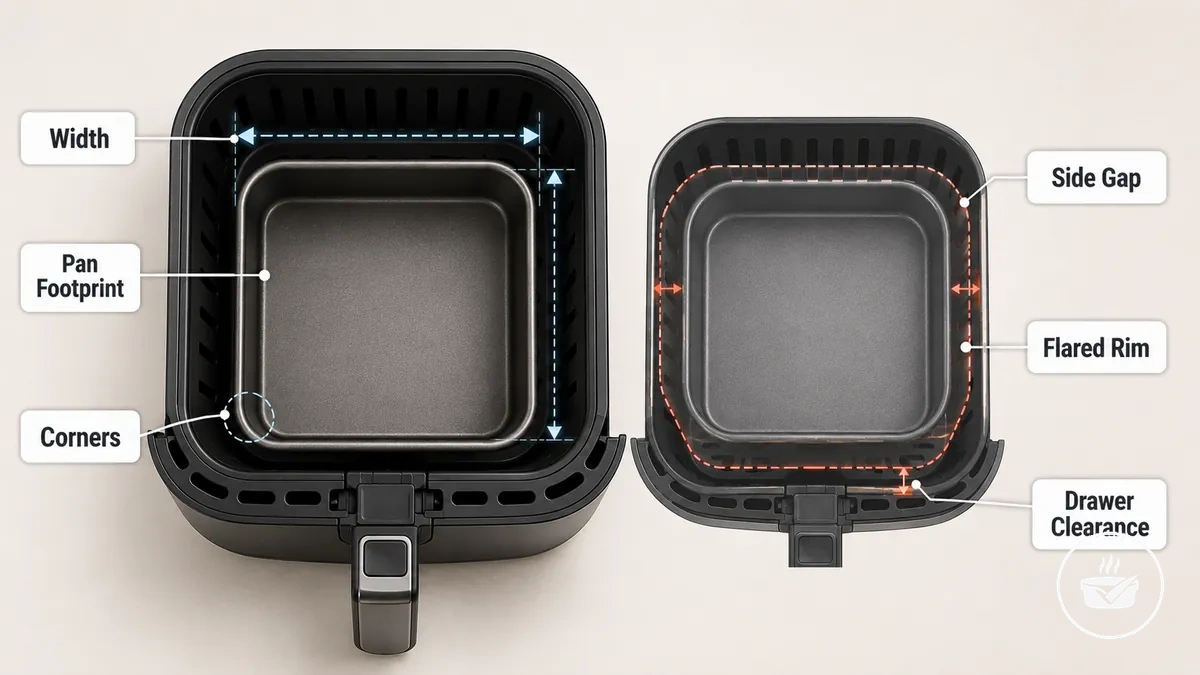
Pan footprint and drawer clearance should be checked together before choosing bakeware. Use this checklist as a local measurement guide:
- Measure the pan base instead of relying only on the labelled outside dimensions.
- Allow for a flared rim if it extends beyond the base width.
- Compare the pan corners with rounded basket corners or a tapered drawer.
- Leave a side gap so the pan is less likely to restrict airflow against the basket wall.
- Check the insertion path because handles or a flared rim may increase the usable footprint.
A labelled diameter alone may not confirm whether a pan will pass the basket opening or sit flat after insertion. Rounded corners, tapered walls, handles, and a flared rim can all reduce usable drawer clearance. For broader measurement guidance, see air fryer bakeware size and fit, and compare the pan with your measured usable internal space.
Pan height, handles, and removable basket space
Pan height and handle clearance should be checked before placing bakeware into a removable basket because vertical clearance affects insertion and removal. A pan may fit by width but still become difficult to move if the rim or handles extend into the available space. Pan height, rim, and handles determine whether the basket can be used with less risk of obstruction. The image below labels the vertical and handling constraints, including the top gap and removal path.
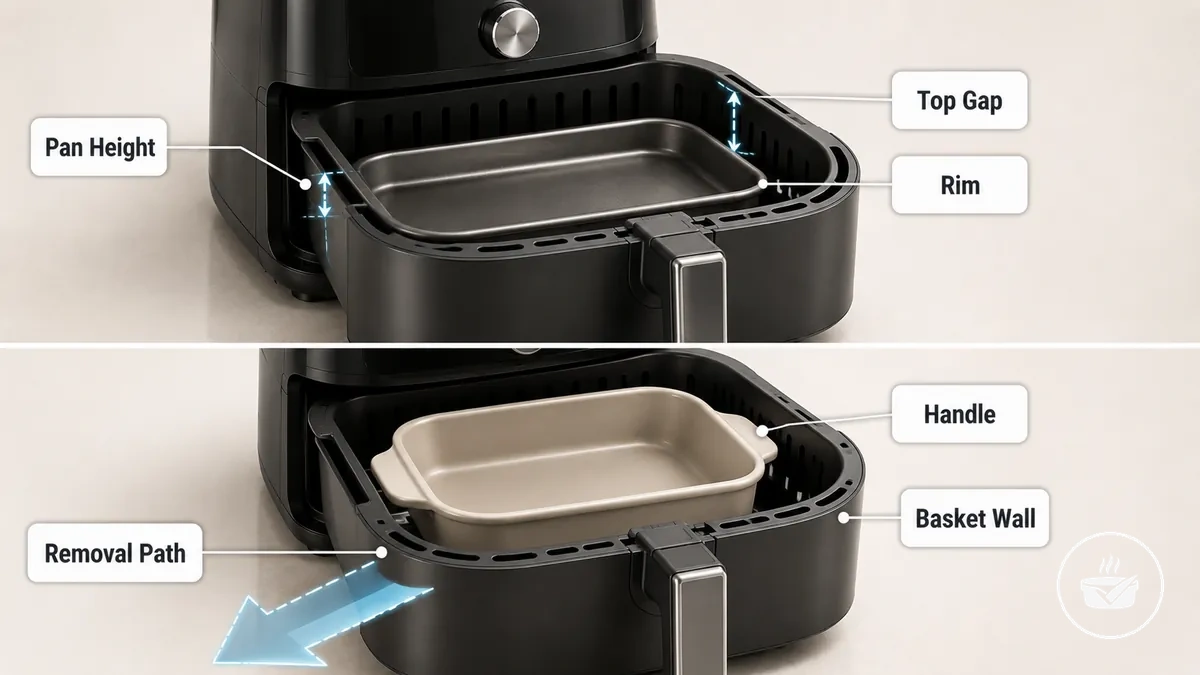
Pan height, handles, and removable basket space work together to determine usable clearance. Check these local fit points before using the pan:
- Compare the rim height with the available vertical clearance inside the removable basket.
- Check whether handle protrusion reduces grip space or creates an obstruction during insertion or removal.
- Consider whether a lid or cover adds extra height that may reduce top clearance.
- Confirm there is enough removal angle to lift the pan without catching on the basket wall.
A low pan may leave more vertical space, while a handled dish may require additional grip space during removal. Either design can be suitable when it matches the available basket insert and clearance. Compare pan height, handles, and removable basket space with the measured usable depth of your appliance rather than relying on width alone.
Oven-style air fryer tray and rack compatibility
Oven-style air fryer tray and rack compatibility depends on cavity width, rail spacing, usable depth, and the airflow path. Unlike a basket model, an oven-style air fryer also relies on stable support from tray rails and the selected rack level. Overall tray size alone is not enough because support points, door clearance, and circulation all influence compatibility. The main criteria are cavity width, rail spacing, usable depth, and the airflow path.
An oven-style air fryer tray should rest securely on the tray rails at the intended rack level before it is considered compatible. A tray that fits inside the cavity but does not align with the tray support may become less practical to use. A mesh tray can help preserve the airflow path when it suits the oven layout, while pan pairing should still leave enough space for circulation and rear fan clearance where applicable. If support or airflow conditions are limited, cooking results may vary even when the tray fits physically.
Oven-style air fryer tray and rack compatibility depends on both support and airflow rather than dimensions alone. Use the table below to organize the main support and airflow checks before treating a tray or rack as compatible.
| Part | Fit attribute | Condition to verify | Compatibility effect |
|---|---|---|---|
| Tray rails | Rail spacing | Tray rests securely on both supports | Improves stability during use |
| Rack level | Support position | Selected level provides suitable clearance | Helps maintain usable cooking space |
| Cavity depth | Usable depth | Tray clears the door and rear area | Reduces fit-related interference |
| Mesh tray | Airflow path | Open design leaves space for circulation | Can support more even air movement |
| Pan pairing | Combined fit | Pan and tray leave adequate support and circulation space | Compatibility depends on both support and airflow |
Tray rails, rack levels, and usable cavity depth
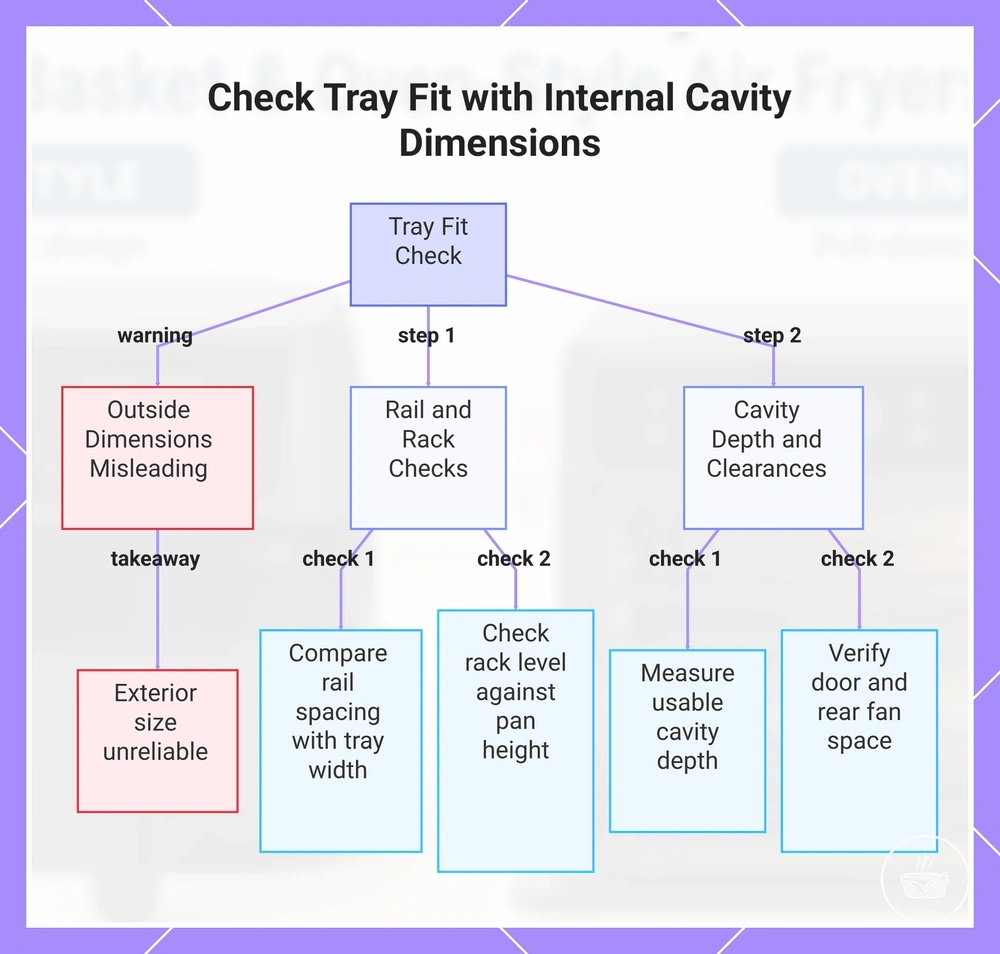
Tray rails, rack levels, and usable cavity depth define the real tray area inside an oven-style air fryer. Outside appliance dimensions do not show whether a tray has stable support, door clearance, or rear fan space. Rail spacing, rack position, usable depth, door clearance, and rear fan space all affect whether the tray reaches a stable fit.
A raised rim or deep pan can change the usable depth even when the tray width appears suitable. If the pan blocks door closure or sits too close to the rear fan area, the fit may become obstructed. Check the measured condition inside the cooking cavity rather than assuming listed capacity equals bakeware capacity.
Tray rails, rack levels, and usable cavity depth should be checked together because the list verifies supported internal tray space, not exterior appliance size:
- Compare rail spacing with tray width to confirm stable support.
- Check the rack level against pan height so the tray does not create an obstruction.
- Measure usable cavity depth to confirm the tray can sit fully inside the cavity.
- Verify door clearance so raised rims or deeper pans do not interfere with closure.
- Leave rear fan space where the appliance design requires circulation behind the tray.
This chart shows the key internal dimensions and checks needed to verify tray fit inside an oven-style air fryer, warning that exterior sizes are not reliable.
Raised mesh trays and basket-and-pan sets
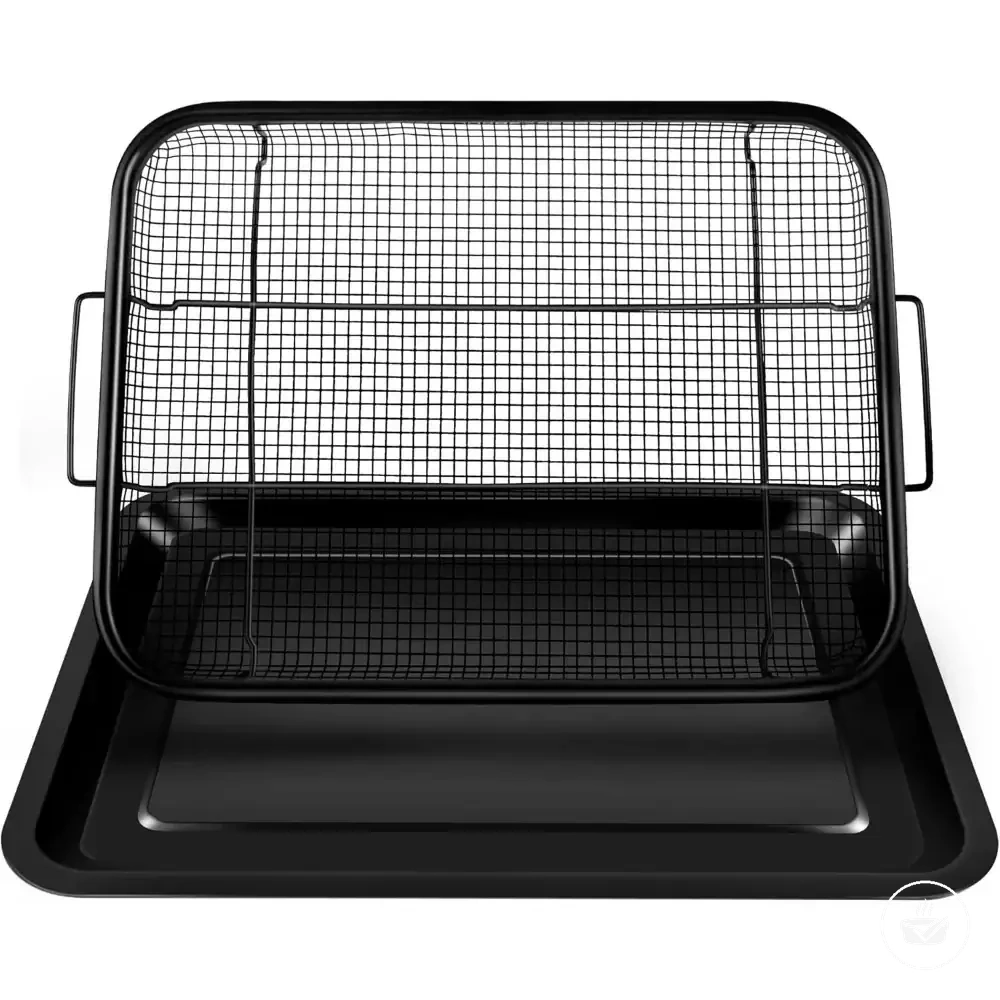
Raised mesh trays and basket-and-pan sets help preserve airflow by lifting food above a supporting surface and separating drips from the airflow path. A raised mesh tray uses elevation and perforation to leave more open space around the food, while a basket-and-pan set places a drip pan beneath the mesh for collection. The local attributes are mesh height, perforation, drip pan pairing, and stability.
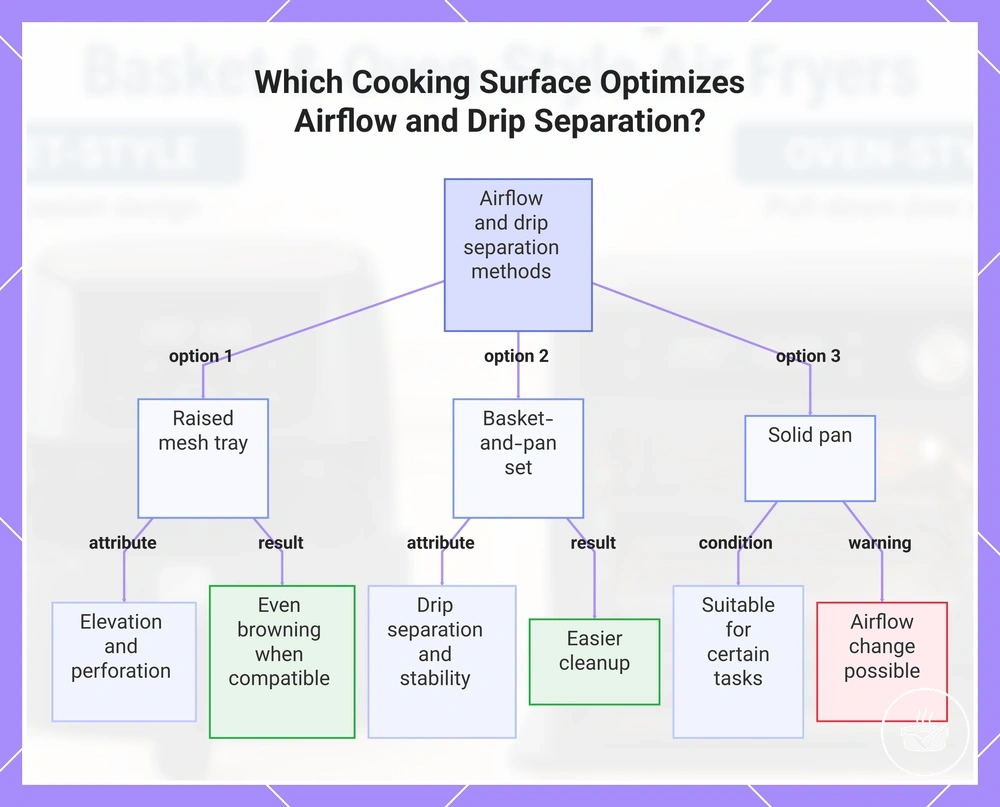
Raised mesh trays and basket-and-pan sets solve airflow and drip-separation limits. The comparison below highlights when the design difference can affect compatibility:
- Raised mesh tray: Elevation and perforation help maintain airflow around the food and may support more even browning when the tray is compatible with the appliance.
- Basket-and-pan set: A drip pan beneath the mesh can separate drips from the airflow path while adding stability and making cleanup easier in many cases.
- Solid pan: A solid surface may suit some baking tasks, but it can change airflow compared with a raised mesh tray depending on the pan design and available clearance.
This chart compares three types of cooking surfaces—raised mesh tray, basket-and-pan set, and solid pan—based on their airflow, drip separation, and suitability.
Airflow clearance inside the cooking cavity
Airflow clearance inside the cooking cavity depends on whether compatible bakeware leaves enough space for hot air circulation around or through the food. Bakeware position influences how air moves during cooking. Side gap, top gap, perforation, elevation, and the fan path are the main compatibility criteria.
When bakeware sits too close to the cooking cavity walls or fills most of the available space, hot air circulation may become less even. A limited side gap, reduced top gap, or blocked airflow path can affect browning, cooking time, and texture depending on the appliance and bakeware position. Perforation and elevation can help air circulate more freely when they suit the cooking task. These effects vary with the cooking cavity and bakeware design, and internal bakeware airflow should not be confused with the appliance's external ventilation.
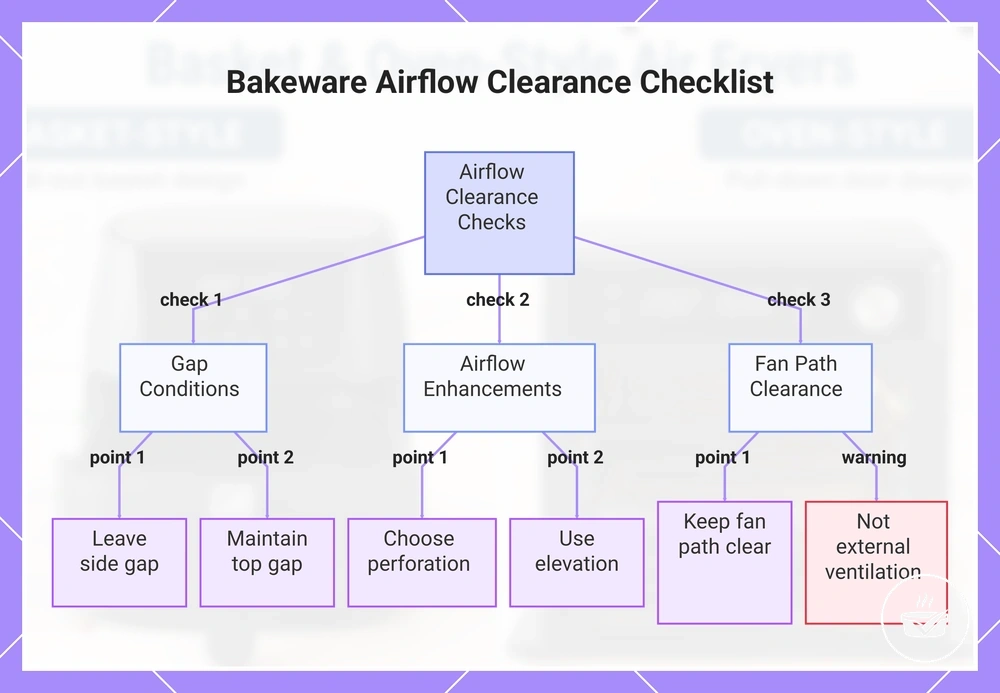
Airflow clearance inside the cooking cavity can be checked using the points below, which verify circulation around or through the bakeware:
- Leave a side gap so hot air circulation can continue around the bakeware.
- Maintain a top gap when using taller dishes to reduce the chance of trapped heat.
- Choose perforation when it supports airflow through the food path and the cooking task.
- Use elevation when it helps air circulate beneath the food and may improve browning.
- Keep the fan path as clear as practical because blocked internal airflow may contribute to uneven cooking.
For practical guidance on using bakeware without blocking airflow, focus on preserving internal circulation rather than changing the appliance's external ventilation space.
This checklist helps verify that bakeware leaves enough space for hot air circulation inside the cooking cavity.
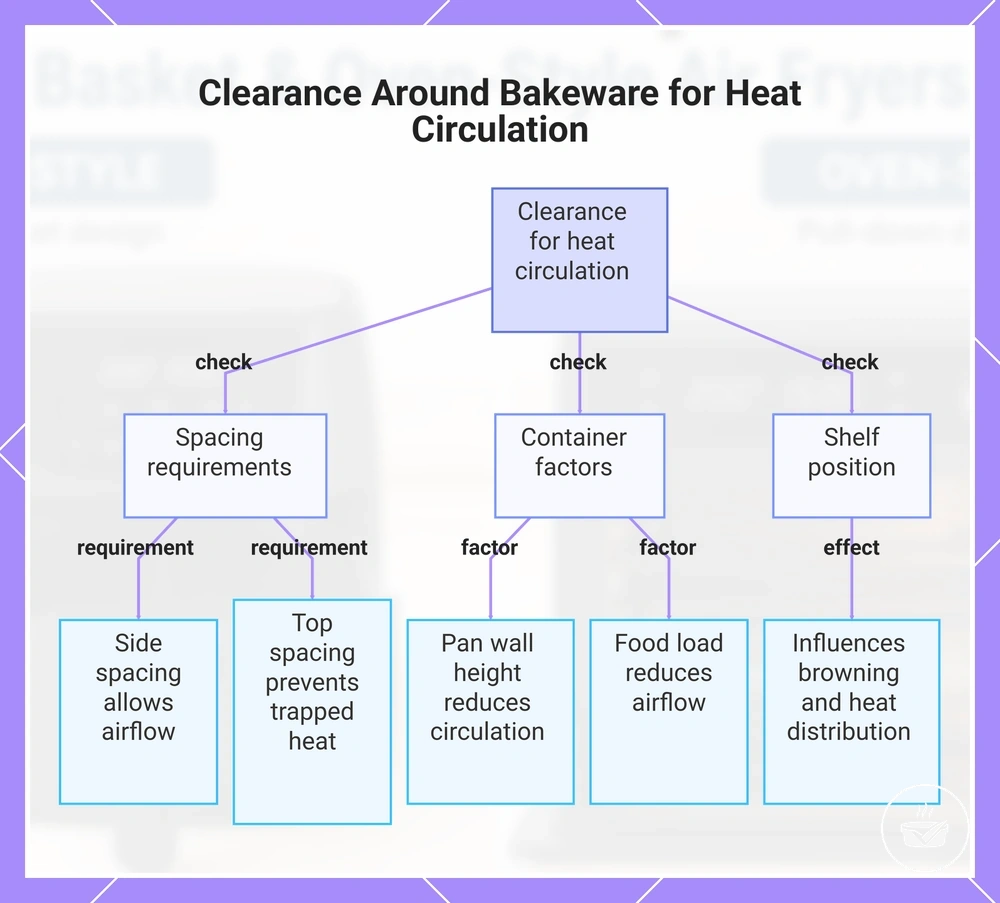
Clearance around bakeware for heat circulation
Clearance around bakeware for heat circulation means pans, dishes, and trays should leave enough open space for heated air to move around the food surface. Side spacing, top spacing, pan wall height, food load, and shelf position all influence how heat circulation occurs inside the cooking cavity. The local attribute is clearance around bakeware for heat circulation.
Clearance around bakeware for heat circulation can be checked using the points below because they verify circulation limits rather than physical fit alone. A tall dish may need more top spacing than width when pan wall height brings the food closer to the upper part of the cooking cavity. Food load and shelf position can also influence heat circulation, so browning and trapped-heat effects depend on the appliance design and bakeware arrangement.
- Leave side spacing so heated air can circulate around the bakeware and reach more of the food surface.
- Maintain top spacing above taller dishes because limited overhead space may increase trapped heat.
- Consider pan wall height because higher sides can change how heat circulation reaches the food.
- Avoid overfilling the bakeware, as a larger food load may reduce circulation around the food.
- Check shelf position because it can influence how heated air moves around the bakeware and affect browning.
This chart shows the main checks and factors that ensure proper heat circulation around bakeware, including spacing, container geometry, and shelf position.
Elevated racks and perforated trays for even browning
Elevated racks and perforated trays for even browning depend on whether elevation or perforation improves compatibility by keeping air moving under or through the food. An elevated rack can increase airflow under food, while a perforated tray allows air and moisture to move through openings when the food structure supports it. A solid pan may still be the better choice when food support or containment is more important than additional air exposure. The local compatibility attributes are elevation, perforation, food support, and drip management.
Elevated racks and perforated trays for even browning are easier to compare with the contrast below because it clarifies when greater air exposure is more useful than containment.
- Elevated rack: Uses elevation to improve airflow under food, which may support even browning and stable food support when the food can rest securely.
- Perforated tray: Uses perforation to promote air movement and assist drip management, which can help crisping when the food is suitable for an open cooking surface.
- Solid pan: Provides better containment for batter or liquid foods, although airflow beneath the food may be more limited than with an elevated rack or perforated tray.
Basket versus oven-style bakeware compatibility trade-offs
Basket versus oven-style bakeware compatibility trade-offs depend on cavity shape, usable space, handling, rack support, and airflow design rather than on one appliance format being better. Basket models and oven-style models support different bakeware layouts and handling methods. The compatibility decision is guided by usable space, rack support, shaking access, tray stability, and batch size.
A basket drawer can make shaking access easier for compact portions, while an oven-style cavity may better accommodate taller pans, multi-level trays, or large flat trays when they fit the available rack support. Tray stability and handling vary with the appliance format and bakeware arrangement. Cooking results and convenience therefore depend on matching the bakeware to the cooking cavity instead of assuming one format is a universal winner. Larger batch size or flatter tray layouts may also influence which format is more practical for a particular cooking task.
Basket versus oven-style bakeware compatibility trade-offs are easier to compare in the table below because the decision depends on cavity shape, handling, and airflow design rather than on a single feature. The comparison stays focused on compatibility rather than serving as an appliance buying guide.
| Appliance format | Compatibility strengths | Compatibility limits | Better use case |
|---|---|---|---|
| Basket drawers | Good shaking access and efficient use of usable space for compact portions | Larger flat trays or taller pans may be more restricted by the cavity shape | Smaller batches where handling and shaking access are priorities |
| Oven-style cavities | Rack support and tray stability can suit taller pans, multi-level trays, and larger batch size | Handling may depend on rack position and accessory arrangement | Cooking tasks that benefit from flatter trays or multiple rack positions |
| Mixed accessory situations | Different bakeware can be matched to different cooking tasks | Compatibility depends on cavity shape, airflow design, and accessory selection | When the bakeware choice changes with the food or cooking setup |
Material and container checks inside compatibility decisions
Material and container checks should be completed after physical fit and airflow have been confirmed because both the container type and its material affect the compatibility decision. A container that fits the cooking cavity should also be evaluated for its oven-safe rating, coating, rim shape, lid status, and expected heat exposure. These criteria work together and should not be assessed separately.
Material checks help determine whether a container remains suitable for the intended cooking conditions. Check the oven-safe rating alongside the appliance manual because an oven-safe rating does not override appliance-specific limits. Coating condition, rim shape, and lid status may influence heat exposure or airflow, while damaged coatings or closed lids can change the compatibility decision. Regular bakeware may still be appropriate when its material, condition, and container type satisfy these compatibility checks.
Material and container checks should be judged together with fit and airflow before using bakeware. The table below summarises the main compatibility criteria without ranking materials, and regular bakeware remains only a compatibility check rather than a separate comparison topic.
| Container/material | Compatibility criterion | Acceptable condition | Effect/risk/decision |
|---|---|---|---|
| Glass | Oven-safe rating and heat exposure | Manufacturer guidance supports the intended use | Compatibility depends on both the container and appliance conditions |
| Ceramic | Material condition and rim shape | No visible damage and suitable fit | May support safe use when airflow remains unobstructed |
| Metal | Container shape and oven-safe rating | Appropriate for the intended cooking conditions | May reduce warping risk when used within its intended limits |
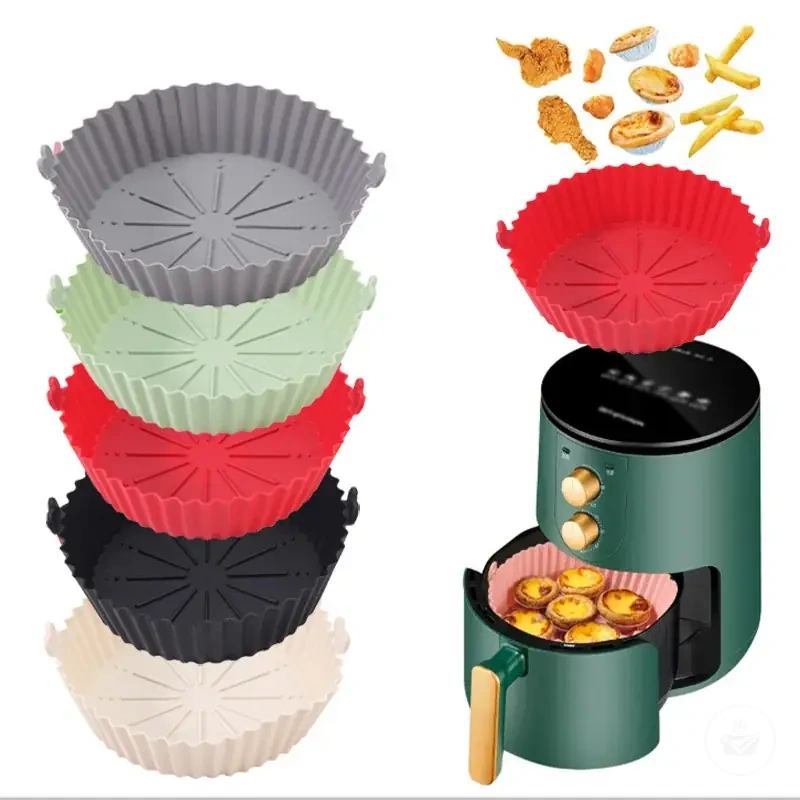
| Silicone | Material rating and container stability | Rating and shape suit the cooking task | Compatibility varies by product and cooking conditions |
| Coated pans | Coating condition | Coating remains intact for the intended heat exposure | Damaged coatings may change the compatibility decision |
| Lids | Lid status | Allows suitable airflow when required | Closed lids may contribute to blocked circulation depending on the setup |
Oven-safe glass, ceramic, metal, and silicone boundaries
Oven-safe glass, ceramic, metal, and silicone still require fit, airflow, and material-condition checks before they can be considered compatible in an air fryer. Microwave-safe alone is not sufficient when oven-safe use is required. Heat rating, thermal shock, rigidity, flexibility, and wall thickness are the key local material boundaries.
Oven-safe glass, ceramic, metal, and silicone boundaries should be assessed together with fit and airflow because material type alone does not determine compatibility. Thick ceramic may reduce usable clearance, flexible silicone may need adequate support, and coated metal should be checked for coating condition before heat exposure. The table below pairs each material with the compatibility checks that influence safe placement or an avoid-use decision.
| Material | Key boundary | Condition to check | Compatibility decision |
|---|---|---|---|
| Glass | Thermal shock | Heat rating and intended heat change are suitable | Use only when the product rating and appliance guidance support the application |
| Ceramic | Wall thickness and rigidity | Container fits without reducing required clearance | May be suitable when correctly rated and positioned |
| Metal | Coating and heat exposure | Coating remains intact and appropriate for the intended use | Avoid use if coating condition or placement creates a compatibility concern |
| Silicone | Flexibility and support | Silicone mold remains supported and keeps its shape during handling | May be suitable when the product rating, support, and airflow conditions are appropriate |
Containers that should not be treated as compatible
Containers that appear to fit are not compatible when their material or condition creates a safety risk or performance risk. Non-oven-safe materials, loose coatings, unstable lids, plastic parts, excessive height, or a blocked vent can override convenience. These disqualifying properties are the local compatibility filter.
Containers that should not be treated as compatible can be identified with the checklist below because it verifies disqualifying properties rather than size alone.
- A non-oven-safe container is not compatible because its material is not intended for the required heat exposure.
- A loose coating is an avoid-use condition because coating damage may affect food contact or the compatibility decision.
- An unstable lid or blocked vent can restrict airflow or create an obstruction, even when the container fits.
- A plastic part exposed to cooking heat should not be treated as compatible unless the product rating specifically supports that use.
- Excessive height that reduces required clearance or blocks airflow can make otherwise suitable bakeware not compatible.
- If compatibility remains uncertain, use the bakeware label and the air fryer manual as the final checks before use.
Selection logic for compatible bakeware and accessory sets
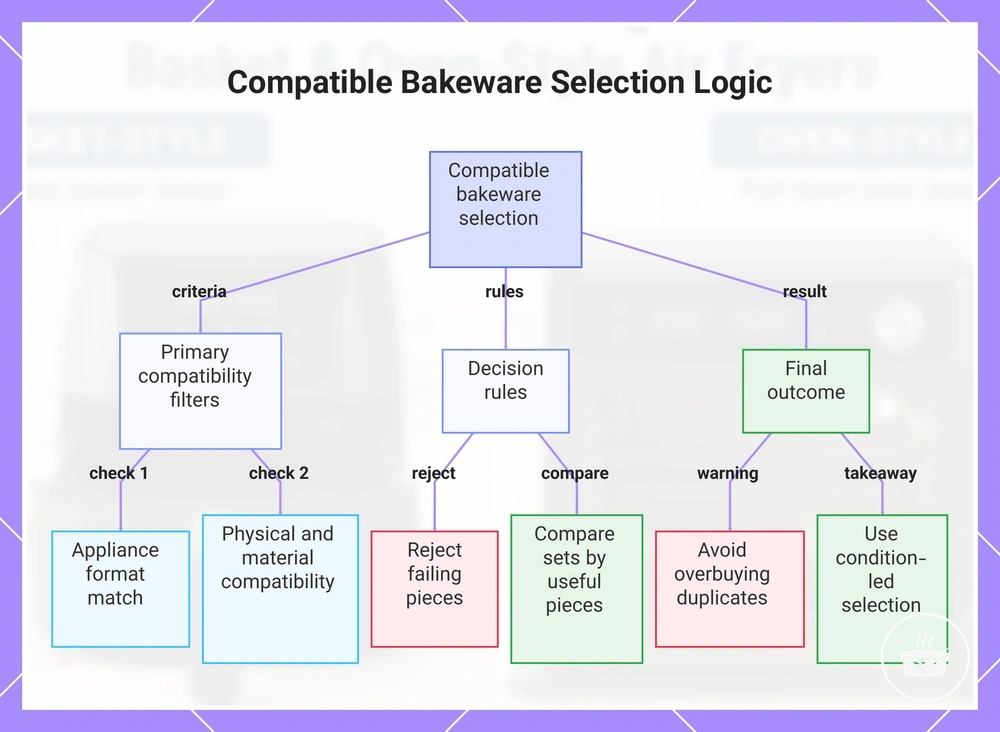
Selection logic for compatible bakeware and accessory sets should start with appliance format, fit, airflow, material, and use case before preference or bundle size. A pan, tray, rack, or set should solve a real compatibility need. The main criteria are fit, airflow, material, and use case.
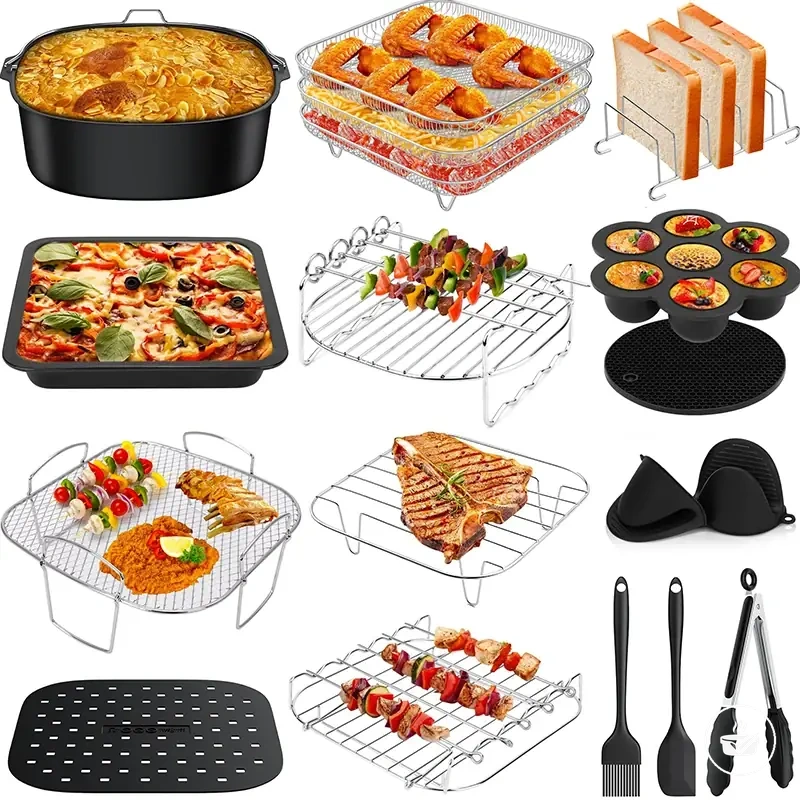
A basket drawer may need a smaller required piece that supports handling and removal, while an oven-style rack may need tray stability and support at the correct level. Mixed accessory sets should be compared by useful pieces rather than by bundle size alone. If a set includes pieces that do not match the appliance format, material boundary, or airflow need, those pieces should be rejected rather than treated as extra value.
Selection logic for compatible bakeware and accessory sets is useful because the checklist below verifies conditions before preference or bundle size:
- Match the appliance format to the required pan, tray, rack, or set before comparing options.
- Keep bakeware that satisfies fit, airflow, and material checks for the intended use case.
- Reject pieces that appear convenient but fail a material, clearance, or airflow condition.
- Compare accessory sets only when the included pieces solve different real cooking needs.
- Avoid overbuying when several pieces repeat the same function without improving compatibility.
Compatible bakeware selection should remain condition-led rather than catalog-led. Basket drawers, oven-style racks, and mixed sets can all be useful when the included pieces match the actual cooking cavity and the food task.
Use the final comparison only after the compatibility filters have reduced the choice to pieces that are realistic for the appliance.
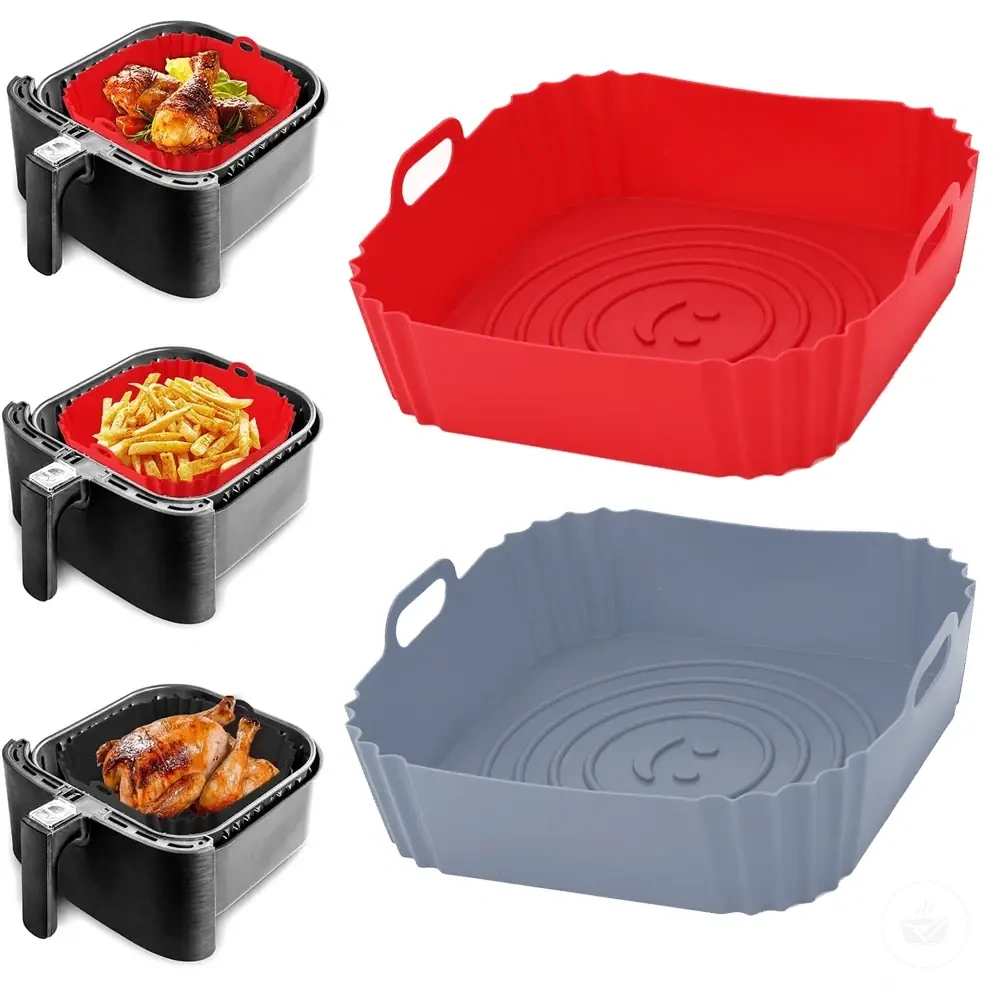
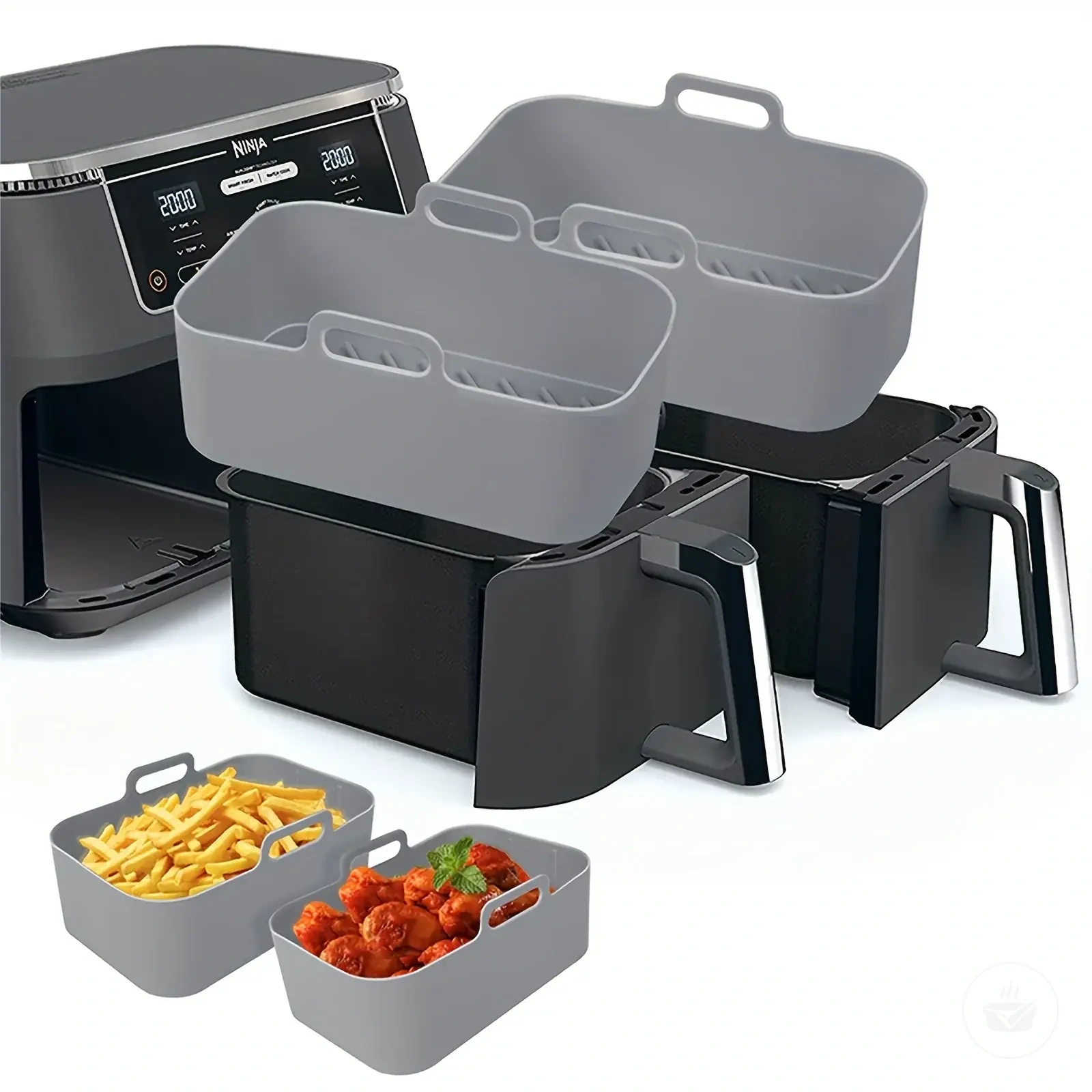
Here are product examples that may make comparison easier. Before buying, always review the compatibility criteria, essential features, and product details.
This chart shows the condition-led selection logic for choosing compatible bakeware and accessory sets, starting with appliance format and proceeding through fit, airflow, material, and use case checks before making comparisons.
When a rack tray set solves a compatibility gap
A rack tray set solves a compatibility gap when the current setup lacks elevation, drip capture, tray support, or airflow below food. A set is not mandatory for every baking task. The local decision depends on elevation, mesh, pan pairing, footprint, and stability.
When a rack tray set solves a compatibility gap, the checklist below verifies whether the set fixes a real limitation or adds an unnecessary accessory.
- Use a rack tray set when elevation is needed to create airflow below food and may support browning.
- Compare mesh or perforated surfaces when the current tray limits air movement under the food.
- Keep a set when pan pairing adds drip capture without reducing fit or stability.
- Reject a set when its footprint does not match the available tray support or cooking cavity.
- Compare the set only when each piece solves a different compatibility gap instead of repeating the same function.
When a special air fryer pan is not the deciding factor
A special air fryer pan is not the deciding factor when ordinary oven-safe bakeware fits the cooking cavity, preserves airflow, and matches the intended task. The label alone does not determine compatibility. Fit, material rating, wall height, airflow impact, and task suitability are the deciding attributes.
When a special air fryer pan is not the deciding factor, the contrast below clarifies why compatibility conditions matter more than product labels.
- Ordinary oven-safe bakeware: May be an acceptable alternative when the material rating is suitable, the fit is correct, airflow remains adequate, and the task suitability matches the food being prepared.
- Special air fryer pan: May be more practical when lower wall height, improved airflow, or a purpose-built shape better supports the intended cooking task.
- Boundary example: Regular bakeware may work for contained foods such as batter when fit and airflow remain suitable, while a purpose-built air fryer pan may be the more practical choice when greater airflow around the food is preferred.
For a broader comparison of compatibility conditions and use cases, see regular bakeware in an air fryer.