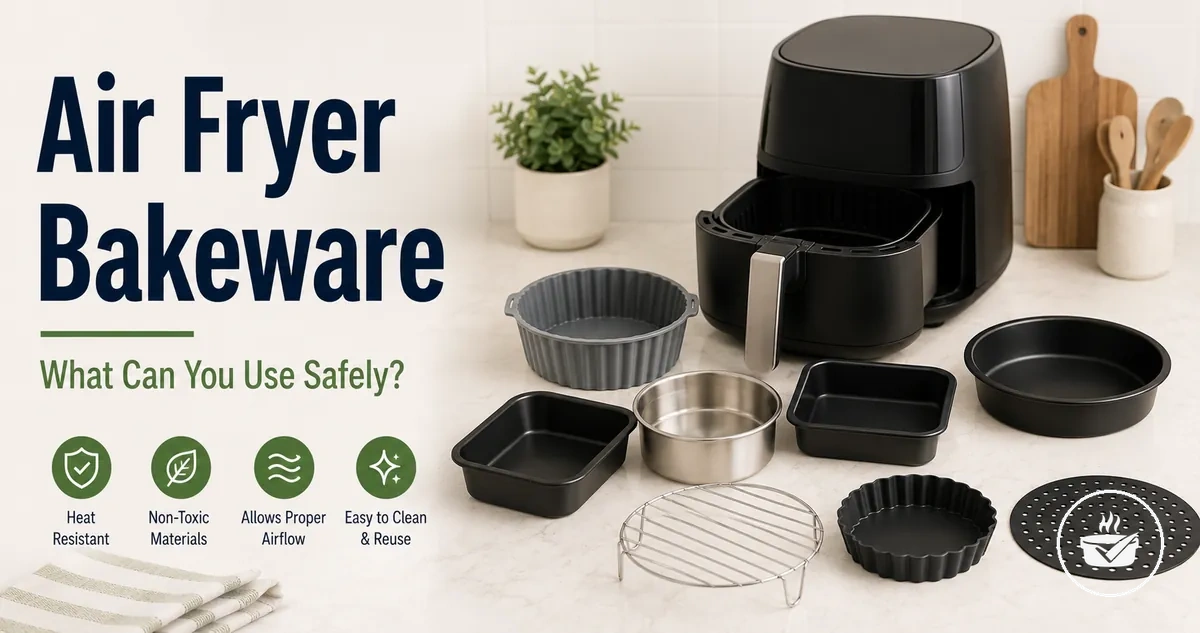
Air fryer safe bakeware: safe pans, dishes, and containers
Air fryer safe bakeware can usually include oven-safe metal, silicone, glass, and ceramic pieces when they fit properly and stay within their heat limits.
Air fryer safe bakeware means bakeware, pans, dishes, and containers made from a heat-tolerant material that can handle the cooking environment without unsafe parts. The material, coatings, handles, lids, and stated temperature tolerance all affect whether a piece may be suitable. The piece also needs enough fit, clearance, and airflow inside the basket.
Oven-safe does not automatically mean suitable for every air fryer. Microwave-safe containers, loose lids, weak coatings, or mixed-material parts may create risk if the component is not made for high heat. When the label, condition, or manufacturer guidance is unclear, treat the item with caution.
A small pan, dish, or container may work in one basket but fail in another if it touches the sides, blocks airflow, or sits too close to the heating area. The safety criteria below explain how to judge material, heat tolerance, fit, and component condition before use in the air fryer bakeware guide.
What makes bakeware safe for an air fryer
Air fryer safe bakeware is bakeware that tolerates air fryer heat while leaving enough space for hot air circulation. Safe use depends on three core factors: material, heat rating, and fit.
Air fryer safe bakeware is judged first by its material and heat rating. A piece may be suitable when its material and temperature limit match the intended cooking conditions and its coating, handle, and lid remain appropriate for that use. The stated heat rating should not be exceeded.
What makes bakeware safe for an air fryer becomes clearer when material, heat rating, and fit are considered together. The image below highlights the main safety checks for clearance, airflow, and key bakeware parts.
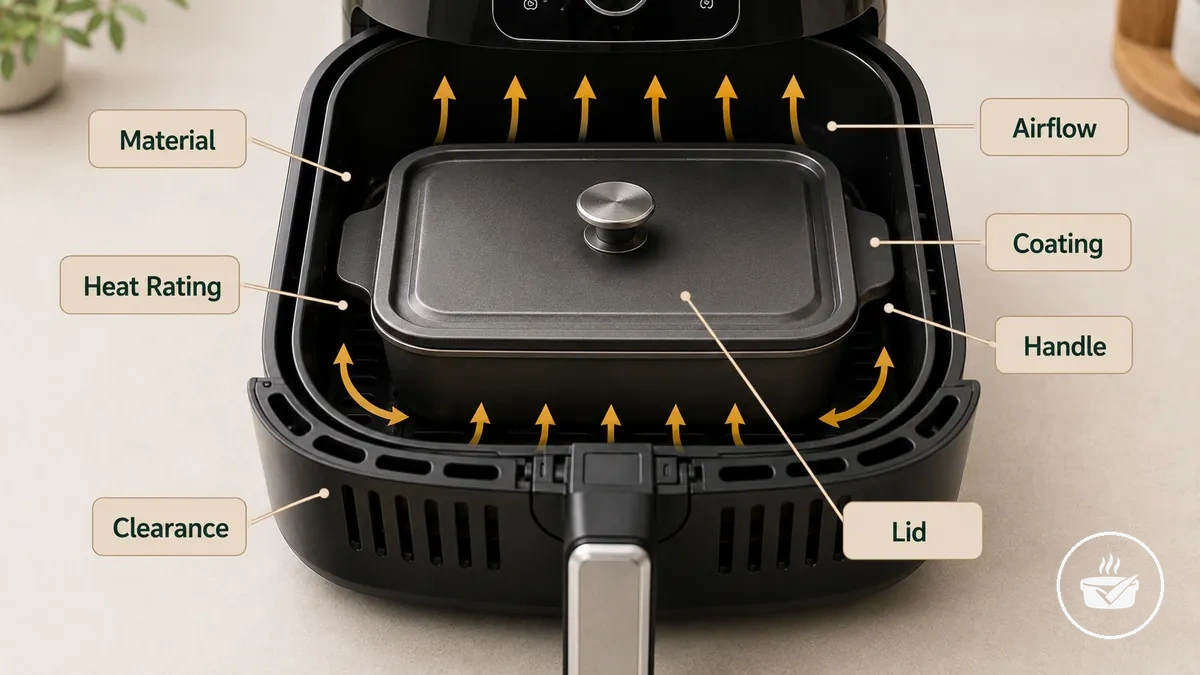
Fit also affects safety because the bakeware should leave enough clearance for airflow inside the basket. A piece that is too large may reduce airflow, while damaged coatings, unsuitable handles, or an unsuitable lid can change whether the bakeware remains appropriate for use. The basket should still allow air to circulate freely.
The table below summarises the main criteria used to assess air fryer safe bakeware.
| Entity or part | Attribute or criterion | Safe condition | Risk or decision |
|---|---|---|---|
| Material body | Material and temperature limit | Suitable for the intended cooking temperature | May melt, crack, or become unsuitable if the heat rating is exceeded |
| Coating | Condition | Intact and suitable for food contact | Damaged coating may affect safe use |
| Handle | Heat rating | Suitable for the intended cooking conditions | Heat-sensitive parts may limit safe handling |
| Lid | Heat rating | Appropriate for air fryer use | An unsuitable lid may create a safety concern |
| Overall fit | Clearance and airflow | Leaves enough space for airflow around the basket | Poor fit may reduce airflow and affect cooking |
Oven-safe status alone is not enough when bakeware is oversized, damaged, has a poor coating, or is used above its heat rating. For more guidance on these conditions, see air fryer bakeware safety.
Oven-safe material and temperature tolerance
Oven-safe material and temperature tolerance should be checked before using bakeware in an air fryer. Confirm that the item has an oven-safe heat rating and that its label or manufacturer guidance supports the intended use.
Oven-safe material and temperature tolerance are easier to verify by checking the label and the main components shown below.
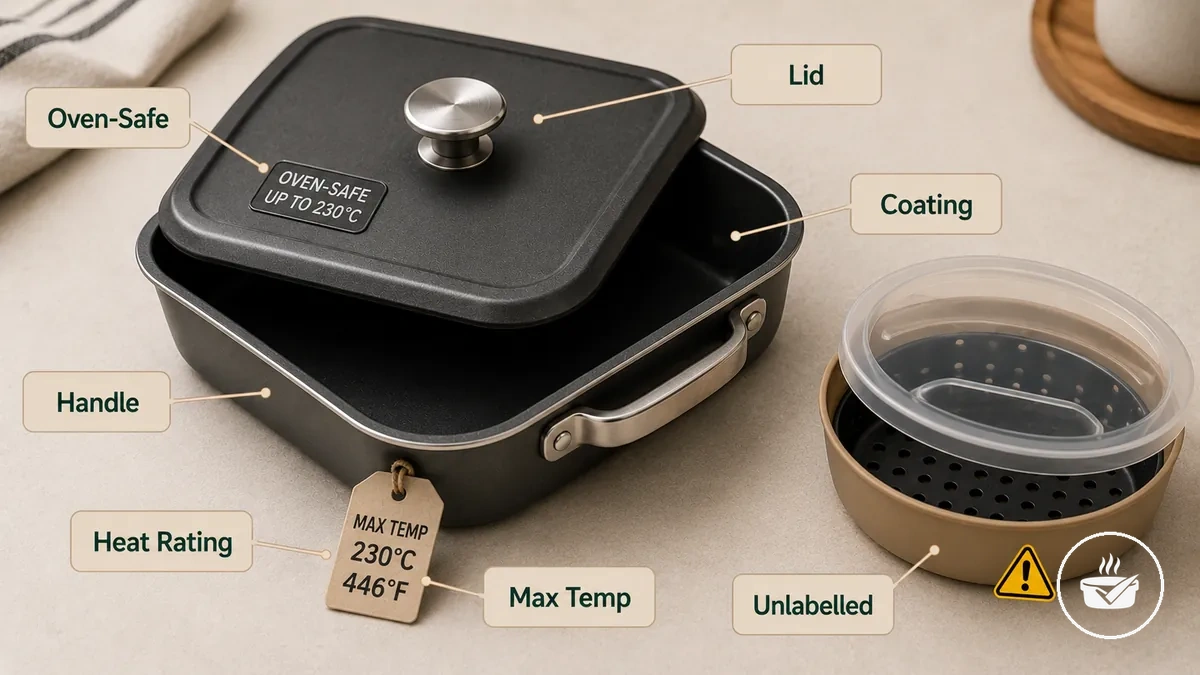
- Check the material body for an oven-safe rating and a stated maximum temperature.
- Inspect the coating for signs of damage, as damaged coatings may increase the risk of coating damage during heating.
- Confirm that every handle is oven-safe or heat-safe, not only the main body, because different components may have different heat ratings.
- Verify that any lid is rated for the intended maximum temperature, since an unsuitable lid may crack, warp, or become unsuitable during use.
- Review every mixed-material item carefully because one component may have a lower heat rating than the rest of the bakeware.
Microwave-safe, dishwasher-safe, or food-storage-safe labels do not prove oven-safe air fryer use. If a bakeware item is unlabelled, older, damaged, or its heat rating cannot be confirmed, use it cautiously or avoid using it until reliable manufacturer guidance is available.
Size, clearance, and airflow inside the basket
Size, clearance, and airflow inside the basket determine whether heat-safe bakeware is physically suitable for an air fryer. A pan or dish may still be unsuitable if it blocks airflow, lacks enough clearance, touches the basket or rack, or sits too close to the heating area, so both physical fit and airflow fit should be checked.
Size, clearance, and airflow inside the basket depend on the available space and an open air path. The image below shows the main placement checks for safe bakeware positioning.
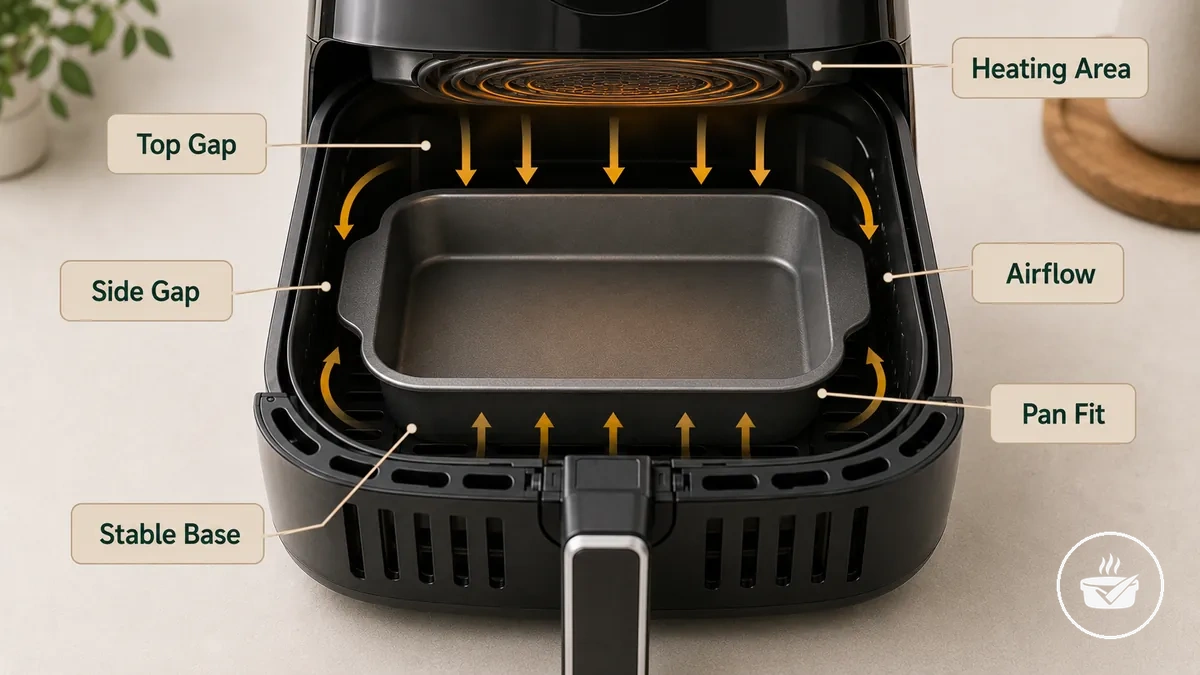
- Leave enough side clearance so air can circulate around the pan or dish.
- Check top clearance to reduce the chance of the bakeware sitting too close to the heating area.
- Make sure the base is stable so the bakeware remains secure in the basket, drawer, or on the rack.
- Keep the airflow path open because blocked airflow can lead to less even heating and may increase the risk of scorching.
- Confirm that the bakeware does not contact the heating area, while remembering that fit depends on the air fryer model and bakeware shape.
Deep dishes, full trays, and tightly fitted pans may reduce available airflow even when they fit inside the basket. Whether they are suitable depends on the basket dimensions, rack layout, bakeware shape, and the available clearance around the piece.
Bakeware that can usually go in an air fryer
Common oven-safe metal, silicone, glass, and ceramic bakeware can usually go in an air fryer when the piece fits properly, allows adequate airflow, and stays within its intended heat limits.
Bakeware that can usually go in an air fryer is easier to compare by material and typical use condition. The table below organises common bakeware forms by safe condition, common use, and points to watch, while keeping fit and airflow in mind.
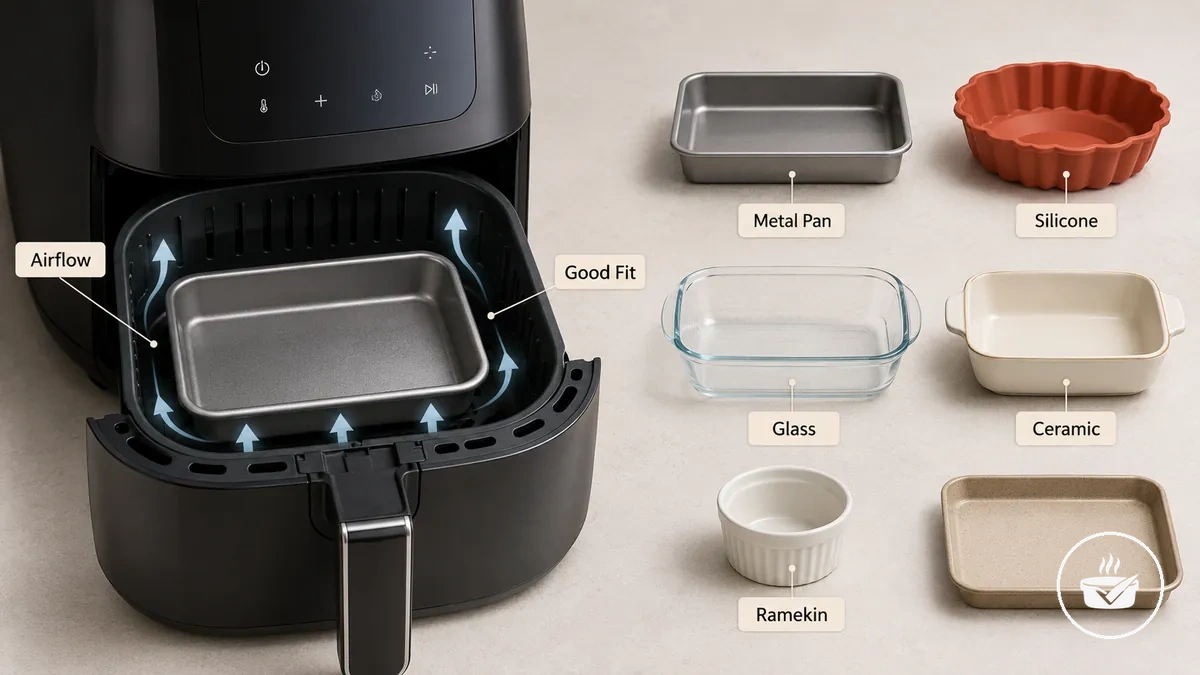
| Bakeware type | Safe condition | Common use | Watch for |
|---|---|---|---|
| Oven-safe metal pan | Fits the basket and allows airflow | Baking pan or shallow tray | Oversized pans that reduce circulation |
| Silicone mold | Heat-safe and properly supported | Small cakes or muffins | Flexible molds without enough support |
| Glass dish | Oven-safe with suitable fit | Baking dish | Thermal shock and restricted clearance |
| Ceramic dish | Oven-safe with adequate clearance | Baked meals | Thermal shock and reduced airflow |
| Ramekin | Fits securely in the basket | Individual portions | Limited basket space |
| Tray | Leaves airflow around the edges | Flat baking or roasting | Full trays that may block circulation |
A metal pan may transfer heat efficiently when it fits correctly, while a silicone mold may need support because of its flexible shape. Glass and ceramic dishes can also be suitable when they are oven-safe, fit the basket, and are handled carefully. Small ramekins often work well when they leave enough space for airflow around the bakeware.
These examples describe general bakeware forms rather than every possible design or accessory. For a broader overview of common forms and accessories, see types of air fryer bakeware.
Metal, aluminium, silicone, glass, and ceramic bakeware
Metal, aluminium, silicone, glass, and ceramic bakeware differ in heat transfer, flexibility, coating condition, and thermal-shock sensitivity, so the material can influence safe use in an air fryer. The table below compares the main material groups and the conditions that should be checked before use.
| Material | Safe-use condition | Main caution |
|---|---|---|
| Metal | Oven-safe rating with an undamaged coating when applicable | Fast heat transfer may increase browning if cooking conditions are not adjusted |
| Aluminium | Oven-safe rating and suitable condition | High heat transfer means results may vary with pan thickness and coating condition |
| Silicone | Heat-safe silicone mold with adequate support | Flexibility may require a stable base during handling |
| Glass | Oven-safe rating and careful handling | Thermal shock may occur with sudden temperature changes |
| Ceramic | Oven-safe ceramic dish in good condition | Thermal shock may occur if exposed to rapid temperature changes |
Material alone does not determine suitability because the oven-safe rating, coating condition, thickness, and intended use can affect the decision. Damaged coatings, flaking surfaces, or bakeware without a confirmed oven-safe rating should be treated cautiously, regardless of whether the material is metal, aluminium, silicone, glass, or ceramic. For a broader comparison of properties and safe-use considerations, see safe bakeware materials.
Cake pans, ramekins, baking dishes, and molds that fit safely
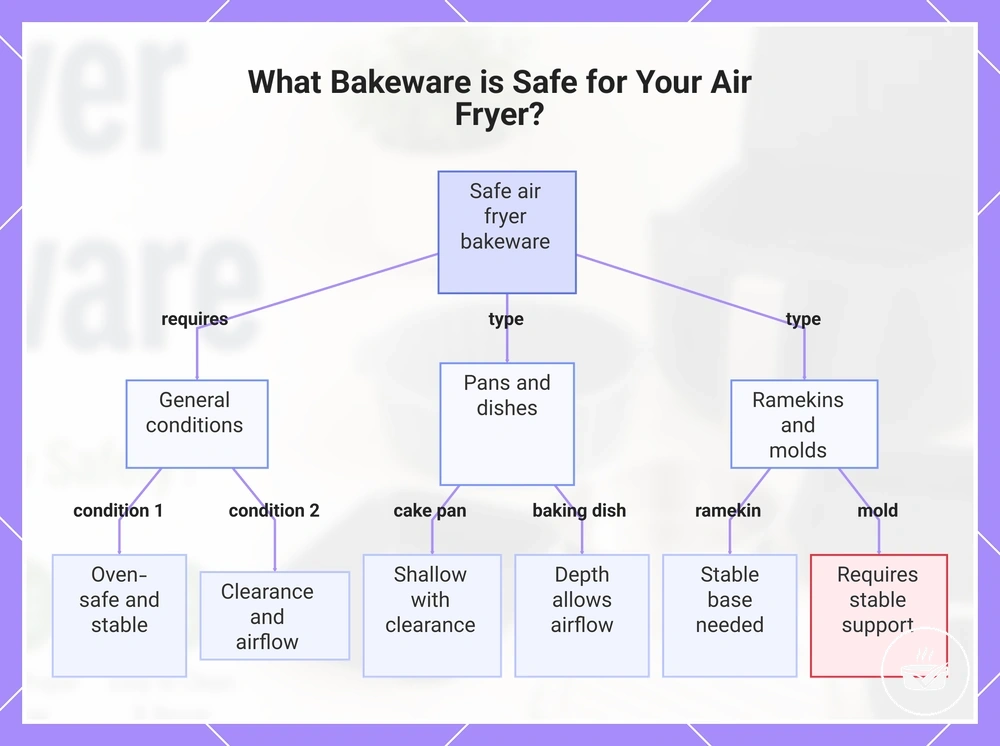
Cake pans, ramekins, baking dishes, and molds can usually be used when they are oven-safe, stable, and small enough for the air fryer cavity. Diameter, depth, rim height, and basket clearance influence airflow and heat exposure, so each piece should fit securely before cooking.
- Cake pan: A shallow cake pan may be suitable when its diameter leaves enough basket clearance. A pan that is too wide may reduce airflow.
- Ramekin: A ramekin with a stable base may work well for individual portions when it can be placed and removed safely.
- Baking dish: A baking dish may be suitable when its depth still allows airflow around the food. Deep dishes can reduce cooking performance if circulation becomes restricted.
- Mold: A silicone mold may be easier to handle when supported on a stable base because flexibility can affect safe removal after heat exposure.
- Handles and lids: Handle shape, rim height, and lid use should not reduce basket clearance or interfere with stable placement and safe removal.
Choose bakeware forms that remain stable and leave enough space for airflow during cooking. For example, a shallow cake pan that fits the basket is generally more suitable than a full-size tray that blocks circulation, while suitability still depends on the air fryer cavity, bakeware dimensions, and stable placement.
This chart shows the key conditions for safe air fryer bakeware and the specific considerations for common types like cake pans, ramekins, baking dishes, and silicone molds.
Bakeware and containers to keep out of an air fryer
Keep non-heat-safe plastic, cardboard, rubber components, non-heat-safe lids, loose coverings, and damaged pieces out of an air fryer. These items can fail under high heat and forced air through melting, burning, fumes, deformation, cracking, movement, or airflow blockage.
Containers that are not designed for air fryer conditions may soften, burn, crack, or lose their shape during cooking. Loose coverings can move because of circulating air and create airflow blockage, while damaged coatings or flaking surfaces may make bakeware unsuitable for continued use.
The table below summarises common bakeware and container items that should be kept out of an air fryer.
| Item or component | Why it is risky | Safer decision |
|---|---|---|
| Non-heat-safe plastic | May soften, melt, or deform under heat | Do not use |
| Cardboard | May burn or become unstable during cooking | Avoid using it in the air fryer |
| Rubber parts | May deform or lose their seal when exposed to high heat | Do not use if the rubber is not heat-safe |
| Non-heat-safe lids | May warp, crack, or lose their shape | Do not use |
| Loose coverings | Forced air may move them and cause airflow blockage | Avoid loose coverings that cannot remain secure |
| Damaged pieces | Cracks, flaking coatings, or unstable parts may increase the risk of failure | Reject damaged bakeware or containers |
Disposable, labelled, or mixed-material containers may resemble oven-safe bakeware, but suitability depends on reliable heat-safety information for every component. If the heat rating, material, or intended use cannot be confirmed, avoid using the item in the air fryer.
Plastic, cardboard, rubber parts, and non-heat-safe lids
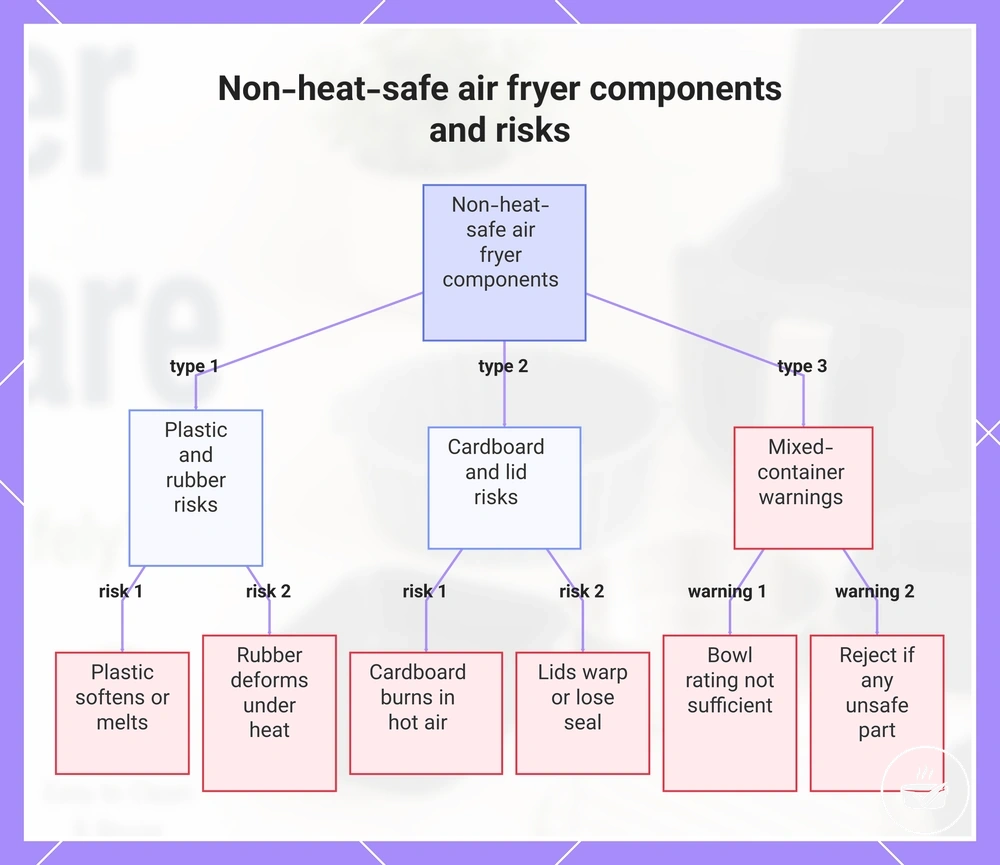
Plastic, cardboard, rubber parts, and non-heat-safe lids should not be used in high-heat air fryer conditions unless they are explicitly rated for that purpose. Heat exposure can cause softening, melting, deformation, burning, or fumes, so every component should have a suitable heat rating rather than relying on the main container alone.
Components such as lids, seals, grips, handle inserts, adhesives, coatings, and decorative parts may have different heat limits from the bowl or dish they are attached to. If any part is not intended for high oven temperatures, it can deform, loosen, or increase contamination risk during cooking. In mixed-component containers, a heat-rated bowl does not automatically mean the lid, seal, grip, feet, or decorative parts are also suitable, so the complete container should be rejected when any non-heat-safe component remains.
- Plastic: If the plastic does not have a suitable heat rating, avoid using it because heat can cause softening or melting.
- Cardboard: Cardboard may burn or become unstable under hot circulating air, so it should not be used as bakeware or a container.
- Rubber parts: Rubber seals, grips, and handle inserts may deform under heat exposure if they are not designed for high temperatures, so reject containers with unsuitable rubber components.
- Non-heat-safe lids: Lids with low heat tolerance, adhesives, or decorative parts may warp, lose their seal, or deform, so remove them or avoid using the container.
- Mixed-component containers: If only the bowl is heat-rated but the lid, grip, seal, feet, or decorative parts are not, do not use the complete container in the air fryer.
This chart shows the main types of materials and components that are unsafe for high-heat air fryer use, along with their specific risks and container-level warnings.
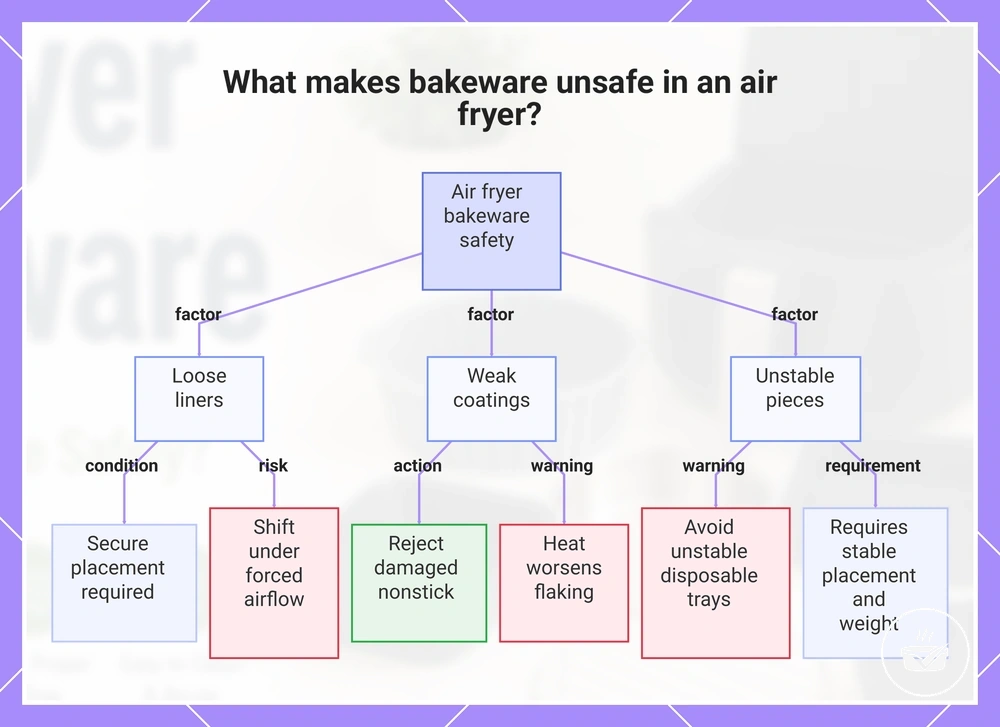
Loose liners, weak coatings, and pieces that can burn, melt, or shift
Loose liners, weak coatings, and unstable pieces can become unsafe in an air fryer because forced airflow and high heat may move lightweight materials or damage worn surfaces. Bakeware should remain stable, securely positioned, and in good condition so it is less likely to shift during cooking.
Coating condition, stable placement, and material strength all affect whether a piece remains suitable for use. Parchment, foil, disposable trays, and damaged nonstick surfaces require extra attention because their condition and placement can change the safety decision, so reject damaged pieces and use lightweight materials cautiously only when they remain secure.
- Loose liners: Loose liners can shift under forced airflow and move toward the heating area, so use them only when they remain securely in place.
- Weak coatings: Weak coatings or coating damage can worsen with heat, causing flaking or sticking, so reject bakeware with damaged nonstick surfaces.
- Foil and parchment: Foil or parchment may be suitable only when stable placement, food weight, airflow, and manufacturer guidance help prevent movement.
- Disposable tray: A thin disposable tray may burn, melt, bend, or shift if it lacks stability, so avoid unstable placement.
- Damaged nonstick: Flaking nonstick coatings should be treated as a reject condition because continued heat exposure can increase coating damage.
A sheet of parchment or foil that is not held in place by food may move because of forced airflow, while damaged nonstick bakeware or an unstable disposable tray should not be used.
This chart identifies the three main risk factors for air fryer bakeware and the recommended actions for each.
How to check a pan or dish before using it
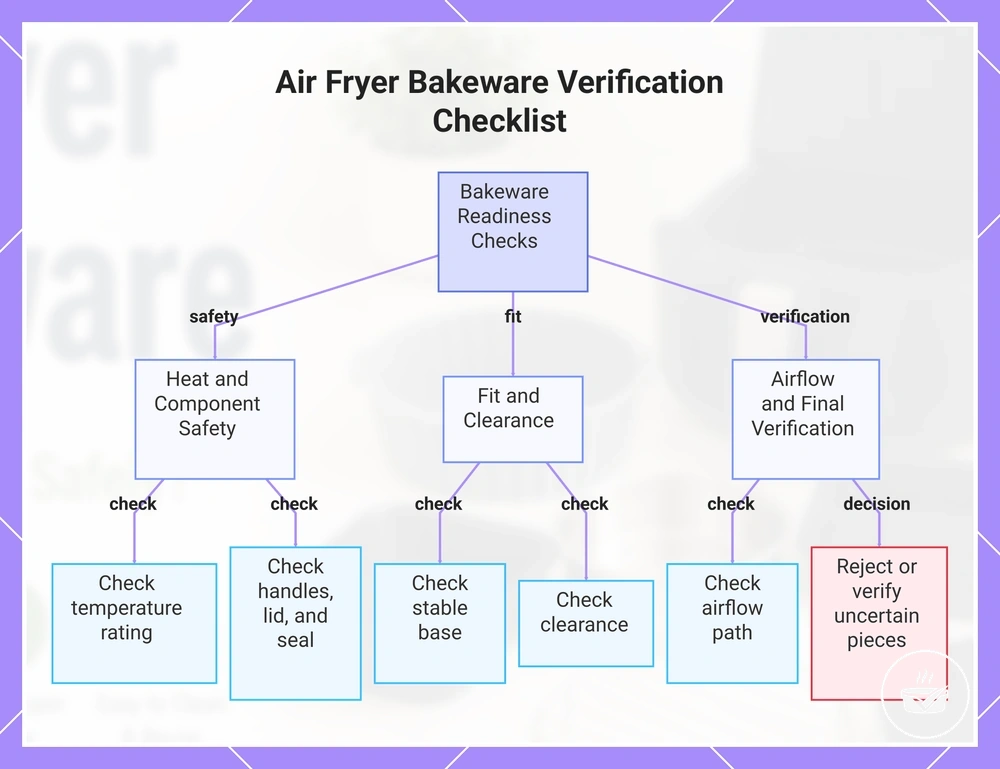
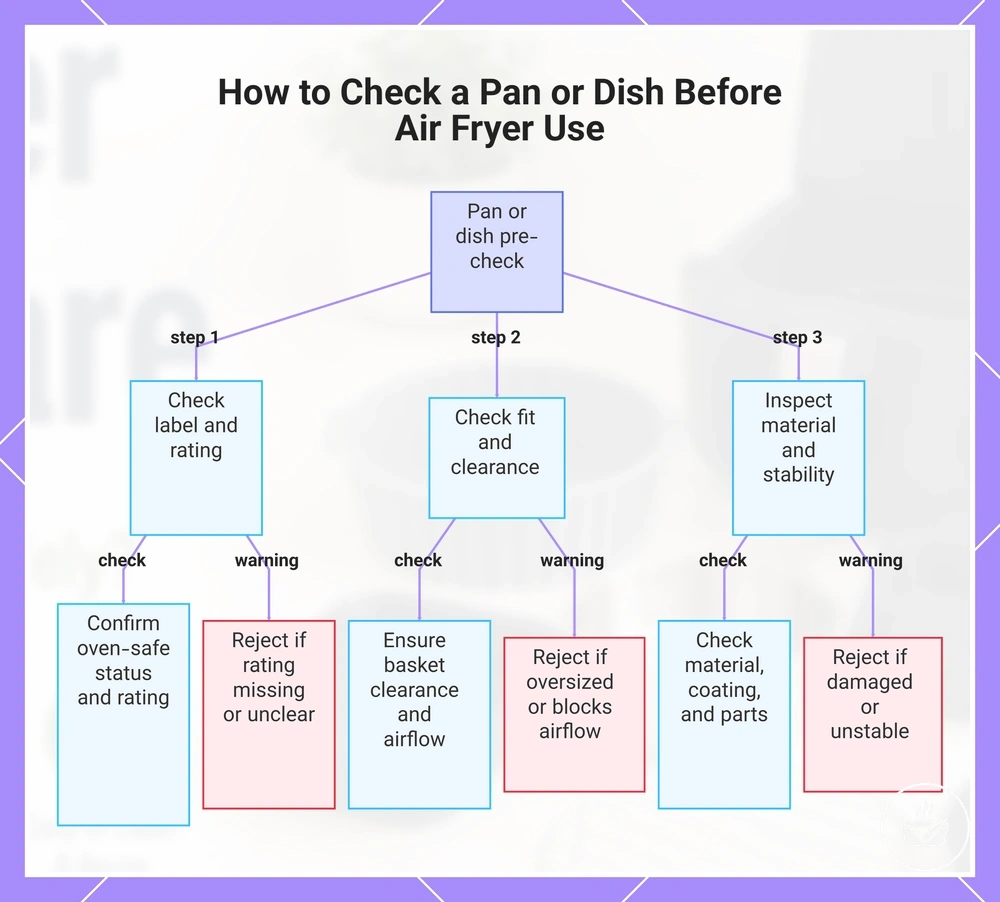
Check a pan or dish for oven-safe status, temperature rating, fit, airflow, stable placement, handles, lid, clearance, and unsafe components before air fryer use, then decide whether to use, verify, substitute, or reject it.
Start with the label, oven-safe status, temperature rating, and temperature limit. If the pan or dish has no clear heat rating or the intended temperature exceeds its stated limit, verify it further or reject it.
Next, check the dimensions, basket clearance, and airflow path. The item should fit without touching the heating area, blocking circulation, or sitting unevenly. Stable placement matters because a shifting dish, loose lid, or awkward handle can change the safety decision.
Use this checklist before placing bakeware in the air fryer:
- Check the label: Confirm oven-safe status and a suitable temperature rating; reject the item if the rating is missing or unclear.
- Inspect the material: Look for heat-safe construction and avoid any material that may soften, melt, crack, or deform.
- Check coating condition: Reject the pan or dish if the coating is damaged, flaking, or unstable.
- Check handles and lid: Verify that handles, lid parts, seals, grips, or inserts are also heat-safe; remove or reject unsafe parts.
- Check fit and clearance: Confirm that the item fits the basket or drawer with enough clearance for airflow.
- Check stable placement: Use the item only if it sits level and does not rock, shift, or interfere with safe removal.
Use the pan or dish when all checks are clear, verify further when the label or component rating is uncertain, and reject the item when it is damaged, oversized, unstable, or not heat-rated. If the shape is the problem, consider air fryer baking pan substitutes that are purpose-sized for the basket.
This chart shows the three main check categories and the rejection conditions for using a pan or dish in an air fryer.
Oven-safe labels versus microwave-safe labels
An oven-safe label and a microwave-safe label identify different tested heat environments and should not be treated as interchangeable for air fryer use. An oven-safe label is a more reliable signal for dry heat and temperature exposure, while a microwave-safe label alone is an insufficient signal for air fryer use.
| Oven-safe label | Microwave-safe label |
|---|---|
| Indicates the item is intended for a dry heat environment. | Indicates the item is intended for a microwave heat environment. |
| Provides a more reliable signal for dry heat and temperature exposure when used within its stated heat rating. | Does not by itself confirm suitability for dry heat, temperature exposure, or air fryer use. |
| The label should still be checked alongside fit, airflow, handles, lid, and overall condition before use. | The label is an insufficient signal on its own and requires further verification before air fryer use. |
For example, a container may display a microwave-safe label yet still lack oven-safe evidence for air fryer use. If a label is missing, worn, unclear, or different across mixed-material components, make a cautious decision by verifying the heat rating and item condition before use or choosing a clearly labelled alternative.
Temperature rating, handles, clearance, and airflow checks
Final temperature rating, handles, clearance, and airflow checks help verify whether bakeware is ready for air fryer use. Check the maximum temperature, removable parts, basket fit, and airflow path before deciding on safe placement, further verification, or rejection.
Use this ordered checklist before placing the item in the basket:
- Check the temperature rating: Verify that the maximum temperature is suitable for the intended air fryer setting; reject the item if the rating is missing, unclear, or unsuitable.
- Check exposed handles: Confirm that handles can tolerate heat exposure and do not interfere with placement; reject the item if a handle is damaged, unstable, or appears unsuitable.
- Check the lid or seal: Verify that the lid, seal, and any removable parts are suitable for heat exposure; remove or reject components that are not heat-safe.
- Check the stable base: Confirm that the bakeware sits level without rocking or shifting; reject items that cannot remain stable.
- Check clearance: Verify that the item fits inside the basket with adequate clearance for safe placement and removal; reject oversized pieces.
- Check the airflow path: Confirm that the bakeware does not unnecessarily restrict airflow; use a different piece if circulation is significantly reduced.
Safe placement depends on the air fryer model, temperature setting, material condition, and bakeware shape. Reject uncertain, damaged, oversized, or unlabelled pieces, or verify them further before use when their suitability cannot be confirmed.
This chart shows the ordered checklist for verifying whether bakeware is ready for air fryer use, covering safety, fit, airflow, and final decision.